November 1936
"How much farther it is to that tourist camp, Gus?" Joe Clark's voice broke into the monotonous drumming of the motor and the steady whistling of the wind as it rushed past the fast moving car.
"Thinking about dinner, maybe?" Gus Wilson grinned, as he shifted one of his huge hands to a different grip on the steering wheel, "I could use a hamburger right now myself; About ten minutes more at the speed we're making ought to land us there. Joe gazed appreciatively at the colorful sunset toward which they were heading. "This is the life, Gus!" he exclaimed. "If you ever have to go to any more family reunions, I hope they come at a time like this when we can both leave the Model Garage for a few days. It's kind of nice not to have to think about automobile troubles all the time."
"Sure is -- other people's troubles, anyhow," Gus chuckled. Dinner out of the way and their baggage settled in a comfortable little cabin, the two automobile men drifted over to join the circle of tourists seated in folding chairs around the glowing campfire. "It's just a waste of time and money bothering with that junk," one of the men in the group was holding forth to the others as Gus and Joe joined them. "All those cleaners and polishes do," he continued, "is to wear away the enamel -- and then what have you got? Your car looks like a dog with the mange," I'm telling you the best way to keep a car looking well enough to get a high trade-in value is to have it washed once every two or three months -- or not even that often if you haven't got it very muddy. Isn't that so?" he finished turning to Gus for support.
"Lots of drivers treat their cars that way." Gus pointed noncommittally as he rammed a charge of tobacco into his pipe with a bony thumb, "and you're right about some of the auto-body polishes being a bit hard on the finish."
"Trouble with that scheme," broke in another man, "is that most of the time you're driving around in a filthy-looking car. What's the use of having a new car if you treat it that way? A fellow doesn't like to go around in a dirty shirt, so why should go to around in a dirty car?"
"That's not the same thing at all," protested the loud-mouthed chap indignantly, as a chuckle went around the circle.
"I can tell you a better scheme than that, by Jimminy." Piped up a wisened little fellow. "A man I know was sent by his firm to another city where his work made it necessary for him to have a car. He knew he was only going to stay there about a year, and then he'd go back to the home office again. Sensible thing for him to do would have been to buy a good secondhand car, but he had a prejudice against secondhand things, so he bought a new one. Then, somebody threw a scare into him about how much he was going to lose when he came to sell, so he vowed he wasn't going to lose any more than he could help. He bought himself a can of real sticky cup grease and smeared a thin layer of it all over that car from stern to stern. Covered every bit of paint and metal work, he did."
The little fellow paused while he bit the end off a cigar and lighted it.
"Well, sir," he went on, "you should have seen that car after he'd driven it a few hundred miles over dirty roads. It looked like the whole car had been carved out of a lump of mud and left in the sun to dry. Worst looking thing you ever did see. When his year was up and they called him back, he spent two whole days getting that mess off with kerosene -- but, by cracky, it looked like new and he sold it for a thumping big price, considering the miles he'd driven it in a territory that is death on car finish."
After the comment provoked by the little man's tale had subsided another member of the group had something to offer. "What I can't understand," he grumbled, "is why the car manufacturers can't put the finish on evenly. There's always a fender or some other part of the car that gets to looking old and shabby long before the rest of the car. The right front fenders of my last two cars have gone dull and shabby, while the rest of the car stayed all right. Can anybody account for that?"
Gus winked slyly at Joe, "Here's where I get a reputation as a magician, he whispered. "You bought a new house four years ago, didn't you mister?" he challenged!
"I did, but how in the world did you know that?" The man with fender finish trouble countered in amazement.
"And you've got a nice car garage," Gus went on, "that faces south directly on a street, with a window on the east side."
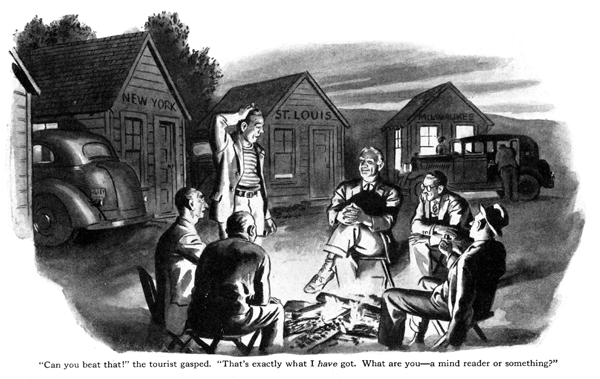
"Can you beat that?" the tourist gasped. "That's exactly what I have got. Are you a mind reader or something?"
A broad smile crept over Gus's rugged features as the eyes of every one in the circle centered on him. "No hocus-pocus like that, just a matter of cause and effect," he explained."You said your last two cars had fender fading. You're the kind of chap that gets a new car about every second year so it was pretty safe to estimate that the trouble started four years ago.
"Now, the only thing that is likely to cause that kind of trouble is unequal exposure to sunlight. That meant that four years ago you began to keep your car in a new place, and guessing when I described your garage, but if you'll stop to think a bit you'll see that's about the simplest combination that'll let sunlight work on your right front fender for several hours every day. If the garage didn't face right on the street you might have to turn the car and back in but if you did that, it'd be the left rear fender that would be affected."
"Pretty slick reasoning all the same," the car owner agreed admiringly amid several expenditures of approval from the others. "I never realized sunlight could do that much damage," he added. "First thing I'll do when I get home is board up that window or put a shutter on it. I don't need that light, anyway."
"Sunlight is the worst enemy you've got when you try to keep a car looking like new." Gus went on, while every man in the circle listened closely. "Whether it's enamel or lacquer, the sunlight not only fades the color in time, but it also seems to hasten the surface corruption or whatever it is that dulls the shine. It takes the life out of rubber, and does things to the upholstery too. That's why winter is actually easier on a car's finish than summer -- the sun doesn't shine so brightly. Of course, you can't keep the sun from shining on your car while you're using it, but it certainly pays to fix your garage so that no direct sunlight can reach it while you're not using it. Another thing you can do is to park your car in the shade when you are going to leave it standing for any length of time."
"Humph!" grunted the tourist who had started the argument. "In my town, it's a heck of a job to find a place to park at all. You have to take what you can get, shade or no shade."
"I guess most places are like that, now," Gus smiled, "but it won't do any harm to keep the idea in mind anyhow."
"Lot's of things are bad for a car's finish beside sunlight," the little man suggested. "Sure, they are," Gus agreed, "a strong wind is one of them especially if it contains a lot of dust. Works on the same principle as a sand blast. Small stones and grit flung up by the tires of the car in front of you can cut right through the paint job and let moisture get through to start a rust spot. The mud in some localities is strongly alkaline and no paint or lacquer is immune to the effect of alkali.
"Road tar itself usually won't harm the finish," Gus continued, "but scraping it off the underside of fenders has spoiled the looks of lots of cars-especially in sections near the seat, because the salt spray attacks the bare metal underneath, and pretty soon there's a hole right up through the fender. When you're up against that proposition, the best thing to do is to leave the tar there."
"Maybe that fellow that greased his whole car wasn't so dumb after all," piped up the little chap again. "None of those things would have much effect on a grease coating."
"He had the right idea, but it was a mighty unsightly way to carry it out," Gus commented. "The sensible version of that would be to give the car a proper waxing.
"A thin coat of wax," Gus went on, "does have some value in cutting down the effect of sunlight, but the coating is too thin to exclude it entirely. It has a lot more effect in cutting down surface oxidation and in warding off the scrubbing effect of dust-blown particles. The grit slides instead of coating it. And wax keeps moisture and dirt from sticking so tightly to the enamel or lacquer."
"What do you mean by "proper" waxing?" asked another of the tourists.
"Well, in the first place," Gus told him, "the car ought to be absolutely clean before you start. That means a good wash with soap and water. If the finish is dull, that's the time to use one of the polishes or cleaners that leaves a high, dry shine.Waxing is just a matter of applied elbow grease. You rub on a coating of the wax, and then polish off the excess so that what's left forms a thin, protective layer.
"Now here's where a lot of fellows go wrong." Gus warned, "Don't let anybody tell you that you can wipe off dried dirt from a wax-coated finish with a dry rag without having a bad effect. "If there is dried mud on the car, or if you have been caught in a shower with a lot of dust on the car and it has dried to a sparkled finish, wet down the car with a hose. Then you can wipe the dirt and water off quickly and easily without using any soap at all."
"But doesn't the mud stick just as tight on a waxed car if you let it dry and stay there for several days?" one of the tourists asked.
Gus replied, "it never sticks so tight, but that it will come off just by a thorough wetting and a gentle wiping. But why let it dry on? A much better plan is to keep a couple of old, ragged bath towels in your garage, and when you come in after a run in the rain, get busy right away and wipe off the whole car."
"But what I want to know is when you should get busy and wax the car again, every month or every two months? The little man asked.
"There's no definite time limit," Gus explained. "When a car has wax enough on it, the rain never really wets it at all. The drops just roll around till they come together, and then run off.The minute you begin to notice that the water is forming a smooth, shiny layer on the surface of the finish, which indicates that it is really wetting it, then it's time to re-wax.
"Well," Gus grunted, indulging in a cavernous yawn, "guess I'll hit the hay. How about it, Joe?"
"Speaking of other people's auto troubles -- " Joe grinned provocatively.
END

L. Osbone 2019