February 1936
SPOTTING IGNITION TROUBLE
by Martin Bunn
Gus Gives a List of Simple Tests To Make When Your Engine Misses
"I'll bet there's at least a bucketful of carbon in this motor, Gus," said Mason Backett, as he pulled in at the Model Garage and Gus Wilson, half owner and mechanic of the establishment, came out to see what he wanted.
"Sounds as if it had a lot -- maybe a couple of cupfuls," the veteran auto man grunted, after testing the motor for a minute, "and that's a plenty without filling any buckets!"
"How soon can you get a valve-and-carbon job done?" Backett asked.
Gus scratched his head. "Come back about three o'clock this afternoon. I'll have it done by then."
At the appointed time, Backett returned, got in his car, and drove off. About an hour later, the phone rang and Joe Clark, Gus's partner in the ownership of the Model Garage, came to the door of his office. "Backett on the phone," he called, "says he's stuck about ten miles up the road near Parrville. He sounds sore as a boil. Claims you busted most of his spark plugs when you cleaned them on that carbon-and-valve job. Better go fix him up. I'll look after things here."
Backett, his hands covered with grime and a streak of black smeared across his face, was still working over the spark plugs when Gus drove up. At the rumble of the service car, he pulled his head out from under the hood.
"Heck of a job you did on this car!" he growled angrily. "What did you clean these plugs with, anyhow -- a sledge hammer? All but two are shorted and I can't get anywhere on two cylinders. She started missing on one cylinder before I'd come two miles from your place. I found the bum plug by shorting them out one at a time with a screw driver, and replaced it with an old spare I found in the tool kit. But that must have been on the blink, too, because it kept right on missing, and then the other plugs went dead in the next few miles. It's up to you to replace all the plugs you've busted and darned if I don't think you ought to pay me for the time I've wasted!"
"Say, mister," snapped Gus, "if a single spark plug goes bad that's commonplace. If two go dead at once, that's as rare as pinfeathers on a turtle. If three or more went dead at the same time, that would be nothing short of a miracle! You're barking up the wrong tree. It just couldn't be spark plugs."
"Not spark plugs!" snarled Backett. "What else could it be? Didn't I hold the screw driver against each one and get absolutely no sign of a spark?"
"Maybe you did," Gus retorted, "but I'll bet a hat you didn't disconnect one of the spark-plug wires and hold it near the plug to see if there was any current flowing to the plug. Start up the motor, and we'll try that."
Backett got the crippled motor going, and Gus, after picking out an apparently dead plug with the aid of the screw driver, snapped the cable loose and held it close to the plug terminal. There was no sign of a spark. He reached around and shut off the motor.
"Trouble with you," he grumbled as he replaced the plug wire, "is that you're like too many other fellows -- always jumping at conclusions. First off, when the motor started missing, trying the plugs with a screw driver was the right thing to do and when you got no spark at one of 'em, replacing it was O.K. I'd have done that myself. And when it kept on missing on that same cylinder I'd have concluded as you did that the old plug from the tool kit was sour, too. But by the time the other cylinders began to cut out you had it so firmly fixed in your noodle that it must be spark plugs you never even thought of looking for anything else."
"All right, I'll bite. What is it?" Backett growled, as he unconsciously added another streak to his facial decoration.
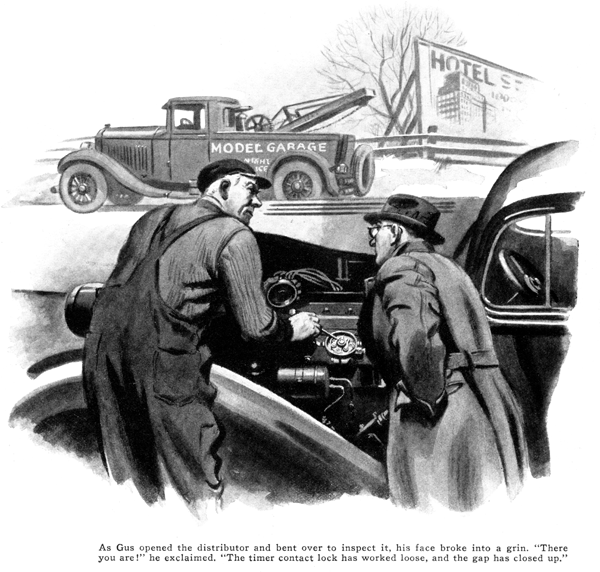
"Dollars to doughnuts it's right here," said Gus, opening the distributor and bending over to inspect it. His face broke into a grin. "There you are! Timer contact lock has worked loose, and the gap has closed up."
"But that would stop the motor entirely," Backett protested.
"It would, but for the fact that nothing made by human hands is absolutely perfect. No matter how nearly true the timer cam may be, by the time it's mounted on the shaft it is sure to run out of true a tiny bit, so that some of the humps on the cam lift the contact arm just a shade more than the others. When the gap was slowly closed by the loose contact turning in its thread, first the lowest hump on the cam couldn't quite make the grade, and that cylinder got no more spark. Then, as the vibration closed it still farther, more cylinders cut out, until only the two served by the two highest humps on the cam stayed on the job. That's how it happened."
While Gus was saying this, he had fished a feeler gauge out of his pocket and reset the gap at its proper opening.
Backett grunted. "And how was I supposed to figure out a tricky thing like that?"
"Well," Gus smiled, "if you hadn't been so sure it was in the plugs, you'd at least have spotted the loose timer contact. Start her now, and see if that wasn't it."
The motor hummed smoothly on all cylinders, and Backett grinned. He looked at his watch. "Too late now to get over to Parksburg in time to catch the man I wanted to see. Have one, Gus," he said as he pulled two cigars out of his pocket. "I feel cheap about dragging you all the way out here. Put it on the bill, of course. If you're not in too much of a hurry, I wish you'd spend a few minutes explaining how to avoid getting off on the wrong foot in locating ignition troubles."
"It's mostly a matter of keeping your mind open as well as your eyes," Gus began, after the cigars were going well."
"Remember, first, that there's hardly any trouble that can happen to a car that can't be due to several different causes, just like there are a lot of things that can give you a stomach ache or a pain in the back. Take this matter of engine missing. It can be due to bum plugs or loose timer contacts as you've seen, but it also might be caused by dirty, worn, or pitted timer contacts, burned away distributor points, a cracked distributor head, a loose timer wiring connection, leaky high-tension wiring, or a partial breakdown in the coil or condenser.
"Then, too," Gus went on, "There's a string of carburetor troubles that'll make a motor miss --"
"Hold on!" Backett laughed. "Just stick to the troubles that are in the ignition system. If you can tell me how to sort them out, that'll be about all I can soak up at one time."
"All right," Gus agreed. "The first thing to do when a motor starts missing is to listen closely to see whether it's a regular miss that may be in one cylinder, or whether it seems irregular and not in any one cylinder. If the missing goes away for a while and then starts again, that's important, because it tells you that the trouble isn't a complete breakdown, and is quite likely to be a loose connection.
"If the miss is always in one cylinder, then you can forget about all the troubles that would causer random missing, such as a loose connection in the wiring, or coil or condenser failure. That narrows the list of possibilities to a shorted plug, a bad wire leading to it, or a crack in the distributor near the point that feeds current to that particular plug, and, of course, the particular form of timer trouble you just had -- which is the rarest of all."
"I can get that fixed better in my mind if I can see what you're talking about," Barkett interrupted, as he lifted the hood again. "That means," he went on, as Gus looked over his shoulder, "that if I found with the aid of a screw driver that there was no spark at this particular plug, I'd change to a spare, and if that didn't do any good, then I'd examine this wire leading to it, first making the test you did."
"And the only place you'd have to examine would be where it touches metal, because it couldn't leak anywhere else," Gus added.
"That's so," Backett agreed. "Then I'd look over the distributor head to see if I could find a crack in it, and, if I didn't, I'd look into the timer for a loose fixed contact."
"That's it, exactly," Gus approved. "Line up your possibilities and go through them one by one.
"You can follow the same idea if the miss seems to be in first one cylinder and then another. Start with the timer contacts first, because they're the most probable cause of missing of this kind, and also because you can spot two other troubles at the same time
"Look here," Gus went on, as he opened the timer and pushed the contacts apart. "These contacts should look smooth and gray as they do now, not rough and pitted. Now, if you place the distributor cap on its side and prop a screw driver so that the shank touches metal and the end comes within a quarter of an inch of the center contact button inside -- like this -- you can get a line on the condition of the condenser, and the coil, too.
"Now," Gus continued, after turning on the ignition, "if you break the contacts this way, you should get almost no spark between 'em, and there should be a nice, fat spark between the center button of the distributor and the end of the screw driver. If there is a sizable spark at the contact points as you separate them, and only a thin, weak spark -- or none at all -- at the end of the screw driver, you can be sure the condenser is just about shot. On the other hand, if there is no spark at the breaker points, and hardly any at the point of the screw driver, the condenser is all right, but you'd better get a new coil."
"And if I still can't find the trouble, then what?" asked Backett.
"Then that's where my phone number comes in!" Gus grinned, as he climbed in behind the wheel of the service car.
END
L. Osbone 2019