January 1936
WINTER FUEL TROUBLES
by Martin Bunn
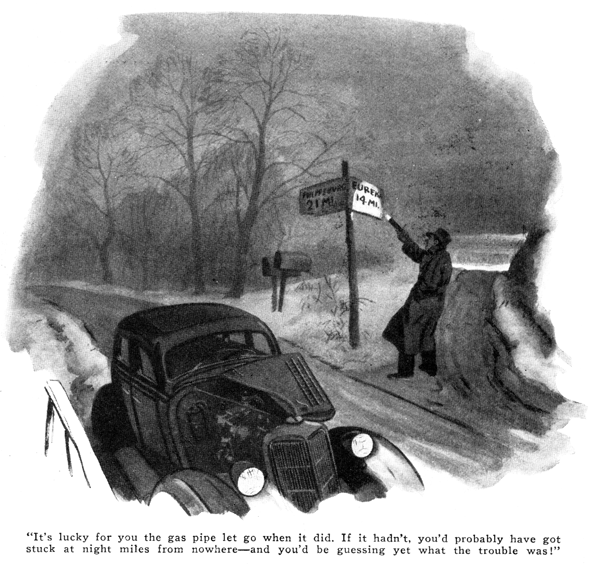
"Darned if it didn't bust right off like it was made out of mush!" Dick Carnaday muttered as he glared wrathfully at the end of the copper gasoline pipe that had broken close to the carburetor connection. No gasoline was coming out of the supply side of the break, because the motor had stopped and the fuel pump was not working, but a slow stream dribbled from the piece of pipe left attached to the carburetor. The crisp morning air was heavy with the smell of gasoline.
"It's funny I can't seem to get a tight gas line on this bus," Carnaday observed to himself. "Maybe I'd better run down to the Model Garage and see if Gus Wilson has some copper tubing that's better than this rotten stuff."
Carnaday bound the broken ends of the pipe together with a piece of tire tape. Taking a wad of chewing gum out of his mouth, he smeared it over the binding and covered it with another layer of tape.
"There" he decided, "that ought to hold until I can get to Gus's place." A few minutes later he was blowing his horn before the door of the Model Garage.
"Howdy Gus!" he replied to the veteran auto mechanic's smiling greeting, as the car came to a stop inside. "Got any copper gas-line tubing that won't break?" What I've got on here now is junk."
"There's nothing wrong with this tubing," said Gus, after an examination. "It broke from crystallization because you didn't put it in right."
"What do you mean, I didn't put it in right?" Carnaday snapped. "I've fixed dozens of gas lines in my time and I never had any trouble like this before."
"You haven't put them in that way on any modern car, I'll bet," Gus maintained. "Motors in cars today aren't fastened tight to the frame the way the old ones used to be. Now they're mounted on rubber or springs to get rid of vibration. Every time you open the throttle, the motor gives a lurch in its mountings. Besides, there's a good deal of motor movement with respect to the frame, where you've fastened this pipe, every minute you're running. Copper isn't rubber and it won't stand bending and vibrating all the time.
"If you had cut that pipe fifteen or eighteen inches longer and put a five or six-inch loop in it," Gus continued, "the loop would have had spring enough to take up the vibration and the tubing wouldn't have crystallized and broken off. How'd you come to put a new pipe in, anyway? This car isn't so old it should need one."
"I should have had sense enough to realize that was what was wrong," Carnaday growled, "only I didn't know the motor moved so much. You can't see it move when you're driving and there's no motion you can see when it's idling. I suppose it really didn't need a new pipe," Carnaday muttered as he slipped a rule from his pocket and started to measure for the copper tubing needed to install a new gas line.
"One of the connections was leaking a bit when I bought the car second-hand, and somebody had dented the pipe pretty bad at one spot, so I thought I'd just put in a new one while I was at it."
While Carnaday was speaking, Gus had been poking here and there about the motor. "How is she pulling on the hills?" he asked straightening up again.
"Fine," Carnaday answered, enthusiastically. "The car's got more pep on the hills than I'll ever need. Only thing I notices was that she sputtered a bit just as I got to the top of Blake Mountain, this morning. That was just before the pipe broke, so I guess it must have been leaking so bad the carburetor didn't get enough gas."
"Maybe," Gus grunted, "but I'm saying it's lucky for you the gas pipe let go when it did. If it hadn't, you'd probably have got stuck miles from nowhere -- and you'd be guessing yet what the trouble was!"
"Why, what's wrong?" Carnaday asked sticking his head under the hood and looking about anxiously.
"Same thing that happened to a brand new car last week," Gus smiled. "Do you notice anything wrong with that fuel pump?"
Carnaday ran his fingers over the pipe connections. There appeared to be nothing wrong with them. "Do you think I've X-ray eyes?" he demanded. "How can I see what's wrong inside this pump?"
"There's nothing wrong inside," said Gus. "The pump itself is all right. The trouble is, the bolts holding it to the crankcase have loosened, the pump is moved up and down a little by the lever when the cam on the camshaft turns over, instead of the pump staying still and the lever moving up and down. The movement is only a small one anyhow, and the spring that holds the lever against the cam is stiff -- that it holds the pump when you try to wiggle it to see if it's loose. You can see the pump jiggling when the motor is running. Naturally, when the motor stops the jiggle stops, too. So, by the time you get out to look at it, there's nothing wrong to see!"
"That would have stumped me, sure enough," Carnaday agreed. "But it's easy to see how to prevent that trouble from stopping you on the road. Keep these bolts tight." He got out a wrench and tightened them while Gus cut a new piece of copper tubing.
"Well," Carnaday went on, as Gus bent the new piece into shape, "modern cars bring modern troubles. It didn't make any difference, in the old days, whether the vacuum tank was hanging on by its eyelids or not, it still worked just the same."
"Yeah, but think of all the troubles the vacuum tank had that you can't have now," Gus suggested. "Besides, there're plenty of troubles with gas lines that we'll always have with us. As an old-timer, you ought to know a lot of 'em."
"I should say I do!" Carnaday grinned reminiscently, as he held one end of the pipe while Gus bent the other so it entered the fitting straight. "I guess as long as there's pipes there'll be dirt to clog them. If course the gasoline is a lot cleaner now than it used to be. Some water in it now and then, but that don't amount to anything."
"Maybe it doesn't down South where you come from," Gus grunted, "but believe me, it can put your motor out of commission quick enough up here where we have real winter weather. Lots of car owners have tried to start their cars on a real nippy cold morning and found they wouldn't start at all. Mostly, they blame it on bad gas or poor ignition or a bum battery, when a lot of times it's really just water frozen solid in the gas pipe or in the carburetor jets."
"While you're putting in this new pipe, why not put in an extra filter to take out the water? I keep my car in an unheated garage, too," Carnaday suggested.
"One filter is just as good as a dozen," Gus explained. "How is any filter going to keep water from freezing in the line between the tank and the fuel pump -- unless you put it right at the outlet of the tank? And even filtering the gas before it goes in the tank won't keep water out of the tank. It condenses out of the air that is drawn in as the gas is used.
"Look how those windows are covered with moisture," Gus went on, pointing to the nearest glass, which was covered with a film of water in tiny globules. "That always happens when it turns cold right after warm, muggy spell. Suppose you pull into your garage some warm night and the tank is nearly empty so there's lot of air in it; then, during the night, it gets real cold. The inside surfaces of the tank get dripping wet, just like that window, and maybe as much as a tablespoonful of water settles to the bottom all ready to get into the pipe and freeze there."
"Gosh," exclaimed Carnaday. "There doesn't seem to be any way to get around that."
"You can't." Gus agreed, "but you can stop the chance for freeze-up just the same. All you need to do is drop a tablespoonful of denatured alcohol into the tank every few days and especially after a sudden change to cold weather. If there is, it will mix with it and keep it from freezing."
"That sounds like a good idea," Carnaday observed, as Gus finished installing the new pipe, "and I'm sure going to try it this winter. But what I want to know is, how do you get a car started when there's water frozen in the gasoline line somewhere?"
"Best way I know is to pour hot water over the carburetor -- but be sure it doesn't get in the air intake. Pour some more over the pump and the pipe leading to it, as well as the pipe leading back to the main tank as far as you can get at it. Heating the carburetor that way is old stuff, of course, it's always been a good way to make starting easy in real cold weather."
"What if the ice is farther back in the pipe near the tank?" Carnaday asked.
"In that case," Gus suggested, "about the only thing to do it to crawl under and thaw the pipe with rags dipped in hot water. You'll only have to work on the low spots in the pipe, because the water settles there."
"Thanks for the dope, Gus," Carnaday said, as he stepped on the starter while the mechanic watched to see if any signs of a leak appeared in the joints of the new pipe when the fuel pump began to force gas to the carburetor. "Guess you've covered all the things that are likely to keep gas from flowing, all right."
"Except two," grunted Gus, running his finger around under each joint to make doubly sure there was no leak.
"Two more?" Carnaday questioned. "What are they?"
"One is a frozen air vent to the tank," Gus replied. "Sleet, or even mud, can gather around the filter cap so tight that it closes the vent that lets air into the tank and then you're sure to stop. If the vent is a separate standpipe, moisture can collect in it and freeze, and the result will be the same."
"I hadn't thought of that," Carnaday admitted. "And what's the other?"
Gus smiled. "The most common trouble of all is when the motor stops for lack of gas -- and one that can fool even the expert, because he may not think to look for it -- is an empty gasoline tank!"

END
L. Osbone 2019