March 1936
GIVE YOUR
BATTERY A CHANCE
by Martin Bunn
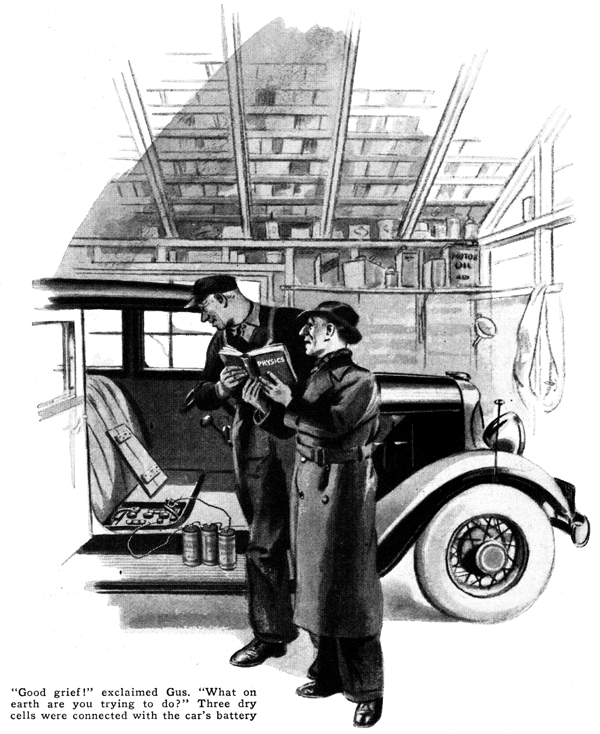
So that's the bunk they teach my boy at school!" Bill Simpson sputtered, shoving an elementary science textbook under Gus Wilson's nose as the garage man pulled into the Simpson driveway in response to a trouble call phoned to the Model Garage.
"See," he went on, pointing to a paragraph with a grease-stained finger, "it says that if you connect the negative pole of a battery to the positive pole of another car, the voltage of the two batteries will added together and you get that much more voltage."
"Hold on a minute," the veteran mechanic grinned, as he climbed out and walked over to Simpson's car. The floor board was up exposing the storage battery. The heavy cable had been disconnected from the latter and, by means of a piece of bell wire, had been hooked to the center terminal of one of the series of these dry cells standing on the running board. The other end of the series was connected, by way of another piece of bell wire, to the terminal of the storage battery.
"Good grief!" Gus exclaimed. "What on earth are you trying to do?"
"That's what I'm trying to tell you," snapped Simpson. "This book says you can get more voltage by adding batteries. So, when the motor wouldn't start because of the cold, I thought I'd just pep up the current by adding the door-bell cells. But it doesn't work at all. The blame thing won't even turn over the motor now."
"Humph!" Gus grunted disgustedly. "Sure would have been a miracle if it had worked. Trouble with you is you didn't read that book far enough. You didn't get to the part where it explains about electrical resistance. Electric current flows because of the pressure behind it, that's right enough, but the volume that that flows depends on both the pressure and the resistance. Hooking those door-bell cells in like that raised the voltage a volt and a half apiece, just as the book said it would. Connect a voltmeter across that circuit and you get a 10 1/2-volt reading -- six from the storage battery and four and a half from the three dry cells. Here, I'll show you."
Gus fished a combination voltmeter and an ammeter out of the service car and connected it between the end terminal of the three dry cells and the frame of the car. It read almost precisely ten and a half volts.
"Now," Gus continued, "I'll connect the ampere part of this motor across one of the dry cells. See, it reads only twelve amperes. That means the resistance inside each cell limits the flow of electricity to twelve amperes of current.
"What you didn't know is that an auto-starting motor draws up to 130 amperes to turn the engine over, or even more than that when it's stone cold. That much current flowing on only six volts pressure means that there must be next to no resistance anywhere in the circuit. Take a look at the thickness of that starting cable -- almost as big as your little finger, and only a couple of feet long. No resistance there. And the starting motor is wound with heavy copper bars instead of small wire, so the resistance in the motor is mighty little, too."
"Gosh!" Simpson exclaimed, as he fingered the heavy starting cable, "Looks like I was sending a boy on a man's errand, all right. I thought this cable was made heavy just so it wouldn't break. But why is it that a storage battery can give so much more current than that door-bell battery can?"
"Just the nature of the beast," Gus smiled. "The lead-acid storage battery has such a low internal resistance that it can supply far more electrical power for a short time than anything else of the same size and weight ever invented by man. In fact, if it weren't for that feature of a storage battery we'd still be experimenting with spring gadgets and compressed air thingum-a-bobs for starting auto engines."
"Well, slap another battery in there, Gus," said Simpson, "While I cart three dry cells back and hook 'em to the door-bell again."
"Hold on a minute," Gus objected, "Did the battery turn over the motor all right before you started monkeying with it, only the ignition wouldn't take hold?"
"Sure, that's it," Simpson agreed. "Just groaned over and over and nothing happened."
"Then," said Gus, "If you'd have hooked those three door-bell cells in the right place, you'd have gotten started without any trouble -- here, let me show you.
"See that small wire leading up from the starter-switch connection?" Gus asked. "That wire carries the current from the battery to the ignition circuit and lights. I'll disconnect it, and we'll hook up those three dry cells in that circuit in series just as you've got 'em.
"This time," he grinned, "we'll send a boy on a boy's errand. Those dry cells couldn't possibly work in the starter-motor circuit where a man-size current has to flow, but they'll serve to pep up the ignition voltage where there's only a little boy current needed.
"You see, when you step on the starter button and you've got a combination like this -- ice-cold motor and an old battery -- the heavy drain of current on the weakened battery pulls down the voltage so there isn't enough left to force current through the ignition coil and make a hot spark. Putting those dry cells to the circuit will add voltage where it's needed, and the motor ought to start."
Gus reached in and shoved the starter button to the floor with a huge thumb. The starter motor clocked into gear and the engine groaned over a couple of times to the accompaniment of a swishing noise as the choke forced raw gas into the cylinders. Then the engine took hold and started off in fine style.
"We'll keep it running till it warms up a bit," said Gus, "then we'll have to stop it and take those dry cells out of the circuit. They wouldn't last long on that service. Of course, if you say so, we can store them under the seat and connect them with a single pole double-throw switch so you can switch them in to ease the starting on cold mornings -- only I'd suggest that you put in three new dry cells."
"Fine idea!" Simpson agreed. "By the way, Gus, why is it that an old storage battery won't give so much current as a new one? Seems to me, the more the battery is used, the easier the current ought to slip through it -- get sort of broken in, like a bearing."
Gus chuckled, "You're getting a chemical setting mixed with mechanical one," he explained. "If electric current were something solid like a piston sliding in a cylinder, you could expect it to work better as it was used. But a better comparison for a battery would be water flowing through a pipe. You know how, when you move into a new house the water runs fast from any faucet. A few years later, it runs a bit slower, because the inside of the pipe has rusted and partly closed up.
"In a storage battery there isn't any rust, of course, but there's something that has about the same effect. That's called sulfate. It gradually forms on the surface and in the pours of the plates and keeps the current from getting at the active material in them."
"Can't that be cleaned off, as you clean out a clogged pipe?" Simpson asked.
"Very often a long, slow charging will get rid of a good part of it," Gus replied. "But the trouble is, by the time that plates get badly sulfated, a lot of other things have begun to happen in the battery that don't improve it any. The inflators between the plates begin to break down, active material in the plates begin to shed and settle to form a thick sludge in the bottom of the coils, and the battery gets to leaking current internally -- so badly that if the car is left without use for a couple of weeks you can't start it al all."
"Wouldn't it pay to have the battery overhauled every six months or so to get rid of those troubles?" Simpson suggested.
"It isn't worth while. No matter how carefully you treat an auto battery, it won't last more than two or three years at the outside, and with the price of new batteries so low, the best bet is to get a new one at the first sign of trouble. Once a battery starts to go bad, it gets in the hopeless stage pretty quick, no matter how much you baby it."
END
L. Osbone 2019