December 1936
Gus
Gives...
SOME TIPS ON TRAILERS
by Martin Bunn
"That's one fad that won't last long!" Nate Pendleton remarked derisively, as his eyes followed a trim, streamline motor trailer skimming smoothly down the road behind a smart new sedan.
Gus Wilson, half owner of the Model Garage, hung up the gas hose and replaced the filler cap on Pendleton's car. He smiled slowly. "Maybe so, Nate, maybe so," he observed, watching the trailer outfit disappear around a bend in the road. "But you've got to remember that it's a fad that has been popular, in one form or another, for a long time now. If it weren't for the fact that lots of our ancestors had a mighty strong urge to go places and do things, we wouldn't be here today. Touring in an automobile is just a modern form of that instinct, I guess."
"But why bother with towing an elaborate outfit in a trailer," Pendleton observed, "when you can stop at a good hotel? Or, if there isn't a hotel, there are sure to be tourist camps with cabins, or places with 'tourists accommodated' signs in the front yard."
"That's all a question of what you're trying to do and how much money you can afford to spend." Said Gus. "If you're only interested in getting from one place to another a long distance away in the shortest possible time, then the hotel or tourist camp is the answer. But if you really want to take your time and see a lot of the country, and perhaps stay in different places weeks or even months at a time, then the motor-trailer outfit will give you the most comfort and convenience at a lot less expense than you can make the same tour on any other basis."
"I hadn't thought of it that way, Gus," Pendleton admitted. "I can see that there's an advantage in knowing just what kind of accommodations you're going to have, and being able to stop wherever you want to is a help. Some of the tourist camps and hotels aren't as conveniently located as they might be, and some I've stopped at were punk. If I hadn't thought this motor camping business was just a passing fad I'd have taken it up before this."
"If you're really interested come back in the shop a minute," Gus suggested.
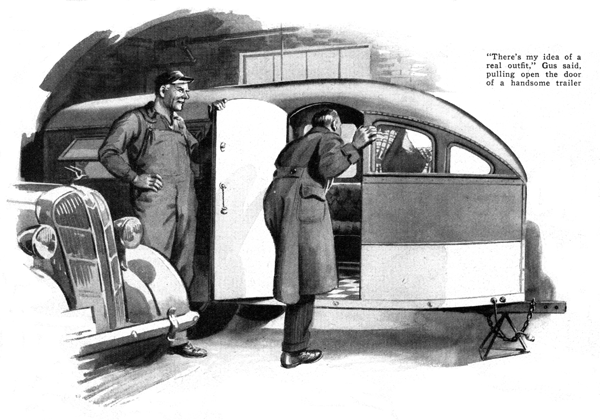
Pendleton followed him into the Model Garage. Far over in one corner, Gus stopped. "There's my idea of a real outfit," he said, pulling open the door of a handsome motor trailer and stepping aside for Pendleton to enter. "Soon as the work slacks up a bit, I'm going to put in a month in Florida with a friend of mine, while Joe Clark , my partner, takes care of things. Then, next winter, Joe's going to take his wife and make the same trip. During the summer, we can take turns using it for shorter tours."
"Swell-looking job," Pendleton commented as Gus showed him the neat arrangement of the "kitchen," the folding bunks, and the ingenious way in which every square inch of space was used to best advantage. "Where did you buy it, and how much did it cost?" he asked with interest.
"Joe and I built it -- Joe's pretty slick as a carpenter," Gus replied. "But you can buy one like it for anywhere from $600 to $2,000, depending on how elaborate the fittings are."
"Seems to me," Pendleton observed, "if you're going to build a house on wheels -- which is what this outfit really is -- you'd do better to buy a truck chassis and build the house body on it. Judging from the size of some of the truck bodies you pass on the road, you ought to have a lot more room that way."
"We thought of that," said Gus. "We even went so far as to look around to see what we could pick up in the way of secondhand truck that would be suitable. You can build a regular 'land yacht' on a truck body. But there are disadvantages to a big outfit like that. In the first place, you have to pay a whopping big license fee in most states on account of the weight. A trailer license doesn't cost much -- only two dollars in Connecticut, eleven in New York, and so on -- and the size or weight doesn't make any difference in the license fee in lots of states.
"Another thing: When you stop for a few days in one place and you want to take short sight-seeing trips here and there, you've got to take the whole works with you if you have a 'land yacht,' whereas with a trailer you can leave it in camp."
"Are they unhooked as easily as that?" Pendleton inquired.
"Only takes a minute or
two," Gus answered. "See, here is the ball-and-socket-joint arrangement
that is used in one form or another by most of the trailer makers. This
jack supports the front end of the trailer when it isn't attached to the
car."
"Why not make them with four wheels, so you wouldn't have to bother with
that clumsy jack affair?" Pendleton asked. "The truck trailers I see going
along the road have four wheels."
"You could make a motor trailer that way, too," Gus agreed, "but it would make the whole construction much heavier and more complicated. Either the front axle would have to swivel, as it does on a horse-drawn wagon, or you'd have to mount the front wheels on king-pins and put in some trick mechanism so the trailer would be automatically steered by the bar connecting the trailer with your car.
"No, that wouldn't be worthwhile," Gus went on. "Two wheels on a single axle placed a little back of the trailer so that 200 or 300 pounds of the weight is carried by the back of the car, seems to be the best combination. Incidentally, that extra weight, plus the fact that the trailer presses down harder when you put on the brake, makes it considerably easier to stop the car."
"How about having brakes on the trailer wheels, too?" Pendleton suggested.
"You can get them if you want them," said Gus. "If your car has hydraulic brakes, it's a cinch to put hydraulic brakes on the trailer wheels and hook them up so they work from the brake pedal along with the car's brakes. Or, you can put on a vacuum operated brake outfit. But considering how much better a trailer makes the brakes on your car work, most people don't bother to have brakes on the trailer except for service in very mountainous country."
"I suppose you'd have some kind of a quick-detachable coupling for the brake connection, wouldn't you?" Pendleton suggested.
"That would be easy," said Gus. "It could be made to work with this cable connection that hooks up the tail and stop lights on the trailer."
Pendleton examined the end of the cable plug. "You just plug this into a similar one on the back of the car when you hook on the trailer, eh" Neat idea, that. And I suppose the trailer is lighted inside from the car battery isn't it?"
"Most trailers are," Gus explained. "A lot of them being built now are wired for 110 volts and there is a plug connection, so when you are in a camp that supplies electric current you can plug in the outside juice and put 110 volts on the sockets. Changing the bulbs is a bit of a nuisance, though, so I rewound an old radio power transformer to give six volts on the secondary. We've got it hooked up so all we do is plug in the outside current and throw a switch, and the six-volt bulbs burn on the outside juice stepped down to six volts.
"Of course," Gus added, "if you're staying for quite a while in a camp where there is no electricity on tap, and if you don't make side trips in the car every day to keep the battery charged, you'll have to use a kerosene lamp or a gasoline camp lamp like this."
He opened a locker and pulled out a lamp of the type that uses an incandescent mantle.
"Well," said Pendleton as he leaned back on one of the cushioned bunks and examined the fittings of the screened window, "it certainly is a comfortable little home on wheels. Gives me about the same sensation I'd have in the cabin of a trim little motor boat.
What do you do about keeping warm in winter?"
"One of the advantages of living in a motor trailer is you can follow the birds south in the fall, and you needn't ever stay where it's cold enough to need heating. But if you do, an ordinary small oil stove will heat up this small space in no time at all. In fact, you'll have to turn the burner 'way down to keep from getting too hot."
"Yes, that would be the solution all right," Pendleton agreed. "And I suppose if you were in a camp where street current was on tap, you could use a small electric heater and avoid the kerosene smell. Heat insulation would help a lot on that. Is there any heat insulation in this outfit?"
Sure," Gus replied. "There's a double floor with a layer of cork board between the layers, and the walls and top have heat insulation between the outside and inside surfaces. But the purpose of the insulation is not so much to make it easy to heat in winter, as to help keep it cool in summer. Most camps that cater to trailer tourists fix things so that you can park under a tree, but if you had to park out in the sun, the inside of this outfit would get as hot as an oven in no time at all without the insulation."
"Guess it takes quite a little more gas to tow an outfit like this doesn't it?" Pendleton questioned.
"Bring up that subject with a motor-trailer enthusiast, and you'll have a real argument on your hands," laughed Gus. "Of course it stands to reason that you can't pull an extra couple of thousand pounds along without using more power to do it, and more power means more gasoline burned. But the increase is not at all in proportion to the increase of your load.
"Suppose, for instance," Gus continued, "that your car weighs, say, 3,000 pounds or thereabouts, and your motor trailer weighs in the neighborhood of 2,000 pounds. Adding the trailer would increase your total load to 5,000 pounds. If weight were the only thing that counted, and you got fifteen miles to the gallon without the trailer, you should get only nine miles with it. Actually, you'll probably only do a mile or two less to the gallon with the trailer than without it."
"How do you figure that out?" Pendleton asked.
"It's all a matter of friction and wind resistance," Gus pointed out. "On level ground, it takes mighty little power to overcome the friction of a pair of roller bearings, even when they are loaded with 2,000 pounds, and the wind resistance at moderate speeds doesn't amount to much if the outfit is streamlined a bit. So the only time you really use more power is in getting the load started and in pulling up hill. Part of this you get back, because the extra weight makes you coast better on gentle down grades. Of course, if you will burn up the road at high speed, the wind resistance is bound to make a difference."
"Want to sell this outfit?" Pendleton asked suddenly.
"Not on your life!" Gus grinned, "but I can give you the names of some concerns that make trailers of about the same type."
"Who are they?" Pendleton asked, fishing out a notebook and pencil. "My landlord's getting a bit uppity. Guess I'll walk out on him, buy a trailer, and the wife and I will head for Florida for a couple of months. I can afford it if I don't have rent to pay here."
"He won't be the first landlord that has been handed a jolt like that these days!" Gus chuckled, as he pulled a bunch of trailer catalogs out of a drawer.
END
L. Osbone 2019