November 1931
SHOULD I PATCH or SCRAP- OLD TIRES?
by Martin Bunn
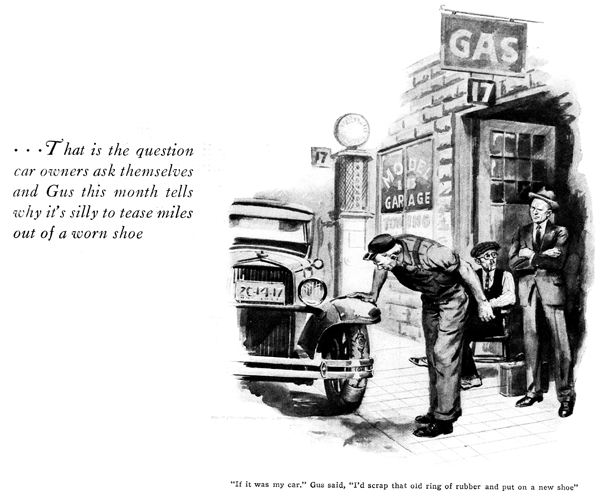
"Now the question is," said Stoddard as he rubbed his thumb over the worn place in the tire. "Shall I put on a blow-out patch or shall I wait till it blows out?"
Gus Wilson, half owner of the Model Garage, grinned and nudged his partner, Joe Clark. "If it was my car," he stated, "I'd throw the old ring of scrap rubber on the junk pile and put on a new shoe."
"There you go trying to sell me a new tire, Stoddard grunted. "There're a lot of miles left in that one. Why throw it away because of a bad streak in the tread?"
"How long do you expect to keep that car, Mr. Stoddard?" Gus asked.
"What's that got to do with it?" Stoddard demanded.
"A lot," exclaimed Gus. "You've had that car now for a year and a half and you'll probably keep it that much longer. No matter how you baby that tire along, you'll have to replace it before you trade in the car. Isn't it sensible to put the new tire on now and have the pleasure and comfort of riding on it? Why let the bird who gets the car next have all the good out of the new tires you'll have to buy anyhow?"
"Sounds fine," Stoddard jeered, "but why buy something now that I won't need for maybe six months?"
"Because you'll save money on blow-out patches, inner tubes, and so on. Besides, isn't it worth something to drive a car without continually worrying about a tire blowing out?"
"Yeah, you'd have to count that, too, I guess." Stoddard grudgingly admitted. "Tires are a nuisance and an expense any way you look at them."
"Not by comparison with what they used to be," Gus commented. "You fellows today don't realize what good tires you're getting. You kick if you don't get better than fifteen thousand miles out a shoe. I can remember when two thousand was something to brag about and only one puncture on a fifty mile trip was a lucky break. When a car owner went on a two or three hundred mile trip he had to carry as many as four spare tires! Those were the days when the trouble meant something!
"And it was tires we carried then." Gus continued. "Not spares all mounted on rims or spare wheels. When we got a puncture or a blow-out, it took a mighty husky man on the rod of a twelve or eighteen inch tire iron to take the flat tire off the wheel and put the spare on.
"I can remember our trip when I blew out three tires in fifty miles and came home with one shoe stuffed with grass and old newspapers.
"You fellows kick about expense. How would you like to fork over fifty or seventy five dollars for a shoe about half as big as yours, knowing that it wouldn't last over three thousand miles?"
Stoddard laughed. "If it was like that now I'd never be able to afford a car. As I understand it, you don't think it pays to fix tires at all. Is that it?"
"It all depends," said Gus, "Of course it pays to have punctures fixed and it sometimes pays to have blow-outs fixed if the trouble is a bad cut when the tire's nearly new. But when a blow-out is caused from wear and old age-buy yourself a new shoe. Some people don't mind buying tires for cheap, light cars, but think that tires for more expensive cars should be fixed. That's the bunk. Doesn't the heavy car need better support? Isn't it more likely to be damaged by a blow-out?"
"The big tires cost more," Stoddard objected. "Why not try to make them wear longer?"
"Tires for a medium car cost far less now than most tires did a few years ago. "Gus replied. "I can remember paying exactly fifty dollars and twenty five cents for two new tires with tubes back in 1917 or 18. Twenty dollars will buy you a much bigger and better tire today. Besides, the price of tires is almost in proportion to the price of cars, so if a man can afford a big car, he can afford to keep its wheels properly shod. The way to save on tires is to treat them so they'll give you plenty of mileage before they start to go bad."
"How can you do that?" asked Stoddard.
"Well," said Gus, "one thing you can do is to figure out how much your tires ought to bulge at the road surface where they're properly inflated and then keep them in that bulge by changing the pressure to suit the load in the car. It's simple enough. You inflate the tires to the recommended pressure. Then with your eye directly in line with the center of the rear shoe, and a full load of passengers aboard, make two lines on the garage floor so they appear to touch the sides of the shoe at the bulge. Now let the passengers get out and you'll see that the bulge shrinks away from the tires. Let out the air till the bulge swells out to the tire again and check the pressure.
"You'll get a bit smoother riding and longer life out of the tires if you keep them inflated exactly to the right point all the time. This idea of pumping the tires only when you can see they're beginning to get flat means blow-outs and junked tires.
"Another thing", Gus continued. When you start on a trip with extra passengers and a lot of baggage do you put more air in your tires?"
"No, is that necessary?"
"Certainly," Gus emphasized. "There ought to be enough more air in the tires or they show only the normal bulge. "
"What else is there I can do to make 'em last longer?" Stoddard asked.
"Plenty," laughed Gus. "Flashy get-aways are tough on tires. So are quick stops. Rubbing the sides of the tires against curbs is another way to kill mileage. And when you pick a service station, try and find one where the service man knows how to get a shoe on without pinching the tube. Lots of flats come from pinched tubes."
"Well," hesitated Stoddard, "I think I'll fix the tire this time anyhow, but when it blows maybe I'll take your advice.
"You were just wasting your breath on that bird," Joe remarked as Stoddard drove away.
"I'm used to it," Gus grinned. "But you and I would have a tough time making a living if it was possible to make the average owner take proper care of his car."
END
L. Osbone 2019