December 1931
DOPING A CAR FOR COLD WEATHER
by Martin Bunn
Jack Harworth and Danny Malone maintained their close friendship even after Danny landed a job with an upstate firm a hundred miles away. Both men were ardent motorists and there was continual friendly rivalry between the two as to which of them could get the most satisfactory motoring service out of his machine. They invariably purchased the same make of car, perhaps because this put the contest on a more even basis.
"Jack," said Danny, who was in town for a few days, "let's run around to the Model Garage for a few minutes. I must have run over a bad bump without knowing it, because the radiator seems to have sprung a leak. Gus Wilson can fix it."
Jack Harworth grinned as he said: "I ought to teach you how to drive. Then you wouldn't be running over curbstones and things like that."
"G'wan!" Danny growled. "My tires last longer than yours do. That proves I'm a better driver. Hop in and let's get going."
"Go ahead and I'll follow in my car," Jack suggested. "I've been intending to see Gus about the latest anti-freeze dope and I might as well do it now."
"Hello! Damon and Phintias," Gus Wilson called as the two cars pulled up in front of the Model Garage. "Still arguing about how good you are?"
"I'm not," Jack replied. "Danny's licked. His bum driving has busted his radiator. Some motorist, eh, Gus?"
Gus carefully inspected the radiator on Danny's car, tracing back the steady slow trickle of water to the leak.
"Bad driving never did that," he announced as he prodded at the leak with a sharp pointed tool. "See, here's the leak and you'll notice it's a hole through the brass, not an opened-up solder seam. Nope, Danny's driving hadn't anything to do with that. Jars and bumps open seams that are soldered together, but a hole in the brass itself is always due to corrosion. From the looks of this radiator, I'm afraid you'll have a lot more leaks soon."
"What do you suppose caused that?" Danny asked gloomily. "Jack's radiator is still all right. Did I have a defective one to start with?"
"I don't think so," Gus said thoughtfully. "The trouble is you fellows don't realize that plain water corrodes a radiator and some water is harder on radiators than others. Up where you live, Danny, the water seems to have more different salts and corrosive things in it than ours. I don't mean that the water is bad but as long as water contains impurities, there's bound to be some electrical action, because you have the iron of the cylinder block for one electrode and the brass of the radiator for the other.
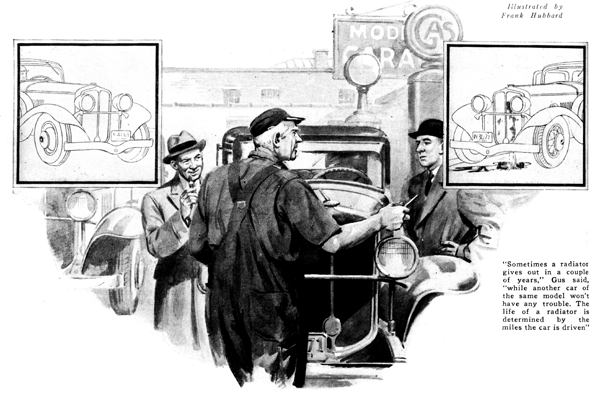
"Temperature has a lot to do with it. Maybe your motor runs a little hotter than Jack's. Heat speeds up chemical action. Remember, too, that the life of an auto radiator is determined by the miles the car is driven and not by it's age. That's why you sometimes see a radiator give out in a couple of years on one car while another car of the some model won't have any radiator trouble for five years or so. Check up and you'll find that the first car is on the road all the time and the other one only goes out on Sundays and holidays."
"I suppose," Danny suggested, "that it isn't worthwhile to solder the leak if the whole radiator is likely to turn into a sieve. "Seems a shame to buy a new radiator core when Jack and I expect to get new cars next spring."
"In that case," Gus advised, "you might try one of the liquid preparations they sell to cure leaking radiators. It will stop the leak all right. Of course a careful repair job is the only real way to cure a leak, but the patent stuff may get you by for the winter."
"Dump a can in right now," Danny ordered as he opened the radiator cap. "And while you're about it, fix me up with some of that anti-freeze that doesn't evaporate. Then I won't have to bother about the radiator all winter."
"Nix!" Gus grunted. "If you're not going to have your radiator fixed properly I wouldn't put in any expensive anti-freeze. It may spring a leak any time and you'll spray the road with about four dollars worth of good anti-freeze. You'll have to take your chances with alcohol this winter."
"Won't wood alcohol do?" Danny asked. "It's lots cheaper than the denatured kind."
"Use it if you want to," grunted Gus. "You mean methanol, of course; the violet stuff in the skull-and-cross-bones can. As for me, I wouldn't take a chance. If you're going to use alcohol at all, get the denatured grain alcohol. You never can tell when you'll get into a traffic jam on an extra warm day in winter with the wind just right and have the motor boil a lot of wood alcohol fumes into the car. Even the fumes of wood alcohol can do a lot of damage if you breathe enough of 'em.
"As for you, Jack," Gus continued, "If you use alcohol of any kind when you've got a perfectly good radiator that doesn't leak, you're wasting time and taking a chance on damaging your car. You need glycerine or ethylene glycol. I've got 'em both in stock. Neither one will boil away or give you any trouble. Which shall it be?"
"How should I know?" asked Jack. "Which is best? Does one cause more corrosion than the other or something?"
"Far as I can see there's no choice," Gus replied. "All the good brands are treated to prevent corrosion. As a matter of fact I think there'll be less corrosion with either than you get with plain water."
"What I can't understand," Jack said, "is why we should have so many new fangled anti-freezes on the market now when a few years ago everybody used alcohol and got good results."
"The main reason for that," Gus explained, "is the kind of motors we have in cars nowadays. Higher compression, and more power out of the same size cylinders naturally means more heat to be carried away by the radiator. Most motors now run a lot hotter than the old timers. Alcohol boils before many modern motor get up to their right running temperature. If you fix 'em so they stay cold enough not to boil away the alcohol, then you're letting yourself in for a lot of other troubles -- mostly extra wear caused by excessive crankcase dilution and poor lubrication."
"How do you mean fix 'em?" Jack asked.
"Leave the radiator uncovered, for one thing, or if you've got a thermostat or an automatic shutter control, adjust it so it doesn't keep the motor so warm."
"If you do that, how do you keep the car warm?" Danny asked. "my car is fitted with a hot water heater."
"The answer to that is buy yourself a pair of fur lined boots," Gus smiled, "or else put in a heater that works directly from the exhaust pipe. The exhaust stays hot even when the motor is nearly cold."
"Gosh!" exclaimed Danny. "I think I'll have a new radiator core put in. What's the sense of fussing around all winter, worrying about the motor freezing into the bargain? Maybe we won't get new cars in the spring and I'd have a new radiator to buy then anyhow."
"I never did think much of makeshift jobs," Gus grinned.
END
L. Osbone 2019