August 1931
by Martin Bunn
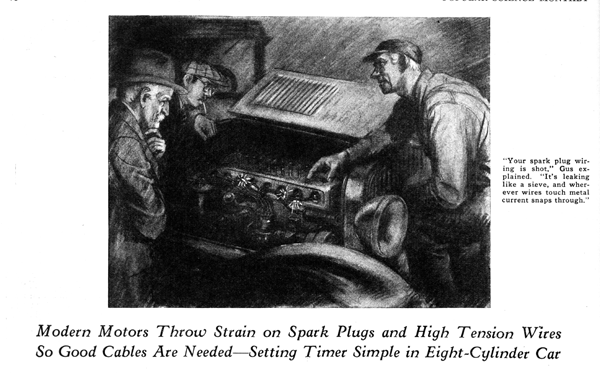
One sizzling hot summer evening while Gus Wilson and Joe Clark were working late on a rush job, a year old eight-cylinder sedan drew up in front of the Model Garage and the owner climbed out.
"Howdy, gentlemen," he drawled as he strolled over to the garagemen. "I see you-all are still making hay though the sun is down. Could I impose on your good nature long enough to have you look over my motor?"
"Be with you in a jiffy, Colonel Marrold," Gus replied as he finished tightening a bolt and reached for a clean piece of waste. "What seems to be the trouble?"
The Colonel's brow wrinkled in a puzzled frown as he twisted the end of his snow-white mustache. "I can show you what it does," he said, "but I haven't any notion of what's wrong. Old Betsy, that was my old car, She, couldn't fool me with her whims; but this newfangled youngster has me guessing for sure."
Gus smiled, for Colonel Marrold at the wheel of old "Betsy," a huge six-cylinder bus of ancient vintage, had been a familiar sight around that section for many years.
"I had it all figured out it was dirt in the carburetor," Colonel Marrold continued as he climbed in and prepared to start the motor. "The pesky engine misses fire as old Betsy did when something got in the carburetor. I cleaned it twice and that didn't do any good. So then I cleaned all the spark plugs and touched up the breaker points. That used to make old Betsy run like a thoroughbred."
The Colonel stepped on the starter pedal and the motor, being warm, started at once, but it did not settle down to a steady purr. The cylinders missed fire irregularly and there was a peculiar roughness in the way it ran.
"Runs sort of shiftless," Colonel Marrold complained. "Kind of like a row of soldiers, some of 'em stumbling and not keeping in line. Only if it was soldiers, Suh, I could have the top sergeant take 'em in hand!"
"You've hit the nail on the head without knowing it, Colonel," said Gus as he reached over and pulled the switch that cut off all the lights outside the garage.
"Look at that," he added, raising the hood of the car on the distributor side.
In the dim light from the street lamp some distance away, the space under the hood looked like a chunk of utter blackness in the general gloom. Here and there tiny sparks flashed at irregular intervals and each flash was accompanied by a sharp but faint snap that was barely audible above the hum of the motor.
"Thundering gunboats!" exclaimed the Colonel in amazement. "What in tarnation is going on there?"
Gus snapped on the lights. "Your spark plug wiring is shot," he said. "It's leaking like a sieve, and wherever one of the wires touches metal, the current snaps through for a spark instead of jumping the points of the plug."
"Most amazing," the Colonel growled. "It's strange I never had trouble like that with old Betsy."
"Probably your old car was fitted with better wire in the first place," Gus suggested. "And what's even more important, all these modern cars have high compression motors compared with the old timers. The higher the compression, the harder it is for the spark to jump at the spark plug points and sometimes, as in this case, the rubber covering on the wire dries out and cracks and the spark jumps through the cracks. It isn't anything to worry about. I'll put in some high-tension wire that will keep the juice where it belongs.
"There's something else wrong here, Colonel," Gus continued. "It sounds to me as though the timer is out of synchronism."
"What kind of a new-fangled trouble is that?" Colonel Marrold asked.
"Just what you said a moment ago," Gus replied. "It's like soldiers out of step. In nearly all these eight-cylinder jobs, the timer is made so that one set of contact points fires half the cylinders and another set fires the other half. That's necessary, because, with a high-speed eight, it'd he mighty hard to make one set of points work fast enough and still get sufficient current through the coil for a fat spark. Point is, that if one set of contact points is out of time with the other, half the cylinders will get a late spark and they'll loaf on the job.
"You'll find that one set of contact points is fixed so you can only adjust the amount of the break. The other set is mounted on a plate so the whole business can be moved. Each breaker arm produces the spark in four of the cylinders. After you've set the fixed arm so it opens the right amount, the next job is to move the plate holding the other one till it breaks the same."
"How do you tell when you have it right?" Colonel Marrold asked."
"I was coming to that," said Gus, "There are a lot of ways. The simplest I know of for the fellow who does his own work is to open up the window that lets you see the timing marks on the flywheel. Then you take a long piece of spark plug cable and hook it on to the high-tension cable from the spark coil that ordinarily sticks into the center hole of the distributor head. Bare a quarter of an inch or so of the cable and hold the end close to the metal right beside the opening to the flywheel.
"Have somebody turn the motor over slow with the ignition turned on. With the spark jumping right beside the inspection hole, it's a cinch to see whether the spark jumps as the timing mark on the flywheel comes under the pointer. If it's off for half the cylinders, move the breaker arm plate till you get it right."
"That sounds easy enough," Colonel Marrold admitted.
"It is easy," Gus maintained. "An eight-cylinder motor is simpler in some ways than a six because it is, after all, only two four-cylinder motors made into one. The ignition system is one example. On some cars, even if one breaker arm went out of commission, the motor would still run on four cylinders. Many of the eights really use two carburetors -- one for each set of four cylinders. It looks like one carburetor because there's only one float bowl, but there are two mixing chambers and two needle valves that have to be adjusted separately."
"How is the best way to do that?" asked Colonel Marrold.
Gus smiled. "Easiest way I know of is to cut out half the cylinders while you adjust the low speed setting for the others. You can do that either by disconnecting one of the coil leads when there are two, or by wedging open one set of breaker points with a bit of thick cardboard."
END

L. Osbone 2019