February 1931
HEAT YOUR CAR BUT DON'T BURN IT
by Martin Bunn
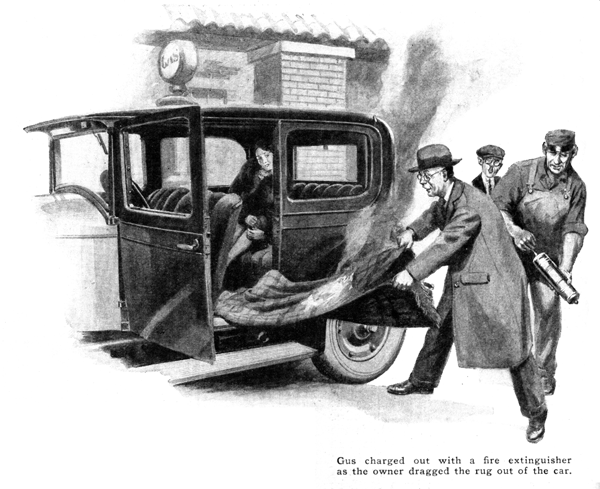
Joe Clark, pencil in hand, was checking the day's gasoline total on the pump outside the Model Garage when a sedan drew up.
"Fill her up!" the driver called. "Got a long trip ahead of us tomorrow." He stepped out and came around to watch.
Joe casually glanced at the attractive woman seated in the car as he ground the crank. She was leaning forward, apparently searching for something on the floor. Then suddenly she sat up with a jerk and yelled "Fire!" at the top of her lungs.
Joe stopped cranking and took up the call. Gus Wilson, his partner, came charging out of the garage with a fat and shiny fire extinguisher.
The owner of the car with one sweep dragged out the lap robe and with it the smoldering remains of a newspaper. The woman immediately hopped out and the men searched for the cause of the fire.
"What's that gadget there?" Gus asked, pointing to a piece of pipe placed crosswise on the floorboards just back of the front seat.
"That's a new car heater I built myself," the owner replied. He placed his fingers on the pipe and instantly jerked them away again. "Ouch!" he howled, shaking his hand. "That pipe sure is hot!"
"I guess we don't have to look any further," said Gus. "The newspaper must have been on the pipe and the robe kept the heat in till it got nearly red-hot."
The owner bent over to examine the pipe. "I certainly am disgusted," he said, after all the work I put into building that heater."
"You did a good job -- as far as you went," reported Gus after checking up on the whole installation. "You got everything tight so no exhaust gas could leak out into the body of the car. But you didn't insulate the pipe from the wood of the floorboards well enough. There ought to be plenty of asbestos separating every part of the outfit from anything that can burn. And you didn't put any guard over it."
"I had no idea the pipe would get so hot," confessed the owner. "I felt of the exhaust tail pipe and it seemed to be just the right heat for a car heater."
Gus smiled. "You forgot that the exhaust gases cool a lot in the muffler. You're taking them out of the exhaust line right back of the motor where they're hottest. Anyhow, plenty of heat certainly isn't a fault in a car heater. If you just insulate it properly and fit a strong wire screen over the pipe on the floor, so nothing can get nearer than an inch or two to it, everything will be fine and dandy."
But the owner's wife cut into the conversation.
"Charlie Green!" she exclaimed. "If you don't have the man take that thing out of the car this minute you'll make the rest of the trip alone! I'd rather freeze to death than be fried to a crisp!"
Green shrugged his shoulders and yielded. "All right," he agreed. "I'll take you down to the hotel and then bring the car back here."
They drove off with Mrs. Green warily eyeing the pipe as though she expected it to blow up.
When the car returned, Gus set to work at once while Green gloomily watched the destruction of his handiwork.
"I suppose you've got to satisfy the women," Gus grunted. "Still, Mr. Green you don't have to go without a heater just because your wife is afraid of this one. I'll install a good one if you say so."
Green's face brightened at once. "That's an idea," he said. "What kind of a heater do you sell?"
"We don't play favorites," Gus smiled. "I can give you any one of three different kinds. Properly installed you get fine results out of any of 'em."
'Why do you carry three makes if they're all equally good?" Green inquired.
"Come in the stock room and I'll show you," Gus offered. "Now," he said as he pulled three bulky packages off the shelf, "In an automobile you've got heat going to waste in two places. One is out of the exhaust pipe and the other through the fins of the radiator. That means you can heat the car either with hot gases or with hot water. The difference between them is almost the same as stream and hot water in house heating.
"The steam is much quicker and harder to control to get even heat. Also it's likely to make a 'hot spot' in the car because there's so much heat in such a little space. Hot water heat, either in your home or in your car, is much slower to get going and a lot more steady. Also the hot water can't get hotter than boiling so there's no possible chance of scorching anything."
"Also," Gus continued, "there's the matter of ventilation. You can't take long trips with every window shut tight without the air in the car getting kind of stuffy. Heating and ventilation are really twin parts of the job of keeping comfortable in winter driving. You've got to figure on one as well as the other.
"Here's a heater that works from the exhaust gases and circulates the air through the cast-iron radiator by a small electric fan. This one," he went on as he opened the second package, "is the same idea, using hot water. It's got a fan, too. The only difference is that the exhaust gas heater gets hot a lot quicker. I find that doctors and others who have to make a lot of short trips with long waits like the exhaust type pretty well because they get heat quick. Salesmen that make long trips are much more likely to pick the hot water job."
"But I don't see how you can get enough heat from the hot water system," Green objected. "The motor runs so cold that there isn't any real heat in the water."
"If it does," Gus retorted, "that's your fault for not covering up part of the radiator. Of course the kind of anti-freeze you use makes a difference. You can't run the motor at summer temperature if you use alcohol, so the exhaust gas heater would have the edge on the water job if you keep the motor cold to save alcohol. If you use glycerin or green ethylene glycol, you keep the motor as near the boiling point as you please."
"How about ventilation with those two?" Green asked.
"Leave one of the windows open," Gus explained. "The fan keeps the air circulating so the draft isn't so bad. This one," he said, opening the third package, "takes care of the ventilation too. This funnel-shaped opening is fastened right back of the engine fan and the fan forces a stream of fresh cold air through the heater and then through the opening in this fixture which fastens over a hole cut in the dash.
"Of course the cold air is heated so it's good and warm by the time it comes out the hole in the dash. This particular job uses the hot water for heat."
"Seems to me," Green broke in, "I've seen the same thing worked out as a cover for the exhaust manifold. Why isn't that simpler?"
"It is if you don't mind the hot engine smell," Gus explained. "Then, too, any leak in an exhaust gasket will fill the car with gas."
"Why don't somebody invent an electric heater that you could hook up to the battery like the rest of the electrical equipment of the car?" Green suggested.
"Would the heat from a dinky little electric toaster be enough to warm your car?" Gus countered. "It takes two hundred and fifty watts of current to run a toaster and your generator produces only eighty watts and most of that has to be used to charge the storage battery. Also, what would be the use of burning more gasoline to drive a bigger generator just so you could operate an electric heater when you have a lot of heat going to waste already?"
"I'm wrong again," Green laughed. "Well, I guess you'd better put in a hot water heater. After what just happened, my wife would feel safer."
There was a frigid snap in the air next morning as Green and his wife set out. They passed the Model Garage just as Gus was opening up for the day.
"I wanted to thank you, Mr. Wilson," chirped up Mrs. Green as they stopped, "for selling my husband that ducky little fixture with the door that lets the heat in from the engine compartment. That's much better than that awful thing he installed."
Green slyly winked, Gus smilingly acknowledged her thanks, and the car drove on.
END
L. Osbone 2019