July 1932
GUS EXPLAINS MYSTERY OF VIBRATION IN CAR
by
Martin Bunn
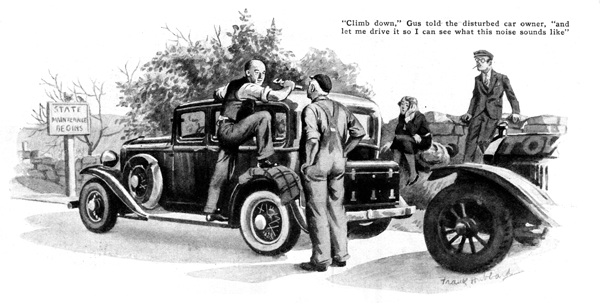
"Stop the car, Clem," Mrs. Ferrers commanded. "I can't stand that awful drumming sound another moment. My head aches like fury. It's driving me crazy. Can't you do something about it?"
Clem Ferrers smiled placatingly, "Sure, Aggie, we'll stop and I'll see what I can do. It didn't seem so bad to me."
"It wouldn't!" his wife snapped. "I declare, Clem, you'd never notice anything wrong so long as the wheels keep turning around."
With that she sprang out, plumped herself down on a near by rock, and rested her head in her hand, a picture of woe.
"Good thing I'm not so gosh-blinked fussy," Clem murmured to himself as he clawed the tool kit out from under the rear seat and hesitatingly thumbed over the various articles in it. Finally his eyes lighted up as his fingers closed over the handle of a huge monkey wrench.
"Maybe a couple swipes with this'll bend it so it won't rattle so," he muttered as he climbed up on the fender and began to inspect the top.
At this particular point in the proceedings, an auto service car labeled "Model Garage" hove into sight with the huge hands of Gus Wilson clasped firmly around the steering wheel. Perched beside the veteran auto mechanic was his partner Joe Clark.
"What do you reckon he's fixing to do up there with that big wrench?" Joe questioned as Gus applied the brakes.
"That's just what I want to know," Gus said as he climbed out and walked over to Ferrers' car
"What's gone wrong, mister?" he asked.
"The madam, there, she says something in the roof is humming so it gave her a headache," Clem explained. "I thought maybe if I gave it a couple of socks here and there, whatever is loose might get stuck so it couldn't wiggle any more. Got any good ideas?"
"Sure," said Gus. "Climb down and let me drive your car so I can see what the noise sounds like."
Gus took the wheel, with Ferrers beside him, and drove off.
"There's nothing the matter with the top," Gus reported when they got back. "Trouble is, some of the body bolts have come loose. At certain speeds you get a vibration in the body that seems to come from the top, I'll tighten up the bolts."
"Beats me how the noise could sound like it came from the top when those bolts underneath were doing it," Ferrers puzzled, as he bent down to watch the work.
"Simple enough," Gus told him, "All noise comes from vibration. And vibrations scoot around in metal or wood till they reach a place where there's a broad, flat surface that isn't fastened all over. Then off they go into the air. Your car tells you where the noise is coming from, but not how it got there."
"That was a funny case," observed Joe as the two garagemen continued on their way home. "there's a lot about this vibration business I don't savvy at all. For instance, I can understand how mounting an engine in the chassis with rubber at every point ought to cut down the vibration, but what's the difference between just ordinary rubber mounting and this 'floating power' they talk about? Does 'floating power' mean anything at all?"
"Did you ever hit a baseball too near the end of the bat, or maybe too near your fingers?" Gus countered, "Stung like a flock of bees, didn't it? When you hit the ball with just the proper spot on the bat, you didn't feel anything except the club stopping in the air, eh? Well, floating power is like that. It's all in the location of the engine supports.
"Suppose," Gus continued, "you could hang an engine up in the air without any supports and start it going, what would happen? It would vibrate a bit -- no engine is perfect that way -- but if you looked over the engine, you'd find at least two spots that didn't seem to move at all. They're like the spot on the baseball bat and the place where your hands hold it. You could touch one of those spots on the engine and you wouldn't feel any vibration to speak of, showing that the whole engine was wobbling back and forth with that point as one of the centers.
"Floating power means holding the engine in the frame by those points where there's no vibration -- after you've found where they are. Of course, you can't hang an auto motor in the frame with only two supports. Extra rubber mounted brackets are put in to steady the engine a bit and to keep it from twisting itself right out of the frame trying to turn the shaft."
"I see," Joe interrupted. "They don't worry about the motor vibrations as long as they can keep them out of the rest of the car. Why didn't somebody think of that before?"
"Probably somebody did," Gus suggested. "but he didn't know how to apply the idea to an auto engine. Rubber mounting made it real easy and practical. Don't get the idea that floating power and rubber mounting are so effective that it isn't necessary to worry about motor vibrations any more.
"Take it from me, if you tried to apply floating power to some of the unbalanced auto engines they made years ago, you'd probably have the motor hop right out of the car if you tried to drive fast.
"No, rubber mounting and floating power are ornaments that can be added only after you've done pretty near all the mechanical balancing that's possible. I can remember when a set of pistons was considered O.K. if they didn't vary in weight more than a few ounces. Now they match 'em on the cheapest cars to the fraction of an ounce, connecting rods the same way. In the old days crankshafts for cheap cars came through without any balancing at all and high grade car makers tested them only for static balance. Now nearly every one, including the cheapest, gets tested for dynamic balance."
"I understand pistons should be the same weight and so on." Joe again interrupted, "but I don't understand that static, dynamic balancing business. If you set a crank shaft with the end bearings resting on a couple of knife edges and you take metal off here and there till it doesn't have any tendency to roll because one throw is maybe, a bit heavier than another, why shouldn't it be in perfect balance when you run it in the engine?"
"It would if you were talking about a thin flywheel instead of a crank shaft," Gus explained. "The static or standing-still balance of the flywheel would be practically the same as its dynamic or running balance because all the weight is in one plane."
"How do they do the dynamic balancing?"
"In a special machine that rotates the crank shaft and registers which way it's out of balance," Gus explained.
"I think I've got a glimmer of an idea about that," said Joe after a minute or two. "Now explain one other thing that's always puzzled me about engine balancing. Why is it you can't balance a four-cylinder motor and get it just as smooth as a six? I never could understand why the two pistons coming down don't equal the other two pistons going up.If the pistons all weigh the same and so do the connecting rods, and the crank shaft is dynamically balanced, what is there left to cause vibrations?"
"Better brains than yours or mine have puzzled over that one, Joe," Gus said with a grin. "The answer is what the engineers call the angularity of the crank shaft. If you measure the motion of the piston as it slides down the cylinder, you'll find it goes quite a bit more than halfway by the time the crank has reached the halfway point. Sounds impossible, but you can prove it for yourself in two minutes with a compass and a ruler. The only way you could get balance would be to put a pair of cylinders on opposite sides of the crankshaft. Then the irregular piston motion would balance."
"So that's it, eh?" said Joe as they reached the Model Garage, "Well, I'll take your word for it. Just goes to prove that whatever goes up must come down -- but not the same way!"
END
L. Osbone 2019