February 1932
by Martin Bunn
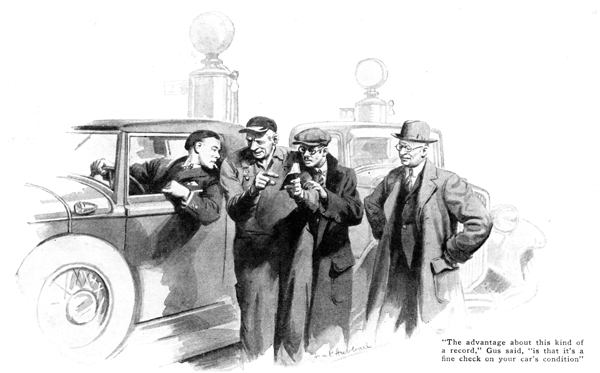
"When I got here," Jack Norcross boasted, "the speedometer showed just 208 miles for the trip. Then I had the tank filled again right up to the brim and ten gallons was all we could get in it. Figure it out for yourself! Comes out mighty close to twenty-one miles to the gallon. That's what I call getting mileage out of gas, eh, Gus?"
"Maybe so," grunted Gus Wilson, veteran auto mechanic and half owner of the Model Garage, "but all you've proved is that you've driven here from Whippville, today, on ten gallons of gas -- more or less!"
"More or less!" echoed Norcross angrily. "Didn't I just tell you we started with a tank full and we could only get ten gallons in when we got here? If that isn't ten gallons for two hundred and eight miles then what is it?"
"No sense in flying off the handle, Jack," said Gus. "What you say sounds fine till you stop to think a bit. For instance, are you sure the car was setting at exactly the same angle when the tank was filled each time? With the filler opening at one end it only takes a bit of a slant one way or the other to make a gallon or two difference.
"Another thing, Whippville is way up in the mountains and there's a powerful lot of long easy downgrades coming this way. On top of that, you've had a rip-snorting tail wind boosting you along for the whole trip. Considering all those things, the mileage you got today may be interesting, but it doesn't tell you much about the gas mileage you can get out of your car."
Young Norcross snorted disgustedly. "Well, how in blazes do you get a real test if you've got to figure on wind, the number of hills, and so on?" he demanded. "Must be as bad as those brain-wreckers the mathematics teacher used to shoot at us every so often."
"It sure would be," said Gus, "if you tried to figure the effect of all those things. But you don't have to. Make the effect of the wind and hills zero by doing a round trip test. Then, if you're mighty careful to see that the car is level both times when you fill the tank, the test will mean something, especially if you try it several times and then take an average.
"Anyhow," he continued, "there are two ways to find your gas mileage. One is to make a special test. The most accurate way to do that is to fit a small special tank that holds exactly a gallon or a half gallon, or to do it as Mr. Boltan does. "Show Jack your gas record, Mr. Boltan," said Gus, turning to an elderly, dignified chap who had joined the group.
Boltan flipped a tiny notebook out of his upper coat pocket with an easy motion that denoted much practice. "Here it is," he smiled. "Quite simple, too. I just put down in this column opposite the date the speedometer reading every time I get gas and over here I put down the number of gallons. I've kept this record ever since I bought the car. I can tell you exactly how many miles I averaged to the gallon for the first two thousand miles, the last two thousand, or for all the miles I've driven the car just by dividing the miles over any period by the number of gallons I've bought."
"The point is, Jack," Gus cut in, "what counts, as Joe and I always tell our customers, is not how many miles you can get out of one particular gallon over one particular route, but how many miles do you average on a gallon of gas? Of course, gasoline is cheap now, but there's no telling when it'll go up again, and with every state charging a gas tax running all the way up to seven cents a gallon in Florida, gas mileage may soon be an important item.
"Another advantage about that kind of a record," Gus added, "is that it's a fine check on the condition of your car. Every so often you can figure the mileage for the last thousand miles and see how it compares with previous records. Any failing off in mileage is a pretty good sign that the motor needs tending to."
"I can see where a record like that gives the real dope." Norcross agreed after he had carefully examined Boltan's neat rows of figures. "I think I'll start one."
"If you do, Jack," Gus grinned, "you'll have to watch your step if you want to come anywhere near equaling Mr. Boltan's record."
"What do you mean, watch my step?" asked Norcross. "Of course you've been driving lots longer than I have," he told Boltan, "but I'll bet you I can come as near getting all the miles there are in a gallon of gas as you can."
Boltan slipped the notebook back in his pocked. "Gus is just kidding you, Jack," he smiled. "You can drive much better than I can."
"I wasn't kidding," Gus grunted. "If you think you know the ins and outs of gas economy, Jack, tell me some of 'em!"
"Why, er, you just coast all you can, of course" Norcross paused. "And that's about all there is to it," he finished lamely.
Gus shook his head sadly. "We'll have to send you to the foot of the class," he observed. "Why, coasting is only one little item. In the first place, you've got to have your carburetor adjusted for the most economical running, and that isn't the way most carburetors are set. Then there's a whole list of little things that, taken together, make a lot of difference. There mustn't be any drag in the brakes. You want to keep your tires pumped at all times to five pounds more pressure than regular. If you don't think tire pressure makes any difference in the rolling friction, just try pushing the car with the tires five pounds below pressure and then with them five pounds over.
"Of course, the condition of the engine itself is mighty important. A reasonable amount of carbon doesn't make any difference, but leaky valves do, and leaky piston rings are still worse."
Norcross was deeply interested. "How do you tell when you've got the carburetor right?" he inquired.
"When you have each adjustment shut down to the lowest point that will give satisfactory running," Gus explained. "Gasoline and air will explode evenly in the cylinders in many different proportions, ranging all the way from a thick mixture rich in gasoline to a thin mixture with several percent less gas. When driving along on a level road you can't tell which mixture you have.".
"A carburetor set for a thin mixture will show up when you start the motor in cold weather. You'll have to use the choke a bit longer to make up for the lack of gas in the mixture. When you strike a hill, the thin mixture will make the motor seem not so peppy. On the other hand, the thin mixture has a tendency to burn away the carbon in the cylinders, and the spark plugs stay clean longer.
"Now about driving so as to get good gas mileage," Gus continued. "You mentioned coasting. That helps, of course. It helps too, to use the brakes as little as possible. Quick starts in traffic waste gas. The speed you drive at is important. You'll have to find by experimenting just what average speed will give you the most miles per gallon. And you have to take the wind into consideration to figure driving speed.
"Suppose, you find that thirty miles an hour is the most economical speed on the average. If you were driving into a head wind of thirty miles an hour and your speedometer also shows thirty miles an hour, your speed through the air is sixty miles, and the most economical speed would be a lot less than thirty. On the other hand, if you have a stiff tail wind as you did today, the easiest speed on the gas supply might be forty or even fifty miles an hour."
"Gosh!" Norcross exclaimed. "I'd have to have two brains to remember those things."
"You don't remember them," Gus grunted; "you make a habit of driving economically if you really want gas mileage. If you want something to remember, try remembering always to stop at the pump that sells the premium grade gas. Filling the tank with good gas is one trick that is sure to help you get plenty of mileage."
END
L. Osbone 2019