June 1932
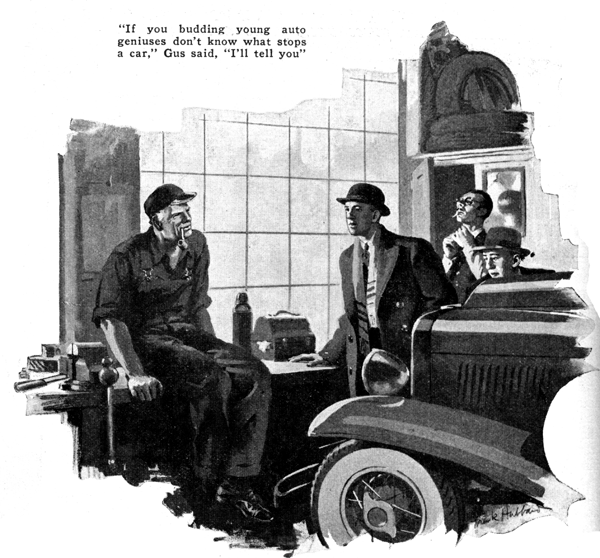
"Gus," asked Jeff Harmby, "when your motor stops suddenly on the road, what's most likely to be the trouble?"
Gus Wilson, half owner of the Model Garage, smiled at the two young automobile enthusiasts who had dropped in during his lunch hour. He shoved the empty lunch box aside and lighted his pipe.
"Jeff," he grunted between puffs, "you ought to be ashamed to ask a question like that after all the miles you've driven. Tell me the answer yourself!"
"I'll bet you can't," chuckled Tim Hibbers, the other of the two young men.
"Better than you can anyhow," Jeff snapped, "The thing that stops most motors is a blown-out condenser on the ignition system. Isn't that so, Gus?"
"I thought you were telling me," Gus grinned. "What do you say, Tim?"
"Aw, Jeff's all wet," young Hibbers replied. "Of course a blown condenser will stop the motor -- suddenly, too -- but it's a rare trouble."
"Score one for Tim," said Gus turning to Joe Clark, his partner. "If this pair of auto geniuses are going to debate what makes a car stop on the road, we'll have to check up on them. Tim certainly is right in saying that a blown condenser is a rare trouble. Lots of cars end their lives in the scrap pile without ever having it. Still I think we ought to put down a half point for Jeff because he picked one of the two ignition troubles that can stop a car as suddenly as though the switch was turned. The other is a burned-out ignition coil. When that happens, nothing short of a new part will get the motor going again. No makeshift stunt will do.
"You can fix a blown fuse by wrapping tin foil around it. You can short out the dead cell in the battery if it gets so bad no current will flow. Or you can get the car going when the whole battery is shot, by disconnecting it and having somebody push you so you can start and drive home slow on the generator alone. I've seen cars get home with a cracked distributor head held together with tape, and contact points working with a rubber band for a spring. I've seen broken wires held together with a piece of chewing gum, but I never yet saw anyone wangle a condenser or spark coil back to life.
"Well, Tim," he broke off, "what's your idea of the thing that's most likely to stop a car on the road?"
"Dirt in the spray jet of the carburetor or water in the gasoline," Tim promptly suggested.
"Rats!" Jeff snorted, "Just because the tank on your old bus is so full of muck and water that you get stuck with a clogged carburetor doesn't prove all automobiles are that way."
"Score's even again," Gus laughed. "You're right, Jeff. Clogged carburetors certainly aren't the most frequent cause of road stops, especially in cars less then two or three years old. Last year we had more trouble with 'vapor lock' than we did with clogged carburetors."
"I never had that. What is it?"
"You can blame last year's troubles with vapor lock on good gas," Gus explained. "A few years ago the gas was so poor that automobiles had other heating gadgets to get the gasoline to vaporize at all. Then came overproduction in gas and refiners faced such stiff competition that they improved the quality of their products. Automobile manufacturers have been making better motors, too, and last year the more efficient and hotter-running motors, combined with gasoline that turns into gas at a lower temperature than the old stuff, brought a new trouble we'd never bumped into before.
"You'd be barreling along as at a good smart pace on a warm summer day and all of a sudden the motor would begin to spit and blow back just as it does when water gets into the gas line. Sometimes the motor would stop dead. Then after you'd spent a few minutes trying to find the trouble, you'd step on the starter and she'd tick over as though nothing had happened. As first they blamed it on water or dirt in the gas line, but when it kept on happening, the engineers got busy and found that when the motor got just so hot, the gasoline in the pipe line near the carburetor started to boil. Sometimes it would boil in the carburetor bowl itself. Then nothing but gas vapor went into the carburetor with the air and the mixture got too thin to burn."
"By golly!" said Tim excitedly, "Maybe all that clogged carburetor trouble I've been having is vapor lock. I put in a new gasoline pipe last year and I remember I made it shorter than the old one by running it alongside the exhaust pipe. I'll move it over to the other side of the at the frame today."
"Don't bother," Gus advised. "Just move it away a couple of inches and wrap it with asbestos. That'll keep the heat out of it. That's the way the new cars are fixed to get rid of vapor lock -- a little heat insulation where it's most needed. Sometimes a few sheets of asbestos slipped in around the carburetor bowl will be worth while if it's real close to part of the exhaust manifold.
"Any other suggestions as to what makes cars stop on the road, Jeff?" Gus inquired. "Sure," Jeff replied, "Lots of people get stuck with busted fan belts. I had one break last year."
"So did I," said Tim.
"But you got home just the same, only with a bit of a delay," Gus objected, "Nobody ever gets stuck with a broken fan belt as long as any water is left in the radiator. When the fan breaks and she starts to boil, you have to stop and let it cool off a bit. Then you can go on till it heats again. That may be nuisance but at least you always get to a service station.
"A broken fan belt can do a lot of damage if it happens to let go when the car is hitting the high speeds. I've seen several radiators ruined and once I saw a distributor head smashed to bits by the swinging end of a busted belt. It doesn't pay to run a fan belt after it starts to get frayed."
"How about the battery going dead?" suggested Tim. "I've seen lots of flivvers stuck with dead batteries."
"That stops cars sometimes," Gus admitted. "But it keeps 'em stopped much more often than it stops them. When a battery is going bad, you usually know it because it won't start the car. If the car once starts, it's unlikely that you'll have any trouble until you stop again. Of course, every time you stop down in traffic, you're depending on the battery for ignition, and I have run across cars where a couple of cells shorted so badly while the car was running that the motor went dead in the middle of the street."
I can't think of anything else that happens often enough to be worth mentioning." Jeff said after a moment of thought. "Suppose you tell us, Gus."
"Well," said Gus as he packed up his lunch kit, "if you budding young auto engineers give up the problem, I guess I'll have to solve it for you.
"The thing that's most likely to stop a car on the road these days, is the sight of a hot dog stand and the smell of roasting wienies! Second comes a puncture or a blow-out, and third is the one you ought to have mentioned in the first place -- running out of gasoline!"
END
L. Osbone 2019