August 1932
DON'T WRECK YOUR CAR
When you try to repair it
by Martin Bunn
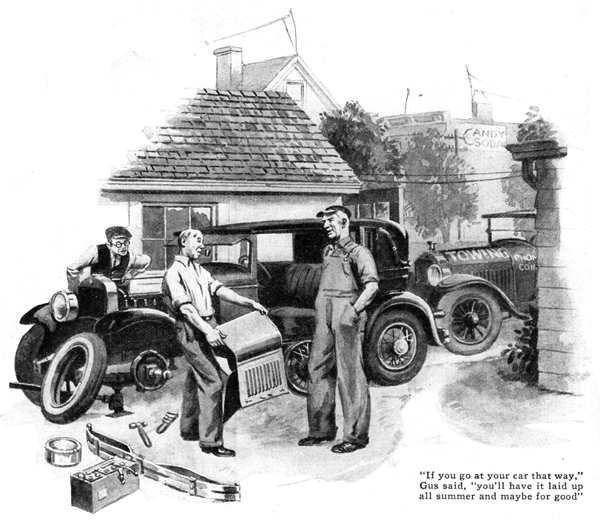
"On the phone, Gus!" Joe Clark bellowed and in a moment or two Gus Wilson, his partner, stepped into the tiny office of the Model Garage. He wrapped a huge and grimy paw about the receiver.
"Sure, Jim," he said after a pause, "I'll stop in on my way home tonight."
Gus dropped the receiver into the hook. "That was Jim Farrel, sort of a cousin of mine," he explained. "His car needs a lot of work done on it, and he figures, with a couple of hints, he'll be able to fix it himself. 'Wants me to tell him what to do."
"I know Jim," Joe answered, "and he'll take a powerful lot of telling. I'll go along. Maybe I'll learn something, too!"
At closing time they headed for Farrel's house.
"Jumping catfish!" Gus growled as they pulled into the driveway, "Take a look at what he's done! It's a good thing we got here quick. Going into the auto-wrecking business, Jim?" he asked.
"Not if I can help it," Jim said with a grin, trailing a black streak across his face as he wiped away the perspiration. "I was just starting to take it apart as I could get to work on the overhauling."
The veteran auto mechanic gazed at the miscellaneous array of parts that had been removed. One wheel was off, a headlight rested on the ground, the bumper was off, the battery out, and bolts and nuts were scattered all over the place.
"If you go at it that way," Gus told him, "you'll have the car laid up all summer and maybe for good. You remind me of the sap who ordered a carload of lumber before he decided what kind of a house he was going to build.
"Before you opened the tool kit," he continued, "you should have made out a list of what needed to be done. Then you should have tackled one job at a time, starting with the one that was most necessary. "That way you get the work done little by little and your car'll only be laid up a few days at a time."
"Oh, is that the way you do it?" asked Jim somewhat sheepishly. "Well, you know what a car needs a lot better than I do."
"Humph!" Gus grunted as Farrel wiped his hands and fished out a notebook and a stub of a pencil. "If I were to tell you all the things this car needs done to it, we'd be here the rest of the night. That's one of the funny things about overhauling an old car, you never know where to stop
"The simplest way is to consider the car as just so much transportation. In that case you do whatever work you can justify on a cost per mile basis and let all the rest go. Your wife, of course, wouldn't be satisfied, for most women would rather have the dents taken out of the fenders and a new coat of paint put on than have you spend money and time fixing the motor so it runs better and uses less gas and all. Some men think that way, too.
"Anyhow," he went on, "no matter how you figure, the first item on your list ought to be the brakes, and the second should be the steering mechanism and the rest of the running gear. Dents in the fenders and a shabby appearance may hurt your pride and a motor breakdown will be mighty inconvenient, but brake or steering gear failure is likely to put you where you won't have any more use for a car!"
"As for the steering mechanism," said Gus, "you may not have to do a thing to it, but while you have the wheels off for the work on the brakes, it's easy to look it all over and see if the king-pins have too much play -- a little won't do any harm -- and also check the linkage to see nothing is coming loose; no cotter pins missing and so on.
"Look over the front wheel bearings to make sure there are no cracked rollers or balls and if you want to be really fussy, clean 'em out and put in new grease. See that the rear hubs are tight on the axles, too."
"Should I pull the rear axle apart to see if that's all right?" Farrel interrupted.
"Why?" Gus demanded. "Unless your rear axle hums or there's too much play when you jack up one of the wheels and rock it back and forth, you'd better let well enough alone. Of course, it's a good idea to flush it out and put in new lubricant, but that has nothing to do with overhauling. It's one of those jobs that ought to be done regularly at the times specified on your oiling chart.
"If you've got a bad hum or a grind in the rear end, that's something else again. In that case you ought, at least, to open up the rear cover and see if the gears are chewed up or the ring gear is working loose on the differential housing. A noise that sounds like all the teeth are nearly worn off the ring gear often means only that the gear is loose. A clicking noise that keeps time with the engine probably means that one of the teeth on the pinion is damaged. If it keeps time with the revolutions of the rear wheel, the sound means a tooth or two on the ring gear partly broken away."
"I never noticed any particular noises," Farrel observed, "so I guess I won't touch the rear end at all."
"Logically, the next things to think about would be the transmission and clutch, but unless the transmission sounds mighty noisy in gear or the clutch slips when you step on the throttle, you can forget them, and that brings us to the motor.
"Lots of repair work done on auto motors are just as much time and money wasted. On the other hand there're plenty of motors heading straight for the scrap pile because their owners won't spend a cent on them.
"Take bearings, for example. There's no sense wanting time or money refitting unless they make a noise you can hear plainly. On the other hand, you're heading for trouble if you let a clanking connecting rod go because the pounding will make the trouble steadily worse till something breaks.
"Piston slap is one kind of looseness you can let go till it gets quite bad before there's any danger of trouble, but burnt rings mean poor compression, wasted gasoline, and continual trouble with fouled spark plugs. Remember that fitting new rings doesn't always cure the trouble, because the cylinders may be worn out of round. In that case the new rings may be worse than the old ones.
"It used to be that carbon in the cylinder head and coated on the tops of pistons made a motor knock so it drove you crazy. Now, with ethyl gas, the motor won't knock with any ordinary carbon deposit, so if the valves seat well enough to make the compression seem fairly even and strong when you crank the motor by hand, and you don't notice any knock with the leaded gas, or any excessive consumption of oil, let the motor alone."
"This motor isn't quite as good as that," Farrel smiled. "It uses a lot of oil, much more than it did when it was new. Besides, she's begun to miss a bit when going slow."
"In that case," Gus advised, "you'd better put a carbon scraping and grinding job on the list and don't forget to scrape and polish the exhaust valve stems. If you think you can handle it, drop the oil pan while you have the head off, unbolt the connecting rod caps, push the pistons out through the tops of the cylinders, and put 'em back again with a new set of rings. Be sure to put the connecting rod caps on just as you found them. Don't get them mixed up or there will be trouble. Pistons should go back in the cylinders they came out of, too."
"I'll be down to get a new set of rings when I get that far along," said Farrel.
"Now as for the ignition and cooling systems and the carburetor," Gus went on as Farrel raised his pencil questioningly, "If they're working right, let them alone. Of course, flushing the radiator and cylinder jacket may improve the cooling, and a new set of ignition cables and spark plugs will pep up the motor; but if it doesn't boil on the kind of driving you do and you're satisfied with the way it runs, why bother?"
"I won't," Farrel chuckled, as Gus and Joe climbed into their car. "I want a new car if I can ever raise the jack, and in the meantime I just want to get by with this old bus. Thanks a lot, Gus, for the advice."
END
L. Osbone 2019