May 1928
CARS OUR READERS CHOOSE
by Martin Bunn
Sixteen Experienced Motorists
Advise Bill Crowley on Picking First Machine -
Contrasting Opinions Help You Find Best Auto for Your Needs
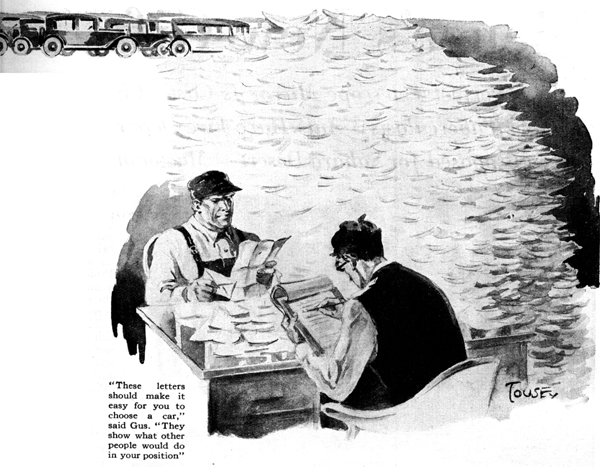
"Gosh!" sighed Gus Wilson wearily as he tipped his chair back against the wall and lighted his pipe. "I sure didn't realize what I was letting myself in for when I appealed to the readers of POPULAR SCIENCE MONTHLY to help me advise Bill Crowley what kind of a motor car to buy. Did you ever see so many letters in your life, Joe?"
"Most as many as Lindbergh got. I guess," chuckled Joe Clark, his partner. "I haven't totaled them up yet, but there's thousands in that stack and every single one of them has been read, too."
"All ready for you, Bill," Gus greeted Crowley as the prospective automobile buyer entered the Model Garage office.
"These letters ought to make it easy for you to decide what car to buy. At any rate they'll show you what other people would do in your position. Let's go over this bunch just as I picked them out without trying to get them in any particular order. I'll read the top one. It's from B. Giegerich, of Pittsfield, Massachusetts.
" 'Forget the light cars and consider your $2,000 all spent to satisfy your wife's vanity and your own. She will adore the rich upholstery and roominess of the larger car and you will admire the ease and quietness of an engine that can maintain a smooth, steady sixty miles an hour with the comfort and security afforded by added weight and larger wheelbase.
" 'The ideal car for you is the Studebaker Commander Victoria. It is cozy but roomy, and you have the kids where you can keep an eye on them. The Studebaker's superiority over other cars of its class lies in lower engine speed. It is the secret of long life, smooth running, fewer repairs and minimum oil consumption. The Studebaker holds dozens of world records for endurance and speed and has all the latest features such as four-wheel brakes, balloon tires, crank case ventilation, gas pump, engine heat indicator and so on. With what's left out of your $2,000 you can buy Mrs. Crowley a new hat and coat to match the upholstery.'
"That's one way of looking at it," commented Gus as he reached for the next letter. "Let's see what Peter Herzig, of Plainfield, New Jersey, says:
" 'Bill Crowley has the money to invest in an expensive car, but his knowledge and experience in handling any kind of car amounts to plus nothing. His wife, who also will drive it, knows no more than he does. Therefore an expensive car would be a waste of money. I suggest that he buy a 1928 model Ford sedan for the following reasons:
" 'It is the best value for the least money.
" 'It will stand wear and tear better than the higher priced cars.
" 'It is easier to operate and to care for a Ford than any other care, which in the long run will be a big advantage to the two inexperienced drivers.
" 'Not only is the initial cost less but the upkeep of this new model Ford is much less than that of any other car thus far built.'
"That," said Gus, "represents exactly the opposite point of view. Of course, the final and conclusive test of how a car stands up is in actual service. That applies to any new model of any make. Here's what R. E. Ambrose, of Verdi, Nevada, has to tell you:
" 'With a six-year-old and even an eight-year-old child riding in back, for safety's sake he must have a coach. He must have a six-cylinder car because he can choose from among the best sixes within his price range and because the six gives ease of driving in traffic and is easier to park than an eight. He has missed the joys of motoring long enough to feel entitled to the added benefits of a six, yet he would not fully appreciate an eight, even if he could afford it, until he has cut his motoring teeth on a car of inferior capabilities. Four-wheel brakes are essential for the safety of his precious cargo. So for tried and true quality, size, appearance, he can find nothing better than the good old Hupmobile.'
"I suppose he recommends the coach because the kids couldn't open the doors and fall out," suggested Crowley.
"That's Mr. Ambrose's idea," agreed Gus. "The rest of his arguments seem sound enough, except the one about four-wheel brakes. All cars have them now.
"Here's one from a woman, Mrs. H.A. Thomas, of Indianapolis, Indiana:
" 'I think Bill Crowley should buy a Chevrolet four door closed model. Just because Bill has $2,000 is no reason for spending it all on a machine. This is his first car, and he should buy a dependable car -- one that is easily driven and repaired at low cost. He should buy a four-door closed model so that he can drive it in any weather and because the children will not have to climb over the people in the front seat every time they get in or out. He needs four doors, not two.
" 'This first car of Bill Crowley's is for use close to home -- shopping, visiting, pleasure and business; and an inexpensive car is the most practical for such use.
" 'On first driving a car the speed craze gets one -- a light car will not tempt one into disastrous speed.'
"Seems to be a difference of opinion on that four door, two-door question," Crowley commented, when Gus finished reading. "Which is better, anyway?"
"Being a bachelor, I can't answer that one," laughed Gus. "I never had to drive a car with children alone on the back seat so I don't know how they act. Let's read the next one. It's from Otho A. Morris, of Kerrville, Texas.
" 'Bill Crowley should first purchase a used car. It is a mistake for a person of average means, with no automobile experience, to buy a new car. We value things by comparison. After Mr. Crowley has been aggravated for a year or so with an old model he will know how to appreciate a new one, and he will know by experience just what new car will best suit his needs.
" 'In his search for a used car he should not purchase too old a model, for that would disgust him with automobiles at the start. I would suggest an Overland touring 1924 model, the kind I have. It will take him where he wants to go and bring him back and be a fine little car. After he goes through a winter with it and discovers the disadvantages of celluloid curtains, he will know how to appreciate an inclosed model. Experience with an old car will make an automobile mechanic out of him by the shortest possible route. Then he will know how to take proper care of new and more expensive car when he decides to make the change.'
"That," said Gus, "is one viewpoint on the used car question. I remember that letter, but here's another from Ralph Cummings, of Los Angeles, Calif. There's no getting away from the fact that their arguments are as sound as any of the others. Here's what Cummings says:
" 'There is no good reason why Bill Crowley should purchase a new car. With $2,000 to spend he can get a really fine secondhand Cadillac not more than a couple of years old and in perfect running condition. All new cars are secondhand any way the minute you drive them a few miles, so why not let the other fellow suffer the loss of the first year's depreciation -- which always is the heaviest, plus the war tax, delivery and conditioning charges and so on? A good secondhand Cadillac will outlast any new car at the same delivered purchase price, and he will have a better looking and more comfortable car, a car that will do him justice in any company.'
"So much," said Gus, "for the secondhand car question. Now, listen to Grandison Irving, of Yale, Mich.:
" 'I would advise Mr. Crowley to buy a Nash six-cylinder sedan because it has the best bearing system, with seven main bearings, and full pressure oil feed. It has overhead valves with lubricated valve stems and rocker arms.
" 'The oil drain and radiator drain are accessible without soiling the hands. Oil can be added to the supply in the crank case through a large, handy hole in the top of the engine without using a funnel like a French horn.
" 'In addition to these features, Nash cars have fine bodies and the interior fittings are of the best. They don't change styles very often, so your car doesn't get to be a last year's model within a few months after you have bought it.'
"Of course," commented Gus, "there are other cars on the market that have some of the features brought out in this letter. And some of them wouldn't mean anything to the owner who has his oil changed by the service station. The point is that this particular combination of features appeals to this particular owner. Here's another, from W. S. Hoover, who lives in Albion, Pennsylvania, that stresses various mechanical features:
" 'I suggest that Mr. And Mrs. Crowley buy a Chrysler 72 coach. There is no rear door for their youngest child to open and tumble out. Although the Chrysler has been on the market less than four years, it already holds third position in dollar volume sales. It was the first car to combine acceleration with high speed, accomplished by using a small flywheel, 4.6 to 1 gear ratio, and a motor turning 3300 revolutions a minute, mechanical features such as the seven-bearing crankshaft, full pressure lubrication, oil and air filters, thermostatic heat control, invar strut pistons, motor supports mounded in rubber shackles web crank case supports for main bearings, and the new turbulence cylinder head giving a six to one terminal pressure.
" 'The coach is closer coupled than the sedan and Bill won't appear lost when driving alone. Mrs. Crowley will appreciate the beautiful interior of the body and the exceptional ease of handling.'
"Whew!" gasped Bill. "My head is whirling already. That's all Greek to me."
Gus smiled. "It represents," he explained, "the point of view of the man who takes an interest in the mechanical features of his car. Naturally, mechanical features won't mean anything to you until you have driven cars for a while and even then you may never learn anything about what goes on under the hood. And if you do, you may figure things out that other mechanical features are more important to you than the ones mentioned in that letter. Well, let's get on to the next. Another woman -- Mrs. Grace H. Murphy, Melrose Park, Illinois:
" 'I can't think of one reason why Bill should have a car, but I can think of fifteen thousand seven hundred and twenty-three reasons why he shouldn't!
" 'First, last and always there is the matter of expense.
" 'Second, think of the wear and tear on his wife's nervous system.
" 'Third garage rent alone will pay the premium on a $5,000 life insurance policy to protect his family.
" 'Fourth, there's no reason in the world why Bill should pass everyone else on his way to work. Besides, the street cars are sure safe and sane.
" 'Fifth, it's easier to pay carfare than damages.
" 'Sixth, Bill had better be spending Sunday in church and with his family than in the garage.
" 'Seventh, with an automobile Bill and his family will be leading the life of a pack of gypsies instead of developing a decent home life.
" 'Finally, I'm sick and tired of riding on the back seat of my Bill's car.'
Gus joined in the gale of laughter provoked by this letter. "That," he said "is a warning to show you what will happen if you get too nutty over automobiles. Now here's a letter with a totally different idea," he continued as he picked up the next one.
" 'I would like to make a suggestion, in regard to that new car you are thinking of buying.' (This is from Lucile Boone, of Mantua, Ohio.) 'I suggest that you buy two of the new Fords, a roadster and a two-door sedan, in place of one larger and more expensive car. The roadster can be used in fine weather and the sedan will be handy for bad weather and winter. You say Mrs. Crowley is going to drive, which means there will be times when you each want a car. When that happens you can let her take the sedan and you can take the roadster. Thus each of you will have the use of a car, whereas with one expensive car, either you or your wife would have to go without. Then, too, if one car is temporarily out of commission the other will be a available so you won't get stuck without any car.'
"I never looked at it that way," observed Crowley. "Do you think much of the idea Gus?"
"That depends on several things," Gus stated. "If you haven't a two-car garage you'll have to pay out extra money for storage. If you don't use the car for business you aren't likely to want it during the daytime when your wife needs it . . . Of course, if you have room to store two cars without extra expense and you need a car for business use, two cars will be of more use than one.
"The next letter, I see, is from John P. Picco, Salt Lake City, Utah, as owner of a light six. He writes:
" 'This is my third Essex coach and it is better than the other two, which is going some. I have over a dozen friends who have bought Essexes on my recommendation and to date not one of them is anything but pleased with the purchase.
" 'I am an Essex enthusiast because every one of my Essex cars has shown less than seven cents a mile for operating cost, which includes every cent I have spent on operating, insurance, depreciation, interest on money invested, garage rent and so on. I can go fifty five miles an hour all day long and feel rested at the end of the day.'
"And here's an old timer Jess J. Rogers, of Miami, Florida," said Gus, proceeding to the next letter:
" 'Dear Gus: I think your friend Crowley has made a mistake in waiting until he could spend as much as $2,000 for a car. It has made him more or less a cynic. Now if he had started in the automobile game about the time I did he would probably have had $300 available and there would have been no question as to what car to buy! In another way he has missed the spirit of adventure that belonged to automobiling as practiced ten years ago. Roads are so good now that it has lost all the thrills. Crossing Georgia or the Carolinas now is but a matter of a few hours' driving, while ten years ago it was real adventure.
" 'I suggest he buy a Willys Knight Model 70, painted in two shades of gray, and black above the window sills. This will give him a rich but not gaudy car that, because it has no valves to grind, will give him simplicity in operation, low upkeep cost and simple power without noise.'
"He is quite right about the roads being better," commented Gus, "but any one who gets any thrills out of rotten roads can find plenty to practice on!
"Here are a couple of letter that don't hold out much hope for you, Bill, as an auto driver;
" 'In the first place, writes Rube W. Davison of Holderness, New Hampshire, 'I wouldn't spend $2,000 on a car. Half that amount leaves something for doctors' bills or general repairs should Bill climb a tree while learning. A Pontiac coach would be my choice, as Mrs. Bill could easily handle it, and when the whole family is learning to drive there isn't much left of a poor car at the end of a year -- so why spend so much on something you are going to spoil?'
Then Gus read a letter from John G. Hanna, of Dunedin, Fla.
" 'I advise bill Crowley to buy a Dodge Victory Six sedan. The six-cylinder engine is the most satisfactory and the sedan is the family model. The car is large enough for comfort, but not so bulky and heavy as to increase the difficulties of a man learning to handle his first car. The price is far below Crowley's limit, as it should be, because a man's first car is bound to involve more service and repair expense, more rapid wear and depreciation and earlier trade-in than will be expected after he becomes a skilled driver. The staunch steel body is an item the inexperienced driver cannot afford to overlook.'
"And now here's a letter from a man who has been driving cars for twenty-five years, R. C. Jennings, of Denver, Colorado," said Gus.
" 'I drove my first car, a steamer, in 1903,' he writes, 'and I haven't missed many days since. I have owned forty-five different cars -- a great number of them haven't any surviving relatives at the present time. There have been the most wonderful changes the past twenty years, so that today it doesn't make much difference what car you buy, merely how much you want to spend, as all cars will return dollar for dollar if given the proper treatment. I find that cars in the $1,600 class give the best returns for the average family, I would advise Bill to buy a five-passenger Buick sedan, give it proper care, and receive in return service and satisfaction.'
"This is the last one, from Wallace Bryson, of Cedar Rapids, Iowa," said Gus.
" 'Concerning what make and model car Bill Crowley should purchase, it is my best judgment that he select the Auburn 8-77, five-passenger sedan, for the following reasons:
" 'Comparison is the only basis of value, and the Auburn invites comparison, not only with cars in its price class, but with those costing hundreds of dollars more. In beauty of design it is two years in advance of competitors. Therefore it will be up-to-date when the owner wishes to dispose of it.
" 'The body construction is of the best kiln-dried wood and high grade steel. It is equipped with cam and lever type steering especially designed for balloon tires, affording the driver sixty percent less muscular effort. The motor is equipped with vibration dampeners, insuring no vibration at any speed. The chassis frame is exceptionally strong, having seven cross members, three being tubular, providing a rigid foundation. The universal joints are of hardened ground ball and socket construction, and the four-wheel mechanical brakes insure quietness and safety.'
"There you are," said Gus, as he shuffled the letters into a pile and handed them to Bill Crowley. "I'd advise you to read them all over again very carefully and make a list of the various reasons for buying."
"In other words," Bill said, "you're not telling me what car to buy. You're letting me in on the secret of why other people buy cars so I will have something to go on when I pick out my own."
END