February 1928
"WHAT CAR SHALL I BUY?"
by Martin Bunn
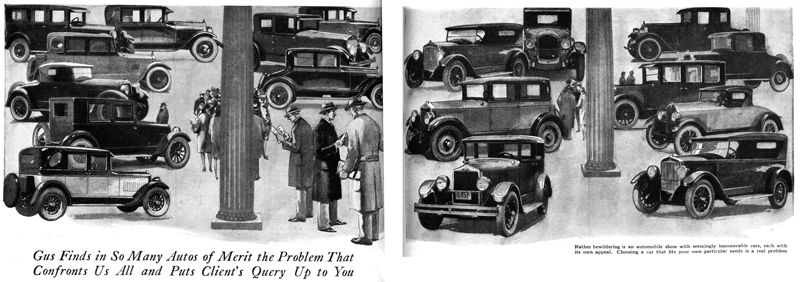
"How about giving the Auto Show the once over tonight," suggested Gus Wilson to his partner as they were closing up the Model Garage for the night.
"I'm game," Joe Clark replied. "Stop around for me any time after eight."
"Can't you make it earlier, I'll have Bill Crowley in tow. He wants me to help him pick out a car."
"What!" exclaimed Joe, "Bill Crowley going to buy a car! Why, he's always saying he hates automobiles?"
"Yeah," grunted Gus, "that was when he was broke. But he's made money recently, so he can afford a car now."
Joe grinned. "Well, I sure don't envy you the job. No matter what car you recommend, if he has any trouble with it he'll blame you."
"No, he won't, contradicted Gus as he shuffled his muscular frame into his overcoat. "I've got a scheme to beat that. You watch how I work it."
Joe was just finishing his supper when he heard Gus's horn. Bill Crowley was already in the car.
"Now the bug has stung another victim," grinned Joe. "Yes," Crowley admitted sheepishly, "it's got me at last. I guess the only cure is to buy one; but what gets me is which to buy, they all look so good."
"Now," said Gus, as they passed into the vast hall filled with shiny, new models, "before we start going the rounds let's figure out about what type of car you want, and how much you can pay, and also let's see if you have any particular requirements that might affect your choice. How big is your family, Bill?"
"Four, the wife and I and the two kids. One of 'em is eight and the other six."
"Is your wife going to drive?"
"Yes," Crowley replied.
"Then I can see one mistake you've made right at the start," snorted Gus. "You should have brought Mrs. Crowley along. She'll have a lot to say about the type of body and the color scheme."
"That's what I thought when I first brought up the question, but she says she doesn't know one car from another and doesn't care what kind I get so long as I get a good one and get it right away."
"All right," said Gus, "now tell me how much you want to spend, and we'll look over all the cars in that class."
Crowley hesitated, "I haven't decided that either," he confessed. "I can spend up to a couple of thousand dollars, but naturally I don't want to spend any more than I have to."
"Humph!" grunted Gus, "How am I going to suggest a good car to buy when you haven't any idea what kind you want or how much you think a car will be worth to you? Well, let's get started and see if we can't pick up some good ideas."
They moved slowly from exhibit to exhibit and examined each glistening machine. Now and then Gus halted before one and briefly pointed out various mechanical and body design features.
"Of course," said Gus as they stopped to admire a particularly good-looking coach, "it isn't so hard to point out the types of car you shouldn't buy. For instance, you certainly don't want a roadster, even one with a rumble seat in the back for the kids, because you will want to use the car in rainy weather and in the winter, and the passengers in the back seat have no protection at all.
"You might want an open touring car instead of a closed model, but that would depend on how you use the car. If you want it mainly for trips about the country when the weather is good -- real pleasure driving -- then an open car is fine; but if you want to combine pleasure driving with comfortable transportation in any kind of weather, you'll want a closed car. Most of the open cars sold today go to old birds like me or to families owning more than one car. Of course lots of cheap open cars are sold. But there price is the main factor."
"How many cylinders ought a motor to have? Asked Crowley as he strained his neck over the shoulders of a crowd gathered round an eight cylinder chassis.
"That depends on what features you value most," Gus replied, "From the stand-point of reliability and general utility it makes no difference whether you get a four, six or eight. Most of the possible sources of trouble lie outside the cylinders. If the ignition system goes bad, for instance, it will stall on eight just as quick as it will a four-cylinder car, and the same applies to many other troubles."
"But the sixes and eights must have some advantages or they wouldn't sell any," objected Crowley.
"Certainly they have," Gus agreed. "The more cylinders, the smoother the engine runs and the more flexible and quiet it is. Also, it is easier to build a motor with plenty of power by using a lot of small cylinders than to use four big cylinders with correspondingly heavy pistons what would cause excessive vibration."
"What's the advantage of a long wheelbase?" asked Crowley, seeing a sign listing the lengths of wheelbase obtainable on a certain model.
"The longer the car the easier it rides, other conditions being equal," Gus explained. "On the other hand, a long car is harder to handle in traffic, and it takes more space to park or turn around in."
"Well," said Crowley, as the three men stood gazing out over the sea of cars and people after they had examined every exhibit, "now that we've seen them all, what shall I buy?"
Gus revolved the question in his mind, "That's a tough one to answer," he finally replied. "You want to use the car in an average way. You are of average size; the average driving seat will be comfortable.
"You don't seem to have formed any opinions or acquired any prejudices. I'll be hanged if I know what to advise -- tell you what we'll do -- let's put it up to the readers of Popular Science Monthly!"
END