June 1928
GUS EXPLAINS A BROKEN AXLE
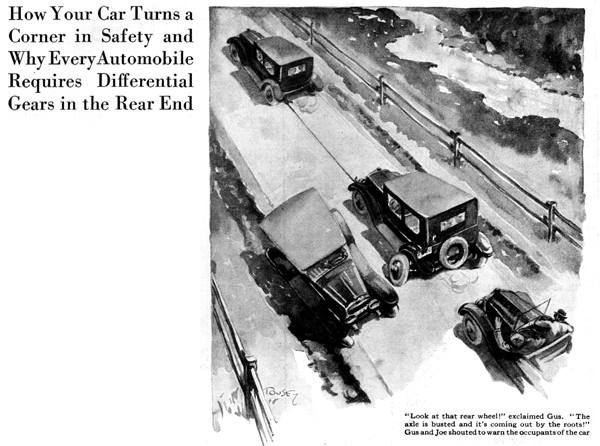
"You might know we'd get stuck behind a bunch of cars on a hill like this," grumbled Gus Wilson as he shifted into low and prepared for the long grind up Smoke Hill.
It was Sunday, and the string of cars constantly passing in the other directions forced Gus and his partner, Joe Clark to stay in line. They had left young Bill to tend the gas pump at their Model Garage while they drove to Windsor for dinner with Gus's sister and her family.
"This is a sure enough bad hill," said Joe, "but that's no excuse for crawling up it like a snail. What's the matter with those two cars right ahead? They're not even keeping up with the procession."
"Looks to me like the rear one is being towed," Gus observed. "The front car is filled with people and if it's trying to pull that extra load, I don't wonder they're going slow. We'll be lucky if they don't get stuck right in the middle of the hill. We're late enough for dinner as it is."
"I don't care much for soup anyway," grinned Joe.
"Humph!" Gus grunted, suddenly sitting up straight and gazing intently ahead, "We'll be lucky if we get there for dessert -- look at that rear wheel! The axle is busted and it's coming out by the roots!"
As Joe looked the rear wheel of the car ahead moved out from under the mud-guard 'til it was actually traveling into the path of the cars coming the other way.
Gus and Joe shouted to warn the occupants of the car ahead, but the roar of the racing motor in the front car drowned their voices. Passing cars veered out to avoid hitting the projecting wheel. Now the rear of the towed car settled with a crash on the concrete road; the jar snapped the tow rope and the first car, relieved of its burden, leaped ahead.
Gus, knowing what was about to happen, had lagged behind so he could avoid a collision. As he stopped his own car, a short and exceedingly fat man eased himself out of the disabled car, and right behind him came a skinny, freckle-faced youth.
"Pa!" called young freckle-face, "The wheel came off!"
"You don't say so!" puffed the fat man sarcastically. "Now, son, suppose you tell me how to get the blame thing on again if you're so confounded bright!"
By this time a string of cars were stalled behind Gus and curious drivers had stopped to look, thus tying up the cars proceeding down the hill.
"There goes the dessert, too," growled Gus. "I thought maybe we could sneak around and get on, but we might as well help this fat bonehead out of his trouble. Anybody got any tire chains?" he called out, "And jack?"
Willing drivers offered them.
"Now," Gus said, "I'm going to loop these chains around the brake drum with enough slack so I can hook the loop over the jack. Then when I get it as high as the jack will go, somebody stand by to shove the foot of one of those other jacks edgewise under the drum. That will hold it while I slack off and put something under this jack -- the tire on the wheel that came off will do. Pushing the jack up to the top again ought to raise it high enough to let you get a jack under the axle in the regular way. You understand? Watch it now!"
Three men put their shoulders to the back of the car lest it start backing off the queer chain sling arrangement and in no time at all Gus had the axle housing high enough to slip the shaft back in place.
"Where are you headed for?" asked Gus.
"Cooperstown," the fat man replied glumly. "I guess we'll have to walk it. No use trying to tow this wagon any more. The wheel'd just fall off again. Can you folks help me push it off the road and then maybe give us a lift to Cooperstown?"
"Get in our car." Gus offered. "We're going that way anyhow. "We'll be back after dinner and pick you up if you want. Then we'll get the wrecking car and tow you to the Model Garage."
"Suits me," the fat one grunted as he heaved himself in beside Gus. "The bird that was towing me must have got cold feet. He didn't come back. What made that wheel come off anyhow? There's a lot about this automobile business I don't get, somehow."
"You're in pretty good company," Gus laughed. "I suppose most auto owners on the road don't know what the differential gear is. As for why the axle broke -- that was your fault. The wheel was loose on the axle. I guess you never tightened up the nut that holds the wheel on the tapered part of the axle did you? A loose wheel jars the axle badly every time you let in the clutch or put on the brake. In time those break the axle -- usually at the end of the taper. This time it happened to break near the other end. The time to tighten the wheels is after you have driven the new car a few hundred miles. By that time they should seat so solid they won't come loose again.
"The reason the wheel came off is because in your car it is held in place entirely by the axle, and when the axle breaks there's nothing to keep the axle, with the wheel on the end of it, from sliding out except the retainers -- and they were loose, too. If you had kept the retainer bolts tight, the wheel wouldn't have come off, although if the break had been right at the hub the wheel would have dropped off right away.
"The only cars you can tow, no matter where the axle breaks, are the high priced models that are fitted with real, genuine full floating axles in which the wheel rides on bearings on the axle housing and the axle does nothing but turn the wheel. The axles they generally called 'full floating' these days are really only three quarter floating."
"It's all too deep for me," sighed the fat man. "Why don't they put in one axle that goes right through from one rear wheel to the other? What good is the differential anyway?"
"Ever hear a freight train going around a sharp curve," questioned Gus, "and notice that shriek the wheels make? The wheels on freight cars are fastened to a solid axle. If you measured the rails on the curve you'd find the outside rail quite a lot longer than the inside one. That means that the wheel on the outside rail ought to turn faster. The shriek is caused by the wheels slipping on the rails because being fastened to the solid axle, they can't turn at different speeds.
"When an automobile goes around a curve, the outside wheel turns faster. Wheels can slip on steel rails but the rubber tire wouldn't slip on the road and the axle would be twisted in two by the strain. The differential gear lets 'em turn at different speeds. Did you ever drive a train of horses?"
"I surely have, I was brought up driving horses." The fat man visibly brightened up. "There's nothing you can tell me about handling horses. But what's that got to do with differential gears?"
"Then you know how a whiffletree equalizes the load on the two horses of a team. If one horse starts loafing his side of the whiffletree moves back toward the wagon. A differential gear in an auto is simply the whiffletree idea made up in gears so that the motion is continuous. Of course the action is the other way around. The motor applies power in what would be equivalent to the wagon tongue and the wheels are connected by gears just as though they were hooked to the ends of the whiffletree."
"By cracky! Now I see it," Gus's passenger exclaimed. "That explains why the car won't run if just one of the axles is busted. It's just as though the harness broke loose on one side. Then, of course, the whiffletree would sag back so that end; and if it's gears instead of a lever like the whiffletree, why you never could get any pull on the wagon tongue!"
"You've got it exactly," said Gus, "But remember that even if differential gears work like a whiffletree, you can't treat them like one. Gears wear out unless they're lubricated, so clean out the rear end and put in fresh lubricant once in a while -- say about every five thousand miles. Well, here's Cooperstown. So long, we'll be back for you in a couple of hours."
END