May 1968
GUS GOES
FOR A LITTLE SPIN
by Martin Bunn
(Ron Benrey)
Ambrose Skinner's case
against Jed Morgan's transmission shop
looked airtight till Gus turned up
as a surprise witness .
"No doubt about it," Stan was saying to his boss, Gus Wilson, as Jed Morgan walked into the Model Garage, "with all this modern electronic testing equipment, a moron could diagnose just about any trouble in a car." He tossed the equipment catalogue on the bench and nodded toward the visitor. "'Morning, Mr. Morgan. What're you doing on this side of town so early in the day?"
Morgan returned Stan's nod and cautioned, "I wouldn't put too much stock in those fancy instruments. Sometimes they can fool you." He turned to Gus. "That's why I'm here, Gus. I need your help."
Gus greeted him warmly. "It's good to see you, Jed. What's wrong? You look worried."
"You know Ambrose Skinner, the lawyer? Well, we put a rebuilt transmission in his car about a month ago, and he's been complaining about a noise ever since," Morgan said. "There's a noise all right, usually during the downshift when the car is slowed to make a turn, but it's not the transmission. We've checked it over thoroughly. In fact, there's no noise when the transmission downshifts on the dynamometer, only when the car is driven on the street. Sounds like vibration."
"I'll be glad to check it out," Gus said. "Have you got the car with you?"
"No," Morgan replied. "Skinner won't let me have the car. He's filed a law suit for a new transmission, court costs, and compensation for the time we've had the car tied up trying to locate the noise. He's been all over town getting his cronies to testify that they heard the noise when the transmission downshifted."
"Sounds as if he's building up quite a case," said Gus.
"Yeah." Morgan looked downcast. "And I'll lose because he won't let me try to find out what's really causing the noise."
"But how can I help if you can't get hold of the car?" Gus asked.
"Well," Morgan replied, "I've only been in business six months, and the court might believe Skinner's stories about my incompetent operation, but you helped me to get the franchise and open the transmission shop, and you do know we do an honest job. Maybe if you'd come to court as a character witness, Judge Wilkins might give me another chance to find the trouble."
"Glad to do anything I can," Gus said. "When do you appear in court?"
"The case is scheduled for one o'clock Thursday," Morgan said. "I'll pick you up right after lunch."
"Seems a shame," Stan said as Morgan drove off. "Skinner could ruin Morgan. You got any ideas about the noise?"
Before Gus could answer, a horn blasted outside the shop door. Gus recognized the driver as Tom Jarvis, owner of the town's biggest hardware store. At his side was his five-year-old grandson, Tommy, holding a pinwheel out the window and making noises like an airplane. Both climbed out of the car.
“Morning, Tom," Gus said. "Haven't seen you for quite a spell. All settled in your new home by now?"
"Yes, we're pretty comfortable, Gus. Mrs. Jarvis just loves the place, especially with that circular driveway. Martha never was very good at backing down the long, narrow driveway at our old place. Now she just drives up to the front door and drives out the other end when she leaves."
"Looks like you've had a little accident." Gus pointed to a dent in the bumper at the front.
"That's what I came in about. Oh, not about the bumper, but about the brakes. Martha had to stop suddenly in traffic yesterday and the brakes didn't hold. She bumped the car ahead. Didn't damage the other car, but Martha was pretty upset. And so am I. We bought this car about six months ago; the brakes shouldn't be worn out already, should they? I'm going to raise the devil with the dealer, but wanted your opinion first."
Gus pried the wheel cover off a front wheel, removed the grease cap, and pulled the pin from the castellated wheel nut. He unscrewed the nut and pulled the wheel and brake drum off the spindle, noting that the drum showed no tendency to drag as he slid it free of the brake shoes.
"Linings are only slightly worn," Gus said, "but the shoes are badly in need of adjustment."
"The salesman told me those brakes were self-adjusting," Jarvis protested.
"Hold on a minute, Tom," said Gus, putting the wheel back on the spindle. "Self-adjusting brakes adjust themselves only when the car is driven in reverse. Every time you hit the brakes when you're backing up, a lever pushes one of the teeth in the adjusting cog or star wheel. If adjustment is needed, the cog turns to expand the brake shoes outward. If the brakes are okay, the cog doesn't turn. I'll bet you hardly ever back the car since you've got that in-and-out driveway." Gus tapped the wheel cover in place and asked Jarvis to get in the car.
"Drive it back and forth across the shop a few times. And step hard on the brake pedal each time you back up."
Jarvis backed the car, stepped hard on the brake pedal as he neared the door, then drove forward and stopped short of the rear wall. Each time he repeated the operation, he felt the brake pedal rise until the free movement of the pedal was reduced to about half an inch.
"By gosh, you're right!" Jarvis exclaimed. "The brakes feel like new again." He shut off the engine and set the parking brake. "Even the parking brake feels tighter. Thanks, Gus. You've saved me a lot of embarrassment. How much do I owe you?"
"Didn't do enough to rate a charge," Gus replied. "Forget it."
"Well, thanks again," Jarvis said, starting his engine. The pinwheel whizzed over Gus's head as the car moved out.
"Zoooom," yelled Tommy. "I shot you down."
Gus ate lunch early on Thursday, then changed into a business suit. Morgan arrived at a quarter to one to drive Gus to the courthouse. As he wheeled into a space in the parking lot, Morgan pointed to a car parked nearby. "That's Skinner's car, Gus."
Gus walked over to the car. He noticed a few drops of water on the pavement beneath the oil pan.
"What are you up to?" Morgan asked.
Gus lifted the hood and grasped one of the fan blades. "Just as I thought," he muttered, adding to Morgan's puzzlement. He slammed the hood shut. "Come on, Jed, if we don't hurry, we'll be late for the big party."
The bailiff was calling the case as Gus and Morgan slid into courtroom seats. Skinner began his presentation immediately.
"Your Honor, I intend to prove that Mr. Morgan installed a defective transmission in my car and, in the process, caused the car's cooling system to leak where the tubes that cool the transmission fluid connect to the radiator."
Skinner brought out his battery of witnesses. All swore that they'd heard a deep rumbling vibration each time the car downshifted to intermediate range.
Gus leaned forward and whispered in Morgan's ear. Morgan stood up and faced the bench. "Your Honor," he said, "if the court will permit, I'd like to introduce a witness on my behalf, Mr. Gus Wilson of the Model Garage."
Skinner jumped to his feet. "I object," he shouted. "What could Wilson know about the car? He hasn't even driven it."
Judge Wilkins looked sternly at Skinner. "Over-ruled," he ordered. "Will the witness please come forward and testify."
Gus took an oath and sat down. "Your Honor," he began. "Mr. Morgan told me about the noise and vibration in Mr. Skinner's car. I talked to my helper Stan Hicks about it, and I thought it over, and I figured it couldn't be the transmission. Then I remembered Tom Jarvis coming into the Model Garage the same day, and . . . "
"I object," shouted Skinner. "This is irrelevant, immaterial and…"
"Will you please be seated," said Judge Wilkins. "Proceed, Mr. Wilson."
"Well," Gus continued, "I got to thinking about little Tommy and the pinwheel he had with him the other day, and then it hit me -- most vibration is caused by something turning at high speed in a loose bearing. Before coming into court today, I checked Mr. Skinner's car in the parking lot. There were a few drops of water under it and the fan was loose on the water-pump bearing. I believe that's the cause of the noise and the leak."
Skinner jumped up again. "That's just your word against my witnesses, Wilson."
Judge Wilkins rapped his gavel for silence and smiled down at Gus. "Mr. Wilson, if the court recessed to the parking lot, could you prove your statement?"
"I think so, Your Honor," Gus replied.
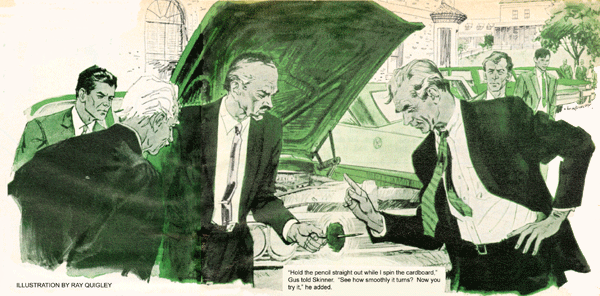
Gus led the group to Skinner's car and raised the hood as they gathered around it. He wiggled the fan to show how loose it was on the water-pump bearing.
Skinner pushed forward. "If that thing is so loose, why doesn't it vibrate all the time instead of when it downshifts?"
"I'll show you," Gus said. He tore a strip off a pad's cardboard backing to make it square, then pushed a pencil through its center. He put the pencil in Skinner's hand. "This is exhibit A for the defense," he told him. "Hold the pencil straight out while I spin the cardboard. See how smoothly it turns? Now you try it," he added.
"What's a spinning wheel got to do with this case?" Skinner demanded. "Besides, I don't see any vibration."
Gus pretended not to hear him. "Spin the cardboard again, Mr. Skinner, but this time turn to one side as it spins."
Skinner spun the cardboard, then did a left face as Gus had asked. The cardboard wobbled and vibrated as he turned. He spun it again and faced right. Again the cardboard wobbled on its axis.
"What's happening?" Skinner asked. "Each time I turn, it wobbles as though it doesn't want to turn with me."
"That's exactly what's happening in your car," Gus explained. "The fan is like a gyroscope and so is this cardboard. When the car moves straight ahead, tension of the fan belt keeps the shaft fairly stable in the worn water-pump bearing. But when you slow down to turn a corner, the transmission downshifts, making the engine run faster and increasing the gyroscopic force on the fan. Then, when the car is steered to the right or left, the fan resists the change of direction and sets up what are known as precession forces to counter the change. These forces cause the fan to wobble, setting up brief but noisy vibrations just as this cardboard did when you turned it to the left or right."
"That's why it didn't vibrate on the dynamometer," Morgan cut in. "The car was standing still."
"What about the leak?" Skinner asked.
"Coolant trickled through the worn bearing while the car was driven," Gus said. "The leak stopped when the engine was shut off, but a few drops dribbled along the bottom of the oil pan and dripped off at the lowest point, a good distance from the water pump. That's why no one suspected it."
Lacking his gavel, the judge pounded his fist on the fender of Skinner's car. "Case dismissed."
END