February 1968
GUS AND THE CASE
OF THE CAR THAT CHIRPED
by Martin Bunn
The Model Garageman
seeks the answer to an automotive puzzle
that's strictly for the birds.
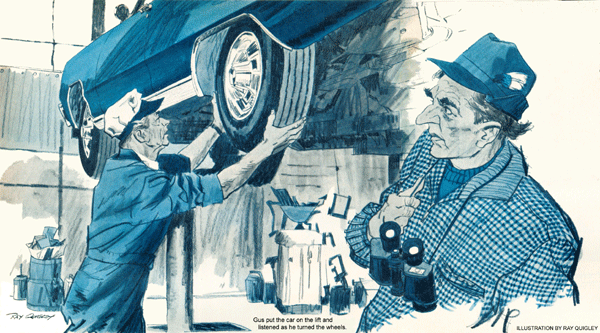
"Gus Wilson! How fortunate -- there was something I had to see you about."
Gus turned on the coffee-shop stool to face the small, bearded man, a member of the local high-school faculty.
"Morning, Mr. Lessing," he said. "Cutting a class for coffee?"
"I don't think so," returned the other, taking a notebook from his pocket and hastily leafing through it. "No, I'm free now. I want to pick up a book I ordered and -- yes, here it is -- to tell you about Paul."
"Paul?" asked Gus, sipping coffee.
"My brother," said Peter Lessing. "He's on one of his recording trips, and stopped to see me, as usual. There's some trouble with his car, so I sent him to you."
"I'm going back to the Model Garage soon as I finish here. What instrument does he play?"
"Instrument?" Lessing peered at Gus in amazement. "Oh, he's not a musician. My brother is an ornithologist, perhaps this country's foremost authority on bird songs."
"This car's difficulty is most serious. It is ruining his ears, which, of course are highly trained and sensitive." The little man looked sternly at Gus, his eyes owlish above a large, beaklike nose. "I am merely a teacher of biology. My brother is a maestro of nature's melodies."
"Well, I sure will help all I can," promised Gus. "Is there anything else on your mind?"
"Let me think," pondered Lessing. "It was something about my wife . . ."
"Maybe you better phone me," suggested Gus, swallowing his coffee. "What did you say's wrong with your brother's car?"
"It chirps!" said Lessing.
As Gus drove up to the Model Garage 10 minutes later, a Plymouth emerged from the shop and drove down the street. If Gus hadn't just left Lessing, he would have sworn it was he driving.
"Well, Stan," said Gus to his assistant on entering. "Did you get the bird out?"
Stan stared at him dumbfounded.
"A guy I've never seen comes in here 15 minutes ago, complains his car chirps like a bird, and when he drives out you come in as if you know all about it!"
"His brother told me. No sweat, huh?"
"The drive-shaft splines were dry," said Stan. "Soon as the grease I put in works through, the squeaks ought to stop."
An hour went by. Then a car horn demanded entrance. When Gus raised the door, the Plymouth drove in, announcing its progress by a series of chirpy squeaks.
Apparently the Lessing brothers were twins, though this one lacked the beard and wore a hunting hat and carried binoculars instead of the book bag Peter Lessing affected.
"It's unbearable," began Paul Lessing. "My ears are throbbing. I may never hear properly again. I believe I heard a house finch this morning, but before I could stop, a cardinal answered this car's abominable chirps and the finch vanished."
"Suppose you take a chair," suggested Gus. "I'll drive the car and listen."
"Thank you. It will be a relief."
Gus got into the Plymouth, the back of which was loaded with tape recorders, microphones, and other equipment. A slow squeak began before he was out of the shop, becoming a rapid chirp-chirp-chirp as the car gained speed. It seemed synchronized with wheel rather than drive-shaft rotation. Applying the brakes had little effect on it. Even without particularly sensitive ears, thought Gus, a few miles of driving to that sound could be maddening.
Back in the shop, Gus put the car on a body lift, the wheels hanging free. He turned them, listening for the click of a defective bearing, the drag of brake lining, or the squeak of out-of-round drums. None of these was evident.
"I should tell you," said Paul Lessing, "that one mechanic wanted to install new brake lining, and another a new drive shaft. But either would have delayed my trip. One man said the antisqueak spring on a brake drum was missing or broken, but on checking confessed himself mistaken."
Gus lowered the car enough to get into it, started the engine, and ran the wheels briefly under power. There was no noise.
"Fine! The chirp's gone," said Lessing.
"Not really," said Gus. "I raised the car to check some things that might show up that way. Others wouldn't. The wheels and suspension aren't loaded with the car on the hoist, nor is the body subject to road stress. That makes a difference."
Dropping the car to the floor, Gus drove it off the hoist a few feet. It chirped. Lessing covered his ears.
On the garage floor, Gus thought, there was hardly enough body movement to cause a door or hood squeak. But the weight of the car came into full play. Getting out, he looked at the wheels for a long minute, then proceeded to take off all four of the full wheel covers, unsnapping the serrated edges that gripped the wheels. Laying the covers aside, he drove the car out again.
Around the block he drove, chirplessly. Grinning widely, he reentered the shop.
"Cheer up, Mr. Lessing," he said. "From now on, the birds you hear will all be up in the trees."
Gus rubbed an oily rag around the wheel flanges against which the covers snapped, then put the covers back on.
"You are quite sure, Mr. Wilson?" asked Lessing. "I don't understand."
"When the car's weight is on them," explained Gus, "the wheels flex a bit each time they go around. This causes a little movement between them and the wheel covers where they touch. Both parts being dry, there's a slip-stick action that makes a squeak, which the drumlike metal parts amplify. The oil I put on should quiet the racket by letting the parts slide on each other."
"Wonderful," said Paul Lessing. "I shall seek out that house finch again."
"He's back," muttered Stan when Gus returned from a late lunch. "With a false beard and a different car."
Looking over his helper's shoulder, Gus saw it was Peter Lessing standing beside a 1965 Pontiac.
"Wrong, Stan. It's his brother," whispered Gus. He turned to the customer.
"What is your problem, Mr. Lessing?"
"My wife and I had a disagreement about this car," the little man answered. "Except for my yearly journey to my Biology Association meeting, we use it chiefly around town. But on two turnpike trips recently it began to shimmy distressingly. A friend suggested wheel alignment, so I asked my wife to bring the car here.
"An inveterate bargain hunter, she saw an advertised special and took it to one of those chain service shops instead. They pointed out what they said was a dangerous condition -- loose lower ball joints -- and said they would not be responsible for alignment or our safety unless those were first replaced, at a cost of $90. As this is what we had budgeted for the Association meeting, my wife says we must forego it to repair the car."
Gus shrugged. "There's a lot of confusion about loose ball joints. Some shops take advantage of it. My twin-post hoist is free, so let's find out."
Driving the Pontiac on it, Gus supported both the lower control arms just outboard of the coil-spring seats.
"This is the only time you'll see any looseness in lower ball joints," he told Lessing. "On the road, spring pressure and car weight holds the ball firm. Here's what they probably showed your wife."
He grasped the wheel at top and bottom and rocked it across its diameter.
"There's less than a quarter-inch of play, so it's within max radial tolerance. But we have to check something else."
Going to the tool bin, Gus brought back a dial indicator, plunger extension, and clamp. He set up the instrument on the steering arm, between the backing plate and tie-rod connection. The plunger extension bore against the underside of the control arm, near the center of the ball joint. With a heavy screwdriver under a backing-plate bolt, he pried straight up. The indicator needle swung around.
"There's 40 thousandths' play," he said. "When it gets to 50 on this car, it's time to replace the lower joints."
The other wheel gave a similar reading.
"Isn't it dangerous?" asked Lessing.
"The upper ball joints should be replaced if they show any looseness," said Gus. "But the lower ones are compression joints, safe within the specified clearance. Since 1963, a lot of lower ball joints were mistakenly condemned by state inspection stations and mechanics. Thousands of good ones were scrapped.
"Many returned under warranty checked out well within the safe clearance. On later models some car makers reduced that clearance -- Cadillac cut it to 20 thousandths -- to end such misunderstanding."
"I hope you're saying it won't cost $90," put in Peter Lessing.
"Not for new ball joints," said Gus with a grin. "Wheel bearings are okay, control arms tight. Springs don't seem soft. I'll balance and align the wheels. Your bill ought to be way below that."
That afternoon Gus shifted a cupped tire to the rear, then balanced and aligned the front wheels. Caster proved somewhat excessive. Gus set in the necessary shims to correct it.
In the road test, steering was smooth and self-straightening. No trace of shimmy appeared even at 75 m.p.h. Satisfied, Gus took the car back to the shop.
When Mrs. Lessing phoned, Gus was able to name a reasonable figure.
Just before closing time, Paul Lessing's Plymouth rolled in to the accompaniment of loud chirping.
"Can't win them all, Gus," remarked Stan.
The Plymouth came to a stop. The bird sounds did not. They continued as both Lessings got out, smiling. When the song ended, Paul Lessing reached inside the car and flipped a switch.
"A special rendition for you, Mr. Wilson," said the little ornithologist "In gratitude for enabling me to record the first song of the house finch in this area."
"And for saving me a considerable amount," put in Peter Lessing.
"You know, Boss," muttered Stan as he closed the shop door, "those splines were dry. But they weren't squeaking. How did you know it was the wheel covers making like the birds?"
"Guess I was one up on you," replied Gus innocently. "I got a merit badge for bird study when I was a Boy Scout."
END