August 1968
GUS GIVES AN
OLD CAR A LIFT
by Martin Bunn
(Ron Benrey)
Why would a car stall
when
the engine was perfect?
Maybe, Gus figured,
because
he engine had nothing to do with it.
"Been expecting you, George," called Stan Hicks, as a well-cared-for '58 Cadillac, its left-front fender crumpled, pulled up at the Model Garage.
A tall, sad-faced young man eased out of the driver's seat, nodded morosely to Stan, and then just stood there gazing at the damaged sheet metal.
"Don't worry," Stan said cheerfully. "My boss will prove you were in the right. Let's go talk to him."
Gus Wilson sat in the office, perched on his favorite swivel chair, relaxedly puffing his pipe.
"Gus," Stan began, "this sad-looking guy is George Fox. He's an old buddy of mine, and he's got a problem."
Gus smiled a welcome, then asked, "Aren't you the parking-lot attendant at Sam Eastman's restaurant?"
"Ex-attendant is probably more accurate," Fox answered glumly, "unless you can explain why that Caddy out there stalled all of a sudden last Sunday."
"Okay," Gus said. "Let's start at the beginning,"
"That Caddy belongs to Eastman, Mr. Wilson," said Fox. "It's his pride and joy, and he keeps it in great shape. Last Sunday afternoon, while I was putting it into his reserved parking space, the engine quit -- just like that -- and so did the power steering. I lost control for only a second, but that was enough to plow into a lamp post next to me."
Gus followed the young men outside, and made a quick examination of the car's battered front end.
"Does Sam Eastman blame you solely for the accident?" Gus asked.
"Yes and no," said Fox. "At first he believed my story that the car stalled. But then his mechanic checked it over. He got the report yesterday: The engine is in perfect mechanical condition. So now he thinks I lied about the stalling to cover up some kind of dumb driving.
Unless I can prove otherwise by five o'clock -- that's when I promised to return the car -- I'm out of a job. And I guess I'm out of school, too."
"School?"
"Uh-huh. I'm taking a computer-programming course at the State Technical Institute. That's why the parking lot job is important to me. I can go to school in the morning and work in the afternoon."
"Fair enough," said Gus. "Let's do a little detective work." Gus glanced at Stan. "I suppose we can assume that Sam's mechanic made a thorough check?"
"Yup," agreed Stan. "And just to make sure, I went over the engine myself. Ignition and fuel systems are okay. So's the carburetor. And the transmission seems right. The exhaust system has no blockages."
"Okay, Stan," said Gus. "The next step is a test drive, and on the way back, a return to the scene of the crime."
The big engine roared to life instantly, and quickly idled down to a silky-smooth purr. Gus piloted the Caddy onto Main Street for a bit of stop-and-go driving in town, followed by a short turnpike hop at high speed and a medium-speed tour through suburban streets. The engine performed flawlessly.
They were a half-mile away from Sam Eastman's restaurant when Gus pulled up. "You take over, George," he said. "Take a long route to the restaurant and make as many turns as you can."
Sam Eastman greeted them as George steered into the restaurant's driveway: "Afternoon, Wilson . . . George . . . have you uncovered something my mechanic missed?"
"Could be," answered Gus. "Where exactly did the accident take place?"
"Follow the driveway to the end and make a wide right turn," said Eastman.
"Want me to drive on up there?" asked George.
"Nope," said Gus. "Let's head back to the garage." He called out the window to Eastman: "Why don't you come with us? You might find it interesting."
"This some kind of hocus-pocus, Wilson? You know my car runs like a Swiss watch. Now, why doesn't George just back down from his silly story and admit he made a careless mistake. I might let him stay on the job."
George looked at Gus, and shook his head.
"Sam," Gus said, "I believe that this car did stall on Sunday."
"That's ridiculous!" said Eastman.
"No, it isn't ridiculous, but to prove it I'll need some gear that's back at the garage. Want to watch?"
Eastman grunted, but opened the rear door and slid onto the seat. "Wilson," he said, "my mechanic assures me that there is nothing wrong with the engine that could make the car stall the way George describes."
"Your mechanic is right," said Gus, "on that. The trouble isn't anywhere near the engine."
On the apron at the Model Garage, Gus left the Caddy's engine running, got out and headed for the workshop. He returned with two small hydraulic jacks and placed them under the car's front and rear bumpers to lift the right side.
"What's that for?" growled Eastman.
"To simulate the effect of a right turn on the car," answered Gus. "During our test drive I noticed that the engine missed slightly every time we took a right turn. It sounded just as if we were running out of gas. I suspect the trouble is in the fuel line -- but we'll soon see.
George, you start pumping the rear jack. Match your strokes with mine so the car lifts uniformly on the right side."
The heavy car body began to rise slowly, stretching the springs.
"What we're doing now," Gus went on, "is shifting the car's weight to the left side -- that's exactly what happens during a right turn, because of centrifugal force."
The Caddy's right side was tilted up about four inches when the engine began missing; then it coughed and died.
"Well, I'll be -- " said Eastman. "Why did it do that?"
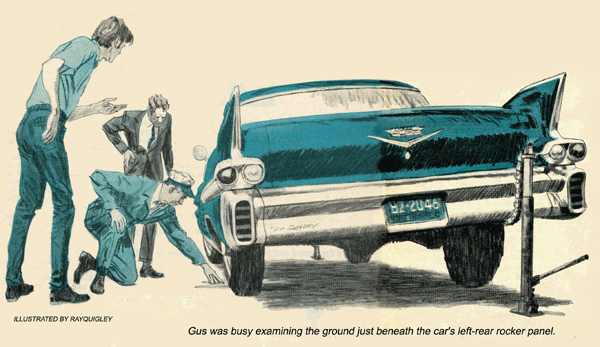
Gus was too busy examining the ground just beneath the car's left-rear rocker panel to answer. In a few moments he found what he was looking for a tiny puddle of gasoline being fed by a steady drip from under the car.
A loud series of horn toots startled Gus, as a small school bus wheeled past the gas pumps and screeched to a halt. The excited driver jumped out and flung open the hood.
"Drop everything, Gus," he shouted. "This is an emergency."
"Hold on, Al," Gus answered, "I'm right in the middle of . . . "
"No time -- no time," the driver interrupted, "I've got to pick up 10 kids at Hiawatha Day Camp in exactly 20 minutes."
Gus looked back at George Fox and Sam Eastman. Both nodded.
"It's gremlins!" the driver rattled on. "I step on the brakes -- the parking lights and tail lights come on with the brake lights. I flip on the left turn signals, they work for a second or two -- then they lock up, and my parking and tail lights come on, too! I'll show you." He slid into the seat and stepped on the brake pedal.
"Nothing seems wrong," said Gus. "Only your brake lights are lit up now."
"That can't . . . " the driver began, but he didn't finish. The tail lights and front parking lights had blinked on.
"Could be an intermittent short in the wiring," said Gus.
"A short circuit wouldn't account for the time delay, Mr. Wilson," said a voice behind Gus. It was George Fox. "I'd say it's some kind of switching action that connects the two circuits."
He turned toward the driver. "You say the turn signals are also involved?"
The bus driver flipped the lever to the left. The left signals flashed twice, then stayed lit at low brightness level as the taillights and parking lights came on dimly.
"You seem to know a lot about automobile wiring, George," Eastman remarked, winking at Gus.
"Not really. But computers are built of thousands of switch-type circuits, and I'm wondering if one of the simple design techniques I've been studying won't pinpoint the trouble."
"Point ahead," said Gus. "Need any test equipment?"
"Nope, just a pencil and paper," George answered. "I want to make a logic diagram describing the various circuit faults we've seen."
He drew a three-by-three-box square grid on a piece of paper. "The idea is simple. I'm going to make a table that compares the lighting effects we're getting with what we want to get. I'll write 'okay' if the correct lights come on; 'fault,' if there's error."
George studied the table, then turned to Gus. "The common denominator of the circuit trouble seems to be the left-rear signal lamp. Am I right in assuming that this one lamp serves the left stop light and left-rear turn signal?"
As Gus nodded, George continued.
"Then somehow the lamp must be making electrical contact with the parking-light/tail-light circuit."
"The dual-filament bulb!" Gus exclaimed. Quickly, he unscrewed the lens of the left-rear lamp.
"Hit the brakes again, Al," he called out.
Gus watched as the bright signal filament lighted normally. But then the hot filament sagged slightly and touched the medium-power tail-light filament. Instantly, the tail lights and parking lights came on.
"Here's your short circuit, Al," he said. "It's inside the bulb itself."
"What about the turn-signal problem?"
"When the left turn signal is on," Gus answered, "this sagging filament flashes normally until it heats up. When it short-circuits against the tail-light filament, the other lights come on, and the greatly increased current locks up the flasher, so everything stays on at reduced brightness. Cure -- a new bulb."
While Stan replaced the playful lamp on the bus, Gus led George and Eastman back to the jacked-up Cadillac. It took Gus only a moment to feel along the Caddy's gas line, on its left side, until he reached the source of the dripping gasoline -- a section of line directly under one of the clamps that held the line to the frame.
"Here it is," he said, "a tiny hole in the steel gas line. It's corroded."
"But why haven't I noticed any symptoms?" asked Eastman.
"Because," said Gus, "the hole is usually blocked by the clamp. When you make a right turn, though, the weight transfer distorts the frame slightly, and the clamp lifts away from the line.
This lets air into the line and breaks the fuel-pump suction. On a normal right turn, this causes a slight miss; it stops as soon as the clamp reseals the hold, when you straighten the car out.
"But," he continued, "on a wide right turn -- the kind George made when he parked the car -- the engine actually runs out of gas and stalls."
"I guess I owe you an apology, George," said Eastman.
George grinned. "How much do I owe you, Mr. Wilson?"
"Not a thing," said Gus. "I'll let Mr. Eastman pay for repairing the gas line. And as far as the diagnosis is concerned, your bit of sleuthing earlier should even us up."
"I get it," said George. "One good turn makes up for a bad one."
END