May 1933
by Martin Bunn
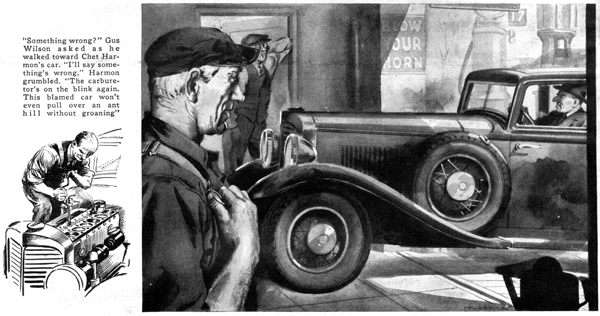
Chet Harmon coaxed his car into the Model Garage. Sputtering and coughing, it gave one last asthmatic wheeze as it reached the center of the repair shop.
"Something wrong, Chet?" Gus Wilson grinned.
"I'll say something's wrong," Harmon grumbled. "The carburetor's on the blink again. This blame car's getting worse and worse. Won't even pull over an ant hill now without groaning."
Gus lifted the motor hood. "Why pick on the carburetor?" he inquired after a brief inspection. "Maybe it's something else this time. Start her up and let's hear her."
After several vain attempts, the motor half-heartedly consented to run. When Gus jerked at the throttle rod, it sneezed violently and, with a final gasp died.
"Acts like a bad case of worn valves," Gus said half to himself. "No power and no compression."
"Worn valves, my eye!" snorted Harmon. "The valves are O. K. I just reground and adjusted them. Guess again, Gus."
"Well, seeing is believing," Gus chuckled good-naturedly, "so let's take off the head and have a look. Tell you what I'll do. If it isn't the valves, the job won't cost you a nickel. How's that?"
"Suits me," agreed Harmon. "But I still think it's the carburetor."
Gus opened the drain cock on the radiator and then proceeded to loosen the upper hose connection on the motor.
"Take a look for yourself," he bade, lifting out the motor head. "If those valves aren't burned and pitted, I've never been in a garage. They look more like hexagonal bolt heads than valves. How long ago did you grind them?"
"Not more than a month," Harmon replied. "I did a good job too."
Gus muffled a chuckle. "Maybe you did too good a job, Chet. Too much grinding is worse than none at all. Were they in bad shape when you started?"
"I'll say they were. All burned and pitted."
"When a valve gets that bad you might better throw it out," put in Gus, lifting one of the exhaust valves from place.
"You ground this one so long there's a ridge all the way around it. A valve in that condition won't last long. Another thing, never grind a valve to a feather edge. The thin metal on the outside won't stand up two hours in a modern high compression motor."
"I thought they made valves out of tough stuff," Harmon objected. "They shouldn't fall to pieces like that."
"Did you ever singe the back of your hand on the exhaust manifold?" Gus asked. "Well, it gets pretty hot. Around 1,400 degrees, even in cold weather. Being right in the cylinder, the valves get about two hundred degrees hotter than that. The heat alone wouldn't be so bad, but they've got to bob up and down thousands of times a minute into the bargain."
"But the intake valves aren't as badly burned as the exhaust valves," argued Chet.
"Of course they aren't," agreed Gus. "Why should they be? The hot gases burn the exhaust valves after every explosion. That's why some car manufacturers put a better grade of steel in the exhaust valves."
"Don't the valve seats burn and warp too?" Harmon asked.
"Sure, but not like the valve heads," Gus replied pointing to the open valve seat in the motor block, "A valve seat has a lot of metal around it and it's cooled some by the water jacket. The valves, though, haven't much surface to carry off the heat and they're only cooled by the stems and their contact with the valve seats when they close. That's why a valve that doesn't seat properly is bound to burn and warp."
"I never realized that valves took such a beating," confessed Chet. "No wonder they don't last long."
"They will last long," Gus corrected him, "if they're serviced now and then. Trouble is, most car owners don't think of the valves until something happens. If you grind your valves every time you scrape carbon, they'll be cooled off between explosions and won't burn so easily. That's why a weak valve spring is just as bad as a poorly ground valve -- the valve doesn't close tightly."
"I never thought about the valve springs," Chet admitted. "How do you know whether a spring is weak?"
"By the length," Gus told him. "If one spring is shorter than the rest, it'll be weaker then the rest. Of course, you can tell for sure by rigging up an ordinary weighing scale like an iceman uses so it'll measure the tension of the spring when it's compressed."
"Gosh, this valve business is kind of complicated," exclaimed Chet. "I thought valve grinding was one of the jobs any car owner could do."
"Valve grinding's easy," Gus assured him, "if you'll take enough time to do the job right. Remember though, too much grinding is worse than none at all."
"That's O.K. but how do you know when the job is finished?" Harmon inquired. "I ground those valves a lot just to be on the safe side.'
"Ever hear of Prussian blue?" Gus asked as he reached for a small can on the repair bench. "It's the stuff machinists use to test a fit. Smear a little on the valve face, press it down on the seat, and give it a twist. If the valve's a good fit, the blue will be smeared off in a circle around the face. And if you haven't Prussian blue, mark six or eight pencil lines across the valve face."
"I suppose the wider you can make the valve seat the better it is," Chet interrupted.
"Nope, you're wrong there. The best kind of a valve seat is a fine, narrow edge. It'll last longer than a wide one and won't offer so much surface to collect carbon particles that may keep the valve from closing.
"Speaking of carbon, there's one point the amateur mechanic always seems to forget when he is refinishing valves -- the valve stems. Be sure they're clean and free from crusted carbon before you put them back. A square of number zero or zero-zero emery cloth will polish them up in fine style."
"Say, Gus, " Harmon said, "Why don't automotive engineers figure out some way to make the valve mechanism on a car safe and sane? They ought to be able to beat the overheating and warping trouble."
"They have in a way," Gus replied. "Some of the new 1933 models have special steel ring inserts for the exhaust valve seats and they're using alloy steel valves that stand up better under the heat. There's one hitch, though. Some of the new alloy steel valves are so hard they're not affected to any great extent by ordinary valve grinding compounds, If they're in bad shape they have to be reconditioned on a regular grinder and then lapped with compound."
"Well," sighed Chet as Gus paused, "I guess I'm hooked. Fix my car up and phone me when it's ready."
"O. K., boy," nodded Gus. "Want me to do the job right and put in new valve springs?"
"Give it the works," Chet told him. "Put in anything that'll make it run again. Put in some valves and valve seats that'll never wear out, if you can."
Gus smiled. "That's an order I'm afraid no one can fill -- yet."
END

L. Osbone 2019