December 1933
QUICK STARTS ON COLD MORNINGS
by Martin Bunn
Outside the house wintry winds howled, but in spite of that, beads of perspiration stood on Dan Nolan's forehead as he reached for the telephone.
"Give me Center 650," he bellowed after jiggling the hook impatiently.
"Hello, Model Garage? That you, Gus? Well this is Nolan up on Pine Road. I can't get my car started. What's that? Yeah, I've tried everything. It must be frozen or something."
Less than twenty minutes later, Gus Wilson was standing in front of Nolan's small one-car garage.
"Blamed if I know what ails it," said Nolan as he opened the garage door and kicked a hand crank lying on the cement floor. "Can't even get a rise out of her with that. Wound her up till I was all in, without so much as a sputter."
Gus climbed into the car and leaned over the wheel. "Let's see what luck I have," he said as he pulled out the choke button and stepped on the starter.
The motor groaned but failed to start.
"Your luck's no better than mine," Nolan observed. "I tell you she's cold. Isn't there some way we can warm her up?"
Gus lifted the hood and poked at the motor with his stubby fingers.
"Let's give her another try by hand," the veteran mechanic said finally. "You pull out the choke button and hold down the clutch pedal while I man the crank."
"What's the idea of holding down the clutch," put in Nolan as he took his place in the driver's seat.
"Makes it easier cranking," Gus explained. "You don't have to push the neutral gears through the cold grease in the transmission."
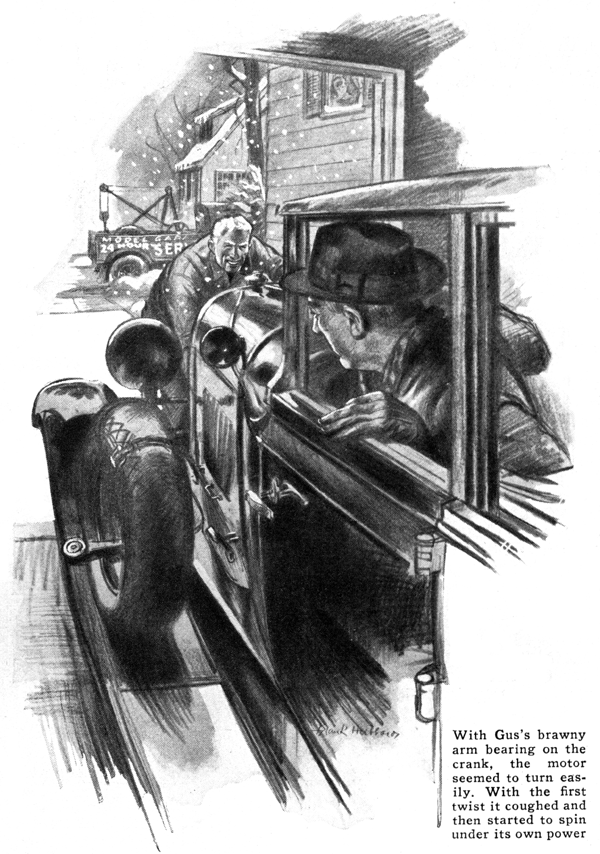
With Gus's brawny arm bearing on the crank the motor seemed to turn easily. With almost the first twist, the engine coughed and sneezed and final spun under its own power.
"Well I'll be hanged," gasped Nolan.
"What did you do, hypnotize it?"
Gus chuckled as he ambled around to the side of the motor.
"Come out here a minute," he said, smiling, "and I'll show you something. The main thing that was ailing this motor was a loose set screw."
"A loose set screw?" Nolan repeated.
"Sure. Do you see that connection where the choke wire fastens to that arm on the carburetor? When I opened the hood, the setscrew was gone and the wire was hanging loose. Naturally the choke didn't work. All I had to do was pick the set screw out of the pan and put it back into place."
"But the cold weather had something to do with it, didn't it?"
"Oh, it probably made the motor a little stiff," agreed Gus. "But cold or no cold, that car would have started if the choke had been working."
"Gosh, simple as that, eh?" Nolan sighed. "In the winter I'm always looking for trouble. I wish I could put some sort of a gadget on the car that would make it start easier on cold mornings."
"If that's all that's bothering you, there are plenty of trick attachments," said Gus. "The latest one I've seen is a midget electric beater that fits right in the cooling system. It looks like one of those aquarium heaters. All you have to do its plug the connection cord that comes with it into the garage lighting circuit.
"But extra appliances and knowing how to start a cold motor aren't the only things that make winter driving easier. It's little troubles like that loose choke rod that cause the headaches. If a car's conditioned for cold weather, you'll -- "
"Yeah, I know," put in Nolan with a grin. "You're going to tell me I ought to dope my radiator with anti-freeze."
"That just keeps your motor from freezing," said Gus, "but it won't make cold-weather starting any easier. Fuel, spark, and oil are the important things is getting a motor started.
"In the first place, don't fool around with a cheap grades of gas. You may be able to get away with it in hot weather but they'll cause plenty of trouble in the winter.
"It's the same way with spark plugs. Treat yourself to a new set every winter. A weak spark never started a cold motor. You ought to change them every ten thousand miles anyway. For the average driver that means at least twice a year winter and summer.
"Give your ignition wires the once over. Run your motor in the dark and watch for those dancing blue sparks that mean leaks and wasted power. From the looks of yours, I'd say you need a whole new set.
"Then, there's the oil. When it's cold, heavy summer oil gets like so much molasses. Change to a thinner oil and you won't put such a heavy load on your starter and battery and the moving parts will get better lubrication."
"Speaking of batteries, Gus," interrupted Nolan, "mine is always going dead in the winter, I can't seem to keep it up to charge, and we don't use the car much."
"That's the answer," Gus explained. "Besides, you probably do all your driving at night. With parking and everything your generator doesn't get a chance to charge the battery."
"Can't I get around that some way," Nolan asked. "I can't be trotting my battery to a service station every week."
"You wouldn't have to if you did some daylight driving," replied Gus. "But increasing the charging rate of your generator will help some."
"How do you do that?" Nolan asked.
"I'll do it for you," offered Gus. "Then you'll know how it's done. But first of all, we've got to make sure your battery isn't too badly discharged. You get your hydrometer and test the battery readings while I run out to the service car and pick up a screwdriver and a pair of pliers."
"Battery seems O. K." Nolan reported when Gus returned. "Reads almost full charge."
Gus bent over the forward part of the motor and lifted a metal cover from the rear end of the generator. The commutator and its brushes were in plain view.
Indicating one of the brushes, Gus said, "This one is called the third brush and regulates the generator. To change the amount of current the generator pushes into the battery all we've got to do is move it along the commutator one way or the other. By the way, what's the highest charge reading you get on your dash ammeter?"
"Oh, about eighteen amps," Nolan replied.
"For winter driving in this car, it ought to be about twenty, so we'll increase it two amps."
Gus loosened the adjusting screw on the side of the generator housing and pushed the brush toward the motor block. "Moving it this way, increases the charging rate," he explained. "Moving it the other way decreases it.
"That ought to do it," he added as he fitted the cover back in place. "Now let's take her out for a test run and see how near I came to hitting it on the nose."
Nolan grinned with satisfaction as the motor started with the first effort.
As they gained speed, Gus watched first the ammeter and then the speedometer. When the dial showed twenty-five miles an hour, he nudged Nolan and pointed at the ammeter. "Just about twenty amps," he said, "That'll help your battery some but don't forget to change it back to normal when spring comes around."
"By the way, Gus," Nolan said as the car coasted to a stop in the driveway, "you haven't tipped me off on any tricks I can use when the motor won't start."
"Hot water poured over the intake manifold will generally make even the coldest car perk," Gus replied. "And if that doesn't work, you can always pour a little ether into the air intake of the carburetor.
"But the important things are good gas, a hot spark, winter oil, and a fully charged batter. And incidentally," he added with a wink, "if you'd fit that garage of yours with insulating board, you'd find the old bus wouldn't get so cold."
END
L. Osbone 2019