June 1933
by Martin Bunn
Gus Wilson was spending his holiday battling the weeds that threatened his garden. Paul Mathews, next door neighbor, paused on the way to his garage and waved a greeting.
"I've got to get the oil changed in my car," he announced. "I think I'll try a place out on the Pike where they sell it for half the regular price."
"What oil is it?" Gus inquired, jerking at a particularly stubborn weed.
"Search me. Some new brand, I think, and it looks good. I know a fellow who's been using it for several months and he swears by it."
"That's possible," the grizzled auto mechanic agreed with a smile. "It takes a while for the effects of bad oil to show. Say, if you can wait till I change my clothes, I'll run out with you and take a look at this bargain stuff."
An hour later the two men pulled up at a small roadside gas station. A grease-smeared individual shuffled toward the car in which they sat.
"I want the oil changed and I thought I'd try some of that special low-priced stuff," Mathews told him.
"Sorry, boss, but we don't change oil," said the man. "Can't afford to at the price. You can buy it here and change it yourself."
"What kind of oil is it?" asked Gus.
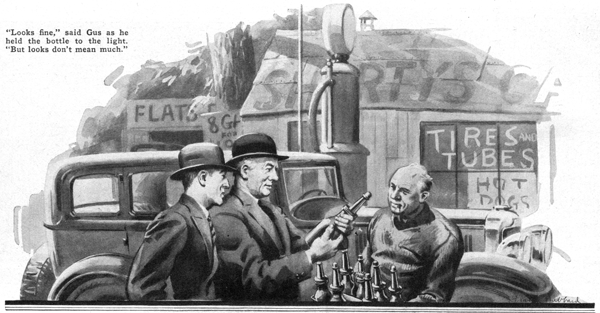
"Special brand, mister. Got an agreement with the producers so's I can sell it cheap. Good oil too," he said, lifting a bottle from a low stand beside a gas pump. "Look at that color."
"Looks fine," grinned Gus, taking the bottle and holding it to the light, "only looks don't mean much with oil."
"Who says so?" demanded the man. "Any time you see oil flow like this, you can bet it's good. It's got good body, see? Stick your finger in and feel of it," he invited, unscrewing the cap, "I've got it in all the regular grades, too, from the lightest to the heaviest."
"You can feel an oil till you wear out your fingers," insisted Gus, "and not find out a thing about its quality. The expert isn't born yet who can tell the quality of an oil by looks or feel."
"Say, are you telling me?" the man growled."I've been selling oil for years and I guess I know what I'm talking about."
"I can see that," Gus replied good-naturedly. "Well, we've got to make another stop. We'll pick up the oil on our way back."
Somewhat bewildered, Mathews stepped on the starter. "What's the idea?" he demanded as the car gained speed. "We haven't any other stops to make."
"Yes, we have," corrected Gus. "I've got to stop off at the Model Garage and you're coming, too, and learn something."
"But what about my oil?"
"Listen, Paul," said Gus seriously, "that oil's no good. If it was, don't you suppose all the other gas stations would be selling it?"
"How do you know it isn't any good?" asked Mathews sharply. "You said yourself you can't tell anything about an oil by looking at it."
"No, but you can tell a lot by looking at the guy who sells it. You can't get good oil at that price. It takes a high grade oil to stand the guff in a motor. No cheap mixture will do the trick."
"But he's got it in all the different grades of thickness just like any other oil," Mathews argued.
"Sure, but that doesn't mean anything, either. The thickness or viscosity of an oil is only an indication of its body at a certain temperature. The thickness of motor oils is graded by numbers -- from ten for the lightest to seventy for the heaviest. But those ratings have nothing to do with quality. The numbers are just like shirt sizes. All they tell you in whether you have a fit. Quality is something else again."
"Well, I don't see why they can't produce an oil that will last longer," said Mathews. "Changing it so often -- "
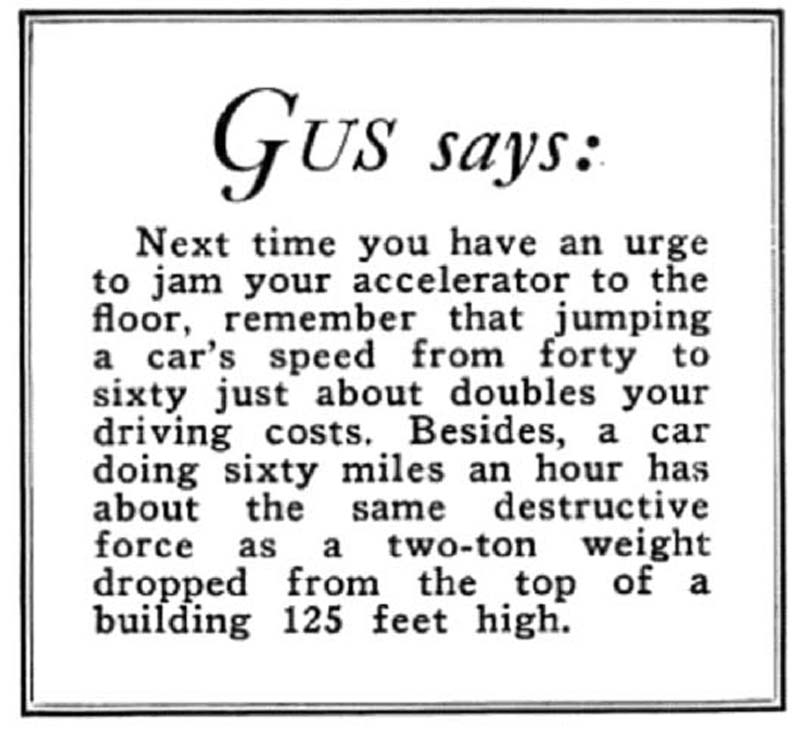
"Is a darned nuisance, I admit," Gus finished for him. "But that's a job I'm afraid you can't dodge. No matter how perfect the oil, it's bound to be thinned after a while by the unburned gasoline, water vapor, and road dust in a motor. And you can't lubricate a high-grade piece of machinery with that sort of muck. Some of the oil just disappears too. Right now, for example, you're driving this car at thirty miles an hour. If you should step it up to sixty, you'd use just about seven times more oil than you're using now. That's one of the things that makes speeding expensive."
By this time they had reached the driveway to the Model Garage. Waving a greeting to the odd-job boy who was taking care of the gas and oil trade over the holiday, Gus opened the door of the car.
"Come on in with me, Paul. It'll only take a second and I think I can show you something interesting," he said.
When they were inside, the gray-haired mechanic pointed casually to a small roadster partially dismantled in the center of the floor.
"What's that, a wreck?" Mathews asked.
"It's a wreck all right, but not the kind you're thinking of," Gus said. "That's a sample of what bad oil will do to a motor," he added, poking the cylinder head. "Carbon's crusted a quarter inch thick on the head and pistons. The rings are black and the valves are chewed and pitted. Besides that, the bearings are worn and the cylinder walls are scorched. And take a look at the crankcase; it's chuck full of gum and goo.
"The baby that owns that car saved plenty using cheap oil but it's going to cost him about eight times what he saved to get the buggy back in shape. Pretty expensive oil in the long run, I'd say."
"Gosh, this oil business has got me." Mathews exclaimed. "You've got to have oil and it's got to be good. Yet, you can't tell whether an oil is good or not until you've tried it -- and then it's too late. What the dickens can a dumb-bell like me do?"
Gus grinned."That's easy," he replied. "Just buy a recognized brand of oil of the right rating for your car from a dealer you know won't cheat you. You can't save yourself any money by buying cheap oil, but you can do it by being careful. For instance, don't use the choke more than necessary. Don't idle the engine or run it at top speed for long stretches. Don't flush out your crankcase with kerosene and never run your car unless it's in the pink of condition. Of course, you want to use the oil that has the right viscosity for your motor in summer and winter."
"Gus, one thing has been bothering me every since I bought my first car." Mathews confessed. "What earthly good is that oil pressure gage on the dashboard?"
"I guess most car owners think it's just part of the decorations," Gus joked. "But if you know how to use it, you can tell a lot about your oil system. If the gage reads high, your oil may be too heavy or the oil line may be clogged. If the pressure shows low, the oil is probably too thin, unless there's a leak or the line's clogged. A fluttering gage needle is a warning that the oil is low."
Glancing slyly at Mathews who stood studying the gage, Gus said, "I guess I've beefed enough. It's about time we were going back along the Pike to pick up your oil."
"Not my oil," Mathews declared solemnly. "I use only good oil in my car."
END
L. Osbone 2019