December 1944
GUS LICKS
A COLD-WEATHER PUZZLER
by Martin Bunn
The red thread of mercury in the thermometer outside the Model Garage was pressing 20, and passing citizens were hurrying along with heads bowed to the icy blast of a north wind, their overcoat collars turned up around their ears.
Joe Clark, gazing out of the window of the snug office, grinned widely. "Cold morning," he remarked. "Bet a lot of people are walking who didn't expect to."
Gus Wilson looked up from some time and material slips he was working on. "Stop gloating over the discomforts and misfortunes of your fellow man," he said.
"I'm not gloating," Joe replied. "But I could be. The first real cold morning always brings a lot of business, and -- " A peremptory ring of the phone cut him short.
"There you go," Joe commented and picked up the receiver. "Model Garage," he said, and then, with a wry face, he listened for maybe three minutes. "Yes," he finally put in. "All right . . . Of course . . . As soon as we possibly can. Good-by."
"That was Mrs. Miller," he told Gus.
"Talked so fast I couldn't get a word in. She says -- "
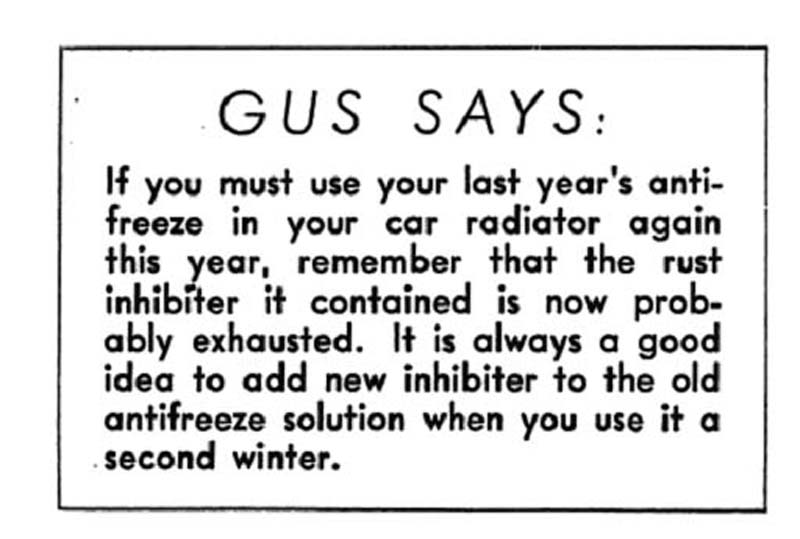
Gus laughed. "You don't have to tell me what she says -- I know. She says her radiator's frozen. I knew that without her calling. I've been keeping her last year's antifreeze for her. Three weeks ago I told her she'd better let me put it in, but she was in a hurry. When it began to get cold yesterday, I phoned her, and she said she'd come right over. But she didn't. I'll send Stan over to thaw her bus out."
Gus grunted and went into the shop. For a couple of minutes he heard a rumble of voices in the office, and then Dr. Nicholson came out into the shop. He's the new principal of our high school -- he took Professor Hiram Scruggs's job a year or so ago when that old crab retired and moved away. Doc's a stout, red-faced, hearty man, as jolly and popular as Scruggs was cross and disliked.
"Morning, Gus," he called out in his usual breezy style. "In me you see a man who is disillusioned, perplexed, and in dire need of a friendly helping hand."
Gus grinned, "Meaning that you couldn't get your car started?" he asked.
"Meaning just that," Nicholson confided.
"And what a blow it was. When I saw what sort of day we were having, I said to Mrs. Nicholson: This is a morning when one really appreciates having a car -- even if one does have to pick up three talkative schoolmarms on the way.
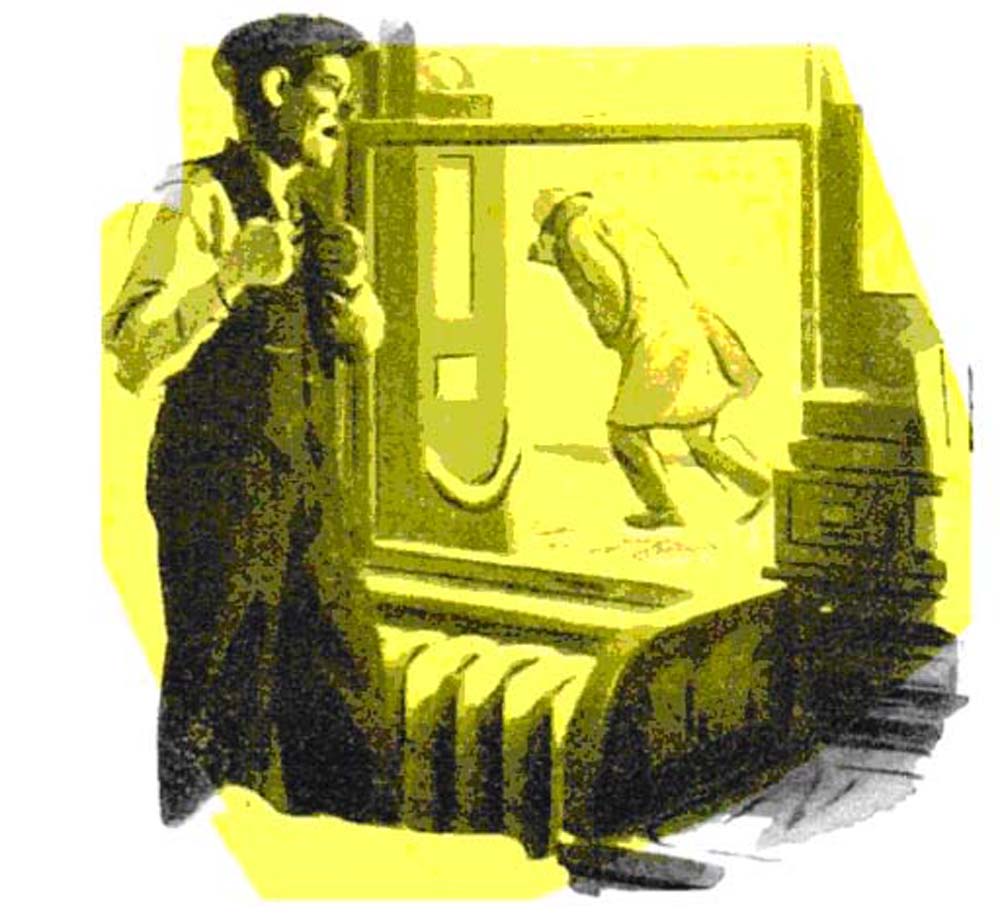
"Full of confidence engendered by the fact that a month ago you had serviced my car for cold-weather driving, I got into it and stepped on the starter. Nothing happened -- no, I'm wrong; there was a sputter somewhere under the hood, but further steppings on the starter weren't rewarded by another. So I walked seven arctic blocks to the bus line, and came downtown that way. I didn't think to phone my car-sharing schoolmarms, and what they will have to say is something I'd rather not think about.
And now what should I do?"
"Why, Doc," Gus said, "the wise thing for you to do would be to go on about your business and let us do the worrying. There probably isn't anything much wrong -- just one of those cold-morning puzzlers that usually turn out to be pretty simple. We'll tow it over here and have it fixed up and waiting for you at the school by the time you're ready to start home."
When Stan Hicks, the Model Garage grease monkey, towed Nicholson's past-middle-age sedan up to the curb, the shop floor was crowded, so Gus went outside. He got in and pressed his foot on the starter. The starting motor turned promptly, but it didn't start the engine. Gus waited 10 seconds and then tried again -- with the same result.
"Move a car out of the shop, and get this one in," he told Stan. "Try a motor heater on it, and see if you can get the engine going. If not, push it in with the wrecker."
Five minutes later he felt a blast of cold air, and looked around from his workbench to see Stan driving Nicholson's car into the shop. The grease monkey got out, shut the shop door, and came over to report: "She started easy after I'd warmed her up."
"All right," Gus said. "Now check the battery."
"Battery's O.K. boss," Stan called after he'd been over it.
Gus walked over to the car. "Then we've got to keep looking. Something keeps the engine from starting up when it's cold. If the battery's all right, it must he something else."
"Ignition, boss?" Stan queried.
"It could be," Gus replied. He took a low-reading voltmeter and checked the primary ignition circuit. There was no voltage drop between the starting motor and the battery connection on the coil or between the primary connection on the distributor and the engine block.
Gus put away the voltmeter and went over the high-tension circuit. He examined the spark coil, distributor cap, and rotor; they all seemed to be in excellent condition.
The wiring looked good, and there was no bad connection. Gus then checked the fuel line and found nothing wrong.
"It must be the compression after all," he told Stan. He knew from the last time he'd seen Doc's bus that it had a case of low compression, but he hadn't thought it would be bad enough to cause hard starting. "Well, I was fool enough to promise Doc we'd have his car ready when school let out, so we'll have to get it fixed. Warm the engine up with the motor heater, and if you can get it going, let it run for a few minutes. Then take the spark plugs out."
When Gus came back from another job, Stan was removing the last plug. Gus got his compression tester out of the glass-fronted cabinet in which he keeps his precision instruments. Pressing the rubber adapter into a spark-plug hole, he watched the indicator hand while Stan stepped on the starter. The cylinders tested unevenly, and all showed rather poor compression. Gus squirted oil around the piston rings and repeated the test. There was no improvement.
"What's the oil for, boss?" Stan asked.
"It seals the piston rings," Gus told him. "If you get a low reading on the first compression test and a higher reading after you've put oil in the cylinders, it shows that the compression is leaking past the piston rings; if both readings are low, it indicates leaky valves. I got a barely fair reading both times on each cylinder; that shows there is some valve leak -- apparently enough to allow enough compression to escape to cause hard cold-weather starting.
"I knew that the compression in Doc's car wasn't as high as it should be, but I didn't think it was low enough to cause any trouble. But we haven't been able to find any other cause for his grief, so I guess I was wrong. I'll have to go by the book and reface the valves."
Gus is one of those top-flight mechanics who get their jobs finished quickly without seeming to hurry. In an astonishingly short time he had the valves refaced and reseated and was shouting for his helper.
"Get into the car and step on the starter when I tell you to," he directed, and poured a little gasoline into the carburetor. "Now!" The engine started promptly.
"That's the job," Gus said. "Let the engine run long enough for it to get thoroughly warm. Then park this bus outside, and bring that Pearson car in and give me a hand with it."
About 3:30 Gus told Stan he'd better run the Nicholson car over to the school. Stan went out, but three minutes later he was back. "Hey, Mr. Wilson," he said, "she won't start!"
"What!" Gus yelled. He went out raised the hood, and told Stan to try again. Stan did. The starting motor cranked the engine, but the engine wouldn't take hold. "Wait minute," Gus said. He took off the air cleaner and held his hand over the carburetor air intake. "Now step on her!" The engine started at once.
Gus's head went under the hood. When it came into sight again his face was red.
"Stan," he asked, "what's the most useful tool in a mechanic's kit? . . . "Never mind. -- I'll tell you. His eyes. Don't ever forget that, kid. If I'd used mine, I'd have saved a lot of time on this job."
"What would you have seen, boss?" Stan wanted to know.
"Come here," Gus said. He indicated the automatic-choke control rod. "Notice anything unusual about it?" he asked.
Stan studied the rod; then he scratched his head. "It looks like it's bent," he said.
"It is bent," Gus told him. "I'll just straighten it and adjust the choke setting, and then I'll take this cold-morning puzzler over to Doc myself. My lunch is past due; I'll get it on the way back."
Doc Nicholson was waiting with the three schoolmarms when Gus Wilson reached the school.
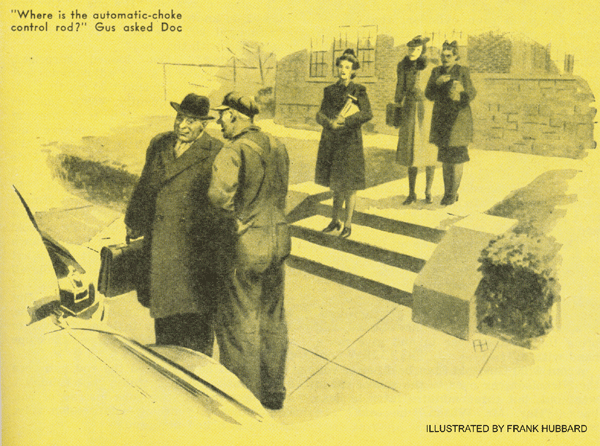
"Do you know where the automatic-choke control rod is?" Gus asked.
Nicholson chuckled. "It's one of the few things I do know.
"I thought so," Gus said. "Have you been monkeying with that rod?"
"Monkeying?" Doc looked surprised.
"Well, I did make a slight adjustment several months ago. A friend told me that automatic chokes frequently waste gasoline by excessive choking, and that bending the link rod slightly would conserve fuel by keeping the choke from closing all the way. I followed his suggestion. Did I do wrong?"
Gus laughed. "You did!" he said. "In warm weather the change of adjustment didn't cause any trouble -- but when it got down below freezing, the quantity of cold air drawn into the carburetor leaned down the mixture too much for starting. What fooled me was that the engine took hold all right after I'd done a valve job on it. That was because it was warm in the shop. But when I'd finished, I parked the car outside, and when I got ready to bring it over to you, the partly open choke caused the same trouble all over again.
"I should have noticed the rod had been bent," Gus went on ruefully, "but I didn't -- and I got myself two jobs instead of one. Well, anyway, your low-compression valve trouble is licked now, too."
END
L. Osbone 2019