September 1944
GUS REFEREES AN ELECTION FIGHT
by Martin Bunn
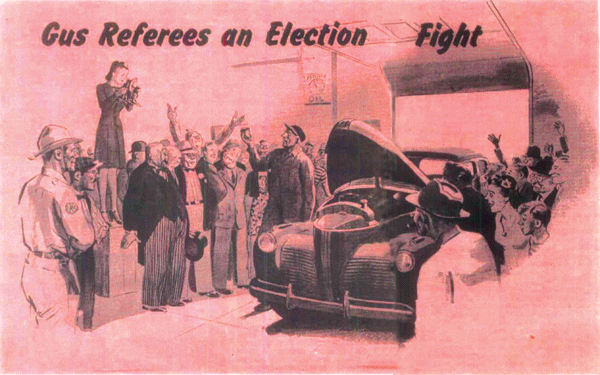
When the businessmen of our town got behind George Knowles for mayor, the crowd at the Model Garage turned into red-hot politicians.
George had been one of the first customers when Gus Wilson and Joe Clark opened their shop and, although he's grown into a big shot since then, he's never fallen out of the habit of dropping in a couple or times a week and sitting around with the boys.
George ran on an honest-government platform, and mighty few people in town had any doubt about our needing a lot more honesty in government than we'd been getting. Mayor Rufus P. Betcher, who seemed to have a mortgage on the office is a politician of the old school. He's a fat man with a pink-and-white complexion, and he wears the last cutaway coat left in circulation in our neck of the woods. Whenever he makes a speech, he starts off the same way. "My dear-r fr-riends," he says, "the gr-reat and glo-rious party I serve, however humbly -- " Then, seemingly overcome by emotion, he breaks off, pulls a big white handkerchief out of the side pocket of his cutaway, gives it a flip in the air, and blows his nose. After that, he opens up and really puts out the old hokum.
It didn't take George Knowles long to heat up the campaign. He carried the fight to Belcher by attacking the way in which he had handed out contracts to henchmen, and -- being an accountant by profession -- he talked figures that the Honorable Rufus wasn't able to explain away.
Syd Carpender, editor or our local daily, was in the fight on Knowles' side, and the week before election he had a bright idea. He arranged a big meeting for Saturday evening, and invited the candidates to debate the issues. George was only too glad to accept -- he'd dug up some new evidence on Belcher's financial juggling. The Honorable Rufus, who knew what he had uncovered and didn't have any plausible answer, tried to side-step, but the Sentinel went after him so hard he had to accept.
It was a real old-fashioned political rally -- prominent citizens trying to look at ease on the bunting-draped platform, the town band playing its head off, and all the other trimmings. Our Model Garage gang went in a body. Old Judge Keegan, the chairman of the meeting, was in his place and George in his, but Belcher's seat was empty as time for the debate arrived. There was a long wait, which the band filled in by playing its loudest. We killed the time watching a pretty redhead taking flash pictures or the local celebrities. None of us recognized her until Stan Hicks, the Model Garage grease monkey, said she was Mary Manning, who'd been his steady date in high school and whom Carpender had hired as photographer-reporter on the Sentinel.
When Judge Keegan couldn't stall any longer, he introduced George and told him to go ahead with his speech.
That wasn't so good for George. He'd written out a speech and had worked in a lot of embarrassing questions. Now he had to fling them at Belcher's empty chair, and after awhile it got to be so much like watching a fellow shadowbox that people had to laugh. But George said what he had to say -- which was plenty.
A boy handed Judge Keegan a note. When George finished, the judge got up and announced he'd received a telephone message from Mayor Belcher saying that he was returning from a trip and that he wasn't able to get back. There was nothing to do but close the meeting. The Belcher people went home grinning.
Then when the Sentinel hit the street on Monday, we got a big surprise. George's charges were on the front page as we had expected, but so was Belcher's countercharge that his car had been tampered with to keep him from answering.
He demanded a full investigation and offered to submit his car for examination to an expert. Carpender named Gus, and the examination was set for four o'clock that afternoon.
By a quarter to four there were at least 100 people milling around in the Model Garage driveway and overflowing into the shop. All our gang was there, and so were a lot of Belcher people. Mary Manning, the Sentinel's redhead, had a camera slung around her neck and a wad of copy paper in her hand, and she was busy on her story for the extra Carpender was going to publish as soon as the examination was finished.
On the dot of four, two cars came slowly up the driveway, one towing the other.
Mayor Belcher got out of the towed car and addressed Gus in a voice intended for the crowd. While hurrying back to town Saturday evening, he said, he stopped at a roadside restaurant for a hasty bite. When he returned to his car he noticed a man hurrying away from it, but thought nothing of the incident and started up for the meeting.
After he had gone perhaps 100 yards, the engine began to buck, and the next moment it went dead. He tried to start several times -- the car would run a short distance and then stop. Very unwillingly he was forced to the conclusion that the failure of his car to -- er -- function properly had resulted from the machinations of unscrupulous political enemies determined to deny him the opportunity or replying to the scurrilous charges they knew were to be made against him at the meeting. He had his car towed home, and since then he had neither driven nor touched it. Now -- with a sweeping gesture -- he turned it over to Mr. Gus Wilson for what he hoped would be a fair and impartial examination.
Everyone crowded around as Gus got into Belcher's car and stepped on the starter.
Nothing happened. Gus pulled out the choke and tried again. This time the engine popped and started, ran a few seconds sputtered, and stopped. Gus started it again and drove into the shop. The crowd followed.
Aided by Stan Hicks, Gus went to work. The ignition system tested O.K., the fuel line was clear, and the carburetor seemed all right. Gus scratched his ear, and then started to re-examine the fuel pump. He slipped off its filter bowl, looked at it, and held it up for everyone to see.
"The reason the Mayor's car won't run properly," he announced, "is that the gasket is missing from the fuel-pump filter bowl. Without the proper seating for the filter bowl provided by the gasket, air sucked into the fuel line kills the engine. It can be restarted by using the choke as the increased suction draws some gas, but it soon dies again. The gasket was, of course, removed by someone. Who that was, or when or why he removed it, I have no way of knowing."
That started a dogfight, with accusations flying back and forth like brickbats. Mary whispered to Stan, and they went out. When they came back 15 minutes later, the row was beginning to die down. Mary stepped up beside the Mayor and urged him to say something.
One of his henchmen brought over a chair, and Belcher climbed up on it. Mary backed away, got her camera focused on him and her flashlight apparatus ready for action.
"My dear-r fr-riends," Belcher sounded off, "the gr-reat and glo-rious party I serve, however humbly -- "Then he broke off as usual hauled his handkerchief out of his pocket, gave it a flip -- and flipped a filter-bowl gasket right into the crowd!
While it was still in the air, a flash bulb flared and Mary's camera clicked. The instant the gasket hit the floor, Syd Carpender pounced on it and yelled; "Here it is, folks -- the missing gasket that kept His Honor from attending the meeting. He had it in his pocket all the time!"
The Sentinel's extra was on the street late in the afternoon, and on the front page was a big picture of Mayor Belcher flipping that gasket out of his handkerchief. Voters went to the polls next day with the paper sticking out of their pockets and grins on their faces.
Knowles' headquarters were in the Park House, and in the evening we all went there to hear the returns. There was no doubt about the results -- George won by a mile.
"It'll be great for the town," Gus Wilson said. "But there's one thing I can't understand -- why Belcher was fool enough to carry that gasket around in his pocket!"
Mary had stopped at our table while she waited to get a picture of George Knowles.
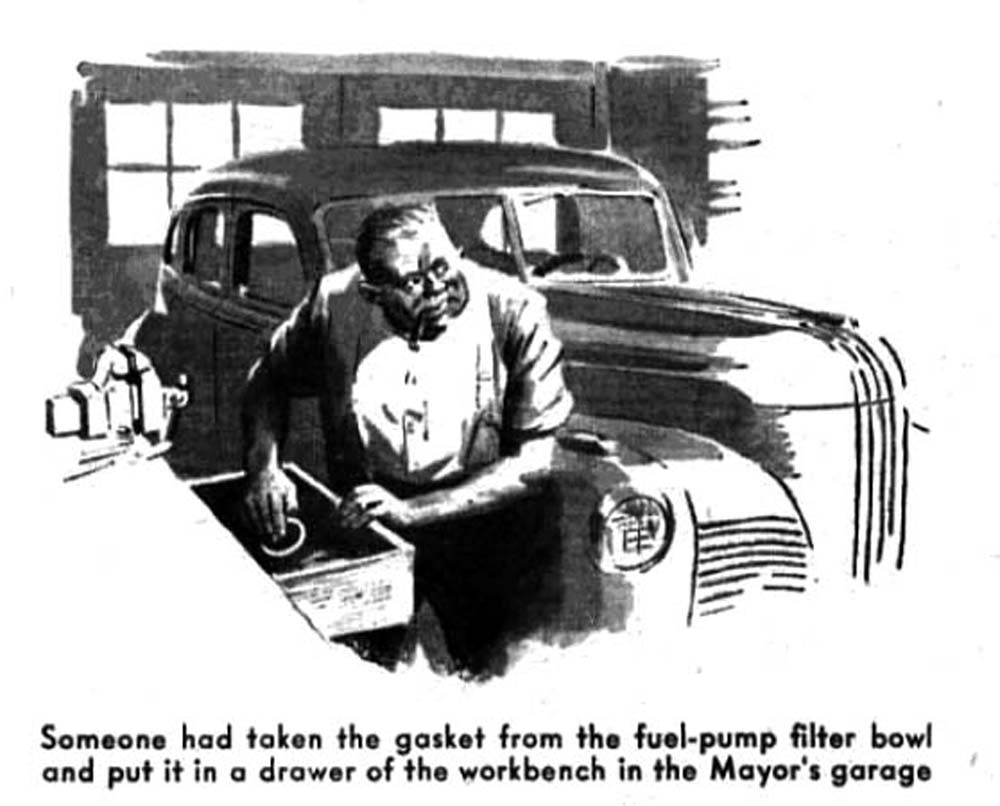
She smiled. "Stan and I had little to do with that," she said. "When you found what was missing from our ex-Mayor's car, Stan and I went to his garage. He found the gasket in a workbench drawer, and I took it -- and slipped it into Mr. Belcher's pocket when I asked him to make a speech."
END
L. Osbone 2019