June 1944
GUS ARGUES A CASE IN COURT
by Martin Bunn
He Balks a Jail Term with His Own Brand of Detecting.
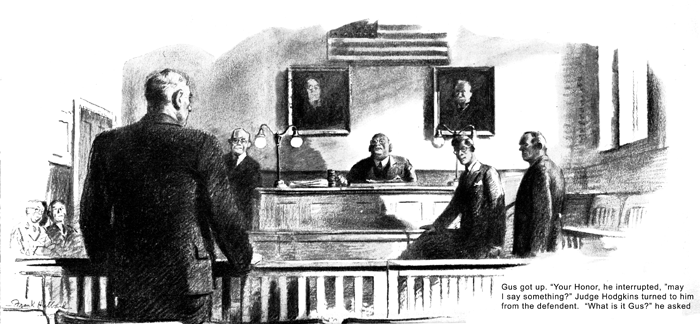
Judge Hodgkins cut off a taxi driver's excuses with a thump of his gavel. "A red light means stop, five dollars. Next case," he called and looked about his courtroom. Then his judicial firmness gave way to a bright smile.
"Hello, there, Gus Wilson," he said loudly. "Come up here and shake hands." Gus, a witness in a minor accident case, crossed the railed enclosure in front of the high bench and grasped the pudgy hand the judge reached down.
"You haven't showed up for our little Saturday night pastime at the Park House for a dog's age," Sam Hodgkins told him accusingly.
"Too busy for poker these days, Judge," Gus replied.
"No excuse in this court," Judge Hodgkins rambled with a wink. "Well, make yourself comfortable."
Gus sat down. The 200-pound judge drained a glass of water, refilled it, and banged his gavel again, "Next case!"
"Leonard Marshall. Charged with driving with undimmed lights . . . ." The clerk droned. Policeman, Jim Devine stepped forward with a tall, bespectacled young man by him.
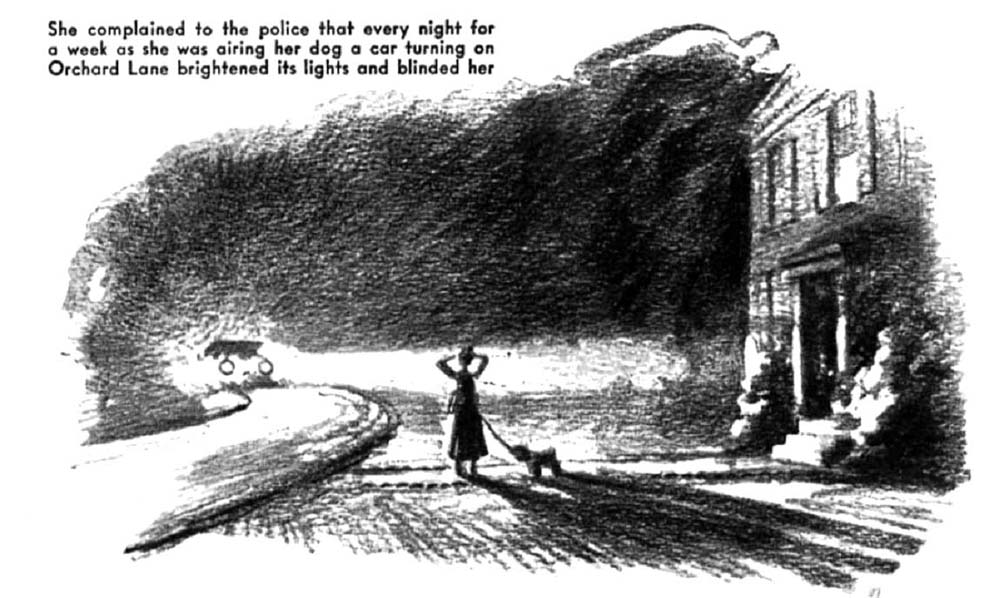
"Your Honor," he said, "a complaint from old Miss Carver on Orchard Lane, just before nine o'clock every night for the last week, while she was airin' her dog, a driver blinded her by suddenly putting on his bright lights. Last night I proceeded to Orchard Lane. At 8:49 a car approached with its headlights dimmed, flashed up its headlights on reaching a turn in the road 50 yards from Miss Carver's property. It was driven by this Leonard Marshall."
"Well," the judge growled at the accused, "what have you to say," guilty or not guilty?"
Marshall's pale face flushed, "I don't know what to say, Your Honor. When this officer stopped me my headlights were on full, but they were dimmed when I left home and I didn't switch them. They went up by themselves, somehow they do that every night just as I get to that particular turn in Orchard Lane." Someone laughed.
Judge Hodgkins' fat face flushed several shades redder than young Marshall's and he hit the desk a mighty smack with his gavel and leaned forward.
"Young man," he roared, "the last defendant who got fresh with this court, is just finishing up ten days. You are in contempt of court . . . "
Gus Wilson stood up, "Your Honor," he interrupted, "may I say something?"
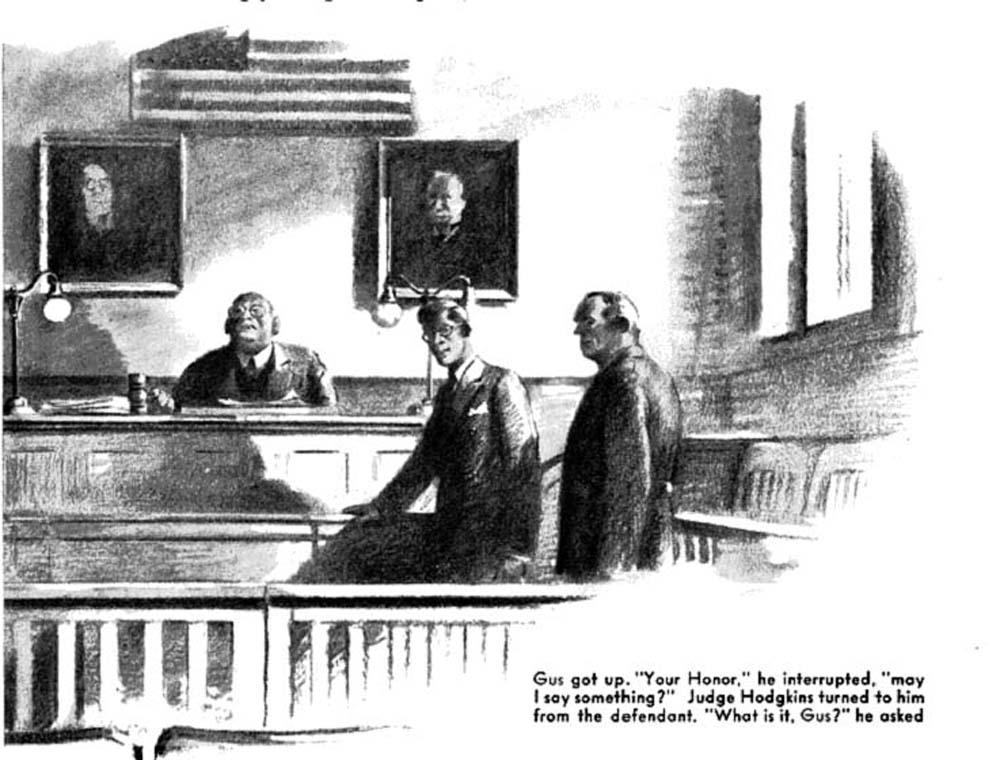
Hodgkins looked at him, "What is it, Gus?" he asked.
"I've seen cars do a lot of queer things," Gus said. "I'll admit Mr. Marshall's explanation sounds phony but it isn't impossible that the lighting circuit could act that way. May I suggest you have the car examined?"
Judge Hodgkins gently rubbed his bald head, "The court accepts Mr. Gus Wilson's suggestion, thanks him for it, and appoints him to examine Leonard Marshall's car," he said after a moment. "Case continued until ten o'clock tomorrow morning."
When Gus finished his case in court, he found Marshall and a '39 sedan waiting for him at the Model Garage.
"Mr. Wilson," Marshall said, "it was mighty white of you to help me. I'm in bad, but I was telling the truth."
"Well," Gus told him, "we've got to find the trouble. When did it first begin?"
Marshall ran long fingers through his hair, "About a month ago," he said, "my beam-indicating light burned out. I didn't do anything about it, because I was busy, and ordinarily I don't use my car at night. But just now I have to. I'm a chemist at the Johnson and Fredericks plant, and for the past week I've had to go down there every evening about nine o'clock to check on a test I'm making on a new material.
"The first night I drove to the plant, just before I got to the Orchard Lane turn where Miss Carver lives, my lights went up. I tried to dim them, but the dimmer wouldn't work. I was in the lab for half an hour. Before I started home I tried the lights again, and they dimmed. But after I'd driven a few blocks they flashed up again, and working the switch wouldn't turn them down.
"I figured that the trouble must be either a loose connection or a short, so I went over the lighting circuit, but I couldn't find anything. Then I thought it must be something in the headlights, so I took them apart and found a lot of side play in the contact pins in the base of one socket. The insulation on the wires had pulled back and exposed the copper for about half an inch. That made me think the wires might have touched when they were jarred. I wrapped friction tape around them, replaced the headlights, and tested the lights. The dimmer switch worked. I thought things were O.K."
Gus nodded and asked, "Then what?"
"The next night," Marshall told him, "I found I didn't have the trouble licked. The lights were all right when I started out, but when I got to that turn in Orchard Lane they flashed up again.
"Well, just on a chance, I got a new dimming switch the next day and installed it. It worked fine in the garage, but when I drove to work, the same thing happened."
"Let's have a look at that bus," Gus said. "By the way, had any fuse trouble?"
"Yes," Marshall recalled, "I forgot to tell you about that. Night before last the fuse burned out -- ends melted right off. I put a new one in."
Gus installed a beam-indicating bulb first. Then he checked the lighting circuit. There was nothing wrong. A check of the voltage regulator showed it in working condition. Then Gus tried the lights, and found that they dimmed when he pressed the switch.
"They always dim all right-in the garage!" Marshall said.
Gus filled his pipe. Then he said: "When a car that is runable has you stumped, I've always found that the best thing to do is to run it and see what happens."
When he got into the driver's seat he noticed the zero showing on the speedometer's tenth-mile indicator. "How far is it from your house to where Jim Devine pinched you?"
"A quarter of a mile," Marshall said. Gus started the engine, switched the lights on, dimmed them, backed the car out of the shop, and headed up the road. Marshall noticed that he was watching the speedometer. The numerals on the tenth-mile indicator hand moved slowly. When the "1" was close to the center of the aperture a ruby spot glowed at the top of the dial.
"They're up again!" Marshall exclaimed. "That's when it always happens!"
"O.K.," Gus said calmly. "That's what I wanted to make certain of. Now I know what the trouble must be, something is acting as a thermostat." He switched off the lights, turned and drove back to the Model Garage. In the shop he began taking the headlights apart. "It's heat that is making your lights act queer." He told Marshall, "and the only place that heat could affect them that way is in the bulbs themselves."
He tested the dim filament of one bulb with an ammeter. For a little over half a minute the reading showed normal current consumption. Then the hand jumped; the lamp was drawing twice the current!
"That beam-indicator light is on, isn't it?" he asked Marshall. "I thought, so! Let's see this lamp . . . Yes, that's it, both filaments burning. Well, that locates the grief." He examined the lamp, "Nothing wrong with filaments," he decided. Carefully he removed the base. "There's the trouble," he told Marshall. "Those filament leads almost touch. When the wires get hot, they expand and touch, causing a short, and as the headlight bulbs are wired in parallel, that makes both filaments of the other lamp burn, too. Naturally, with all four filaments burning, the dimming switch doesn't work. When did you put these headlight bulbs in, anyhow?"
Marshall's face got red. "Why, just before I had my first trouble," he said. "I should have told you that, shouldn't I?"
Gus grinned. "That's one way of putting it," he said. "The other way is that I should have asked you. As for the Judge -- I'll tell him all at the poker game tonight."
END
L. Osbone 2019