September 1963
GUS HELPS
A HOMESICK CAR
by Martin Bunn
"Lady to see you, Gus," Stan called through the open office door of the Model Garage.
"I have to go out on a call," answered Gus Wilson, hanging up the phone. "But I guess it can wait a minute . . . " He looked past his young assistant. Seeing who the customer was, he grinned.
"A minute won't do for Daisy Allen," Gus amended. "I'll leave her to you, Stan."
Stan groaned. "Not me, Boss . . . "
"Get with it," insisted Gus. He let himself out the back door as Stan trudged morosely back into the shop. "Mr. Wilson's on a call. Can I do anything, Mrs. Allen?" Eyeing the '53 Ford six she had driven in, Stan remarked, "That isn't your car, is it?"
"No, it's my parents'," replied Daisy Allen. "I'm staying with them this month while my husband is on a business trip. They take it to a garage in Newton, but I think it's a nice change for a car to be taken to a different garage sometimes, don't you?"
"Yes, ma'am," said Stan numbly.
"Of course there's nothing actually wrong with it -- nothing you could fix. I told my father, but he's old and doesn't understand, and wants it looked at. I did want to go shopping, so I brought it here."
"Sure, Mrs. Allen, but what is -- I mean, what's supposed to be wrong with it?" pleaded Stan.
"Oh, it skips or misses. Like a naughty horse that doesn't want to leave its stall. And for the same reason."
"I'll check it out," promised Stan. "Please call back later."
Daisy Allen bobbed a hat strewn with improbable blossoms. "I will. But don't do anything drastic to it, because it runs fine once it's a few miles away from home."
Meanwhile, Gus, turning off onto Wayne Avenue, rolled along the paved side of the newly widened highway, noting that the other side was still under repair. Three miles farther on he swung into the gateway of a housing development for senior citizens and stopped in front of number 17.
A woman came out, almost girlish in a shift house dress. She had silver hair and snappingly bright blue eyes.
"I'm Mrs. Townsend. Mr. Townsend is asleep, and I'd rather not wake him. He didn't want me to call you. Please come here." She led the way to the attached garage and stood by as Gus raised the door, revealing a popular V-8 sedan. There was a strong odor of gasoline.
"Smell it?" she asked. "It even gets into my kitchen, which is right alongside. I'm afraid to light the stove some mornings. Usually I open the garage to get rid of it, so when my husband gets up it's not so strong. Sometimes I don't smell it at all. But today it was so bad I left it shut and called you. My husband insists there's no gas leak in the car, but I think there must be."
"Does seem that way," agreed Gus.
The woman went into the house. Gus inspected the carburetor, fuel pump, sediment bowl, and fuel lines. Everything was tight and dry.
Whistling softly, he went behind the car, lay down, and shrugged himself under the gas tank.
A dry film of road dust testified to its soundness -- except at one end. Here a moist stain showed where gas had seeped around the corner of the tank and dripped to the floor. Gus felt up the curve of the filler pipe. It was slippery with fuel. He wiped it dry.
After a minute or two, he checked it again. Only a faint trace had reappeared. Sliding out, he almost cracked his head on the bumper as a voice startled him.
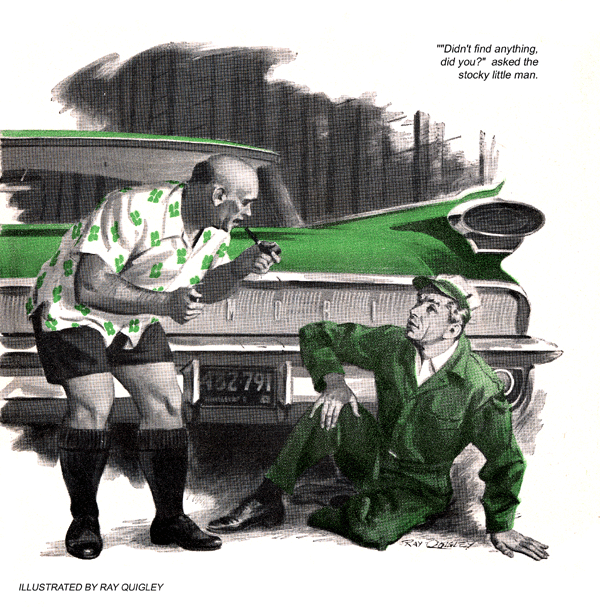
"Didn't find anything, did you?"
Rising, Gus's eyes traveled up a stocky little figure in shorts. Gray eyes under an egg-bald skull repeated the question. In one hand the little man cradled a large pipe, while the other was knuckled over a lighter.
"I wouldn't light that just now," said Gus mildly. "Smell the gas?"
Townsend sniffed. "Tell the truth, I don't. Had a cold all week. But don't tell my wife. She fusses." He put pipe and lighter away. "Mean to say there is a leak?"
"When did you last fill the tank?"
"Midnight, after the late shift at Murdock's. Got a part-time job there."
Gus nodded. "Looks like it's lost all it's going to, so we won't drain any. You see, that gas was cool when it went in. Then the car stood in this sun-heated garage. The gas had to expand. With the tank full, it had no place to go but out the edge of the filler cap, down the pipe, and onto the floor.
"Even when you get gas daytimes, it comes from a cool underground tank. Fire departments get complaints every hot day about cars spilling gas because they're parked in the sun. Just don't say 'fill it up.' Leave some room for expansion."
Townsend nodded. "I should have thought of that myself. What do I owe you for setting me straight?"
Gus told him. As Townsend handed over the price of a road call, he cocked his head apologetically. "Would this cover a bit of advice about my power mower?"
"Why, sure," agreed Gus.
"It's a two-cycle rotary that worked fine last year. But it's lost a lot of pep this season. I had the carburetor cleaned, and put in new points and a plug. That didn't help at all."
Townsend had pulled the machine out.
"Don't start it," said Gus.
Pulling the cable off the spark plug, he tilted the machine enough to put a wrench on the nuts that held the exhaust pipe on the cylinder.
Squeaking protest, they came off. Gently Gus wriggled the pipe free. The exposed exhaust port was rimmed with a thick black edging of carbon.
"There's what mower owners usually skip when tuning up fuel and ignition systems," explained Gus. "That carbon deposit cuts the size of the exhaust port way down. Back pressure then fights the engine, reducing power. Sometimes it causes pre-ignition and overheating.
"Crank the engine over so that the piston is out of the way, and scrape out the carbon. Take care not to scratch the opposite cylinder wall or nick the port edges, though. You'll find the old pep is back. I always yank off the plug cable first, because these one-lungers could start up when you pull the blade around by hand -- and I need all my fingers."
"Me, too," said Townsend. "I'm a machinist. Thanks for both jobs of trouble-shooting. All I got to worry about now is telling my wife she was right."
On his return, Gus found Stan sweating from more than the day's warmth.
"Got Mrs. Allen straightened out?"
"Boss, I can't even straighten myself out. She told me the engine misses, but not to fix it because it runs fine away from home. I locked up for five minutes to drive it around the block. No miss."
The telephone shrilled.
"No, Mrs. Allen," said Gus as soon as he could wedge a word into her chatter. "The car ran well when we test-drove it. Exactly when does it seem to miss?"
"Only when we drive it away from the house, of course. After a few miles it knows who's master, and behaves. It just likes to stay in the garage."
"Mrs. Allen, you say it acts up only when you drive away? Not other times?"
"Of course not. And it runs nicely all the way back, too, the way horses used to do when they knew they were going back to their stables at -- "
"Sorry, Mrs. Allen," interrupted Gus in desperation. "Somebody at the pumps."
He hung up and went back to Stan.
"According to Daisy Allen, we've got a homesick Ford on our hands."
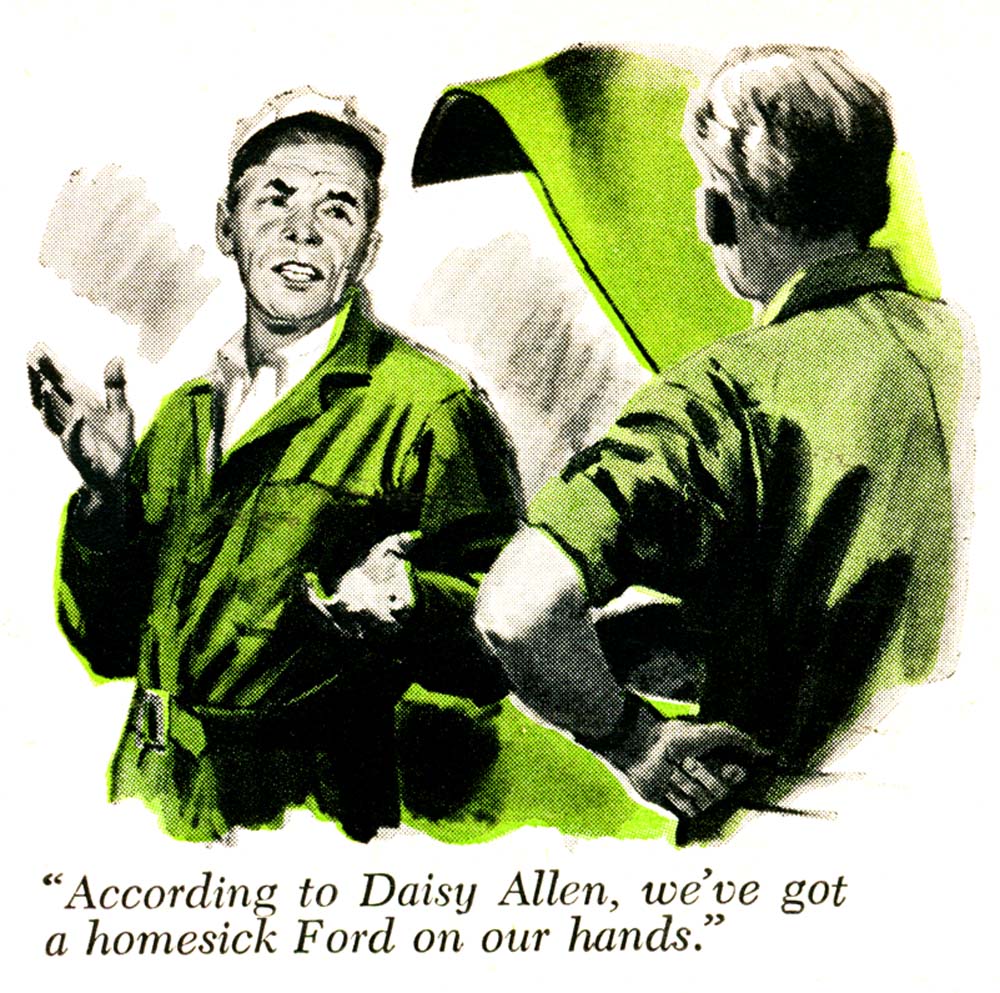
Stan grinned fiendishly. "See what I mean about that dame, Boss?"
"At least she has an open mind."
"Yeah. A hole in the head," muttered Stan. "Look, Gus. Compression checks out good. Fuel pump ditto. The carburetor is new, and it's the right one. Float level's okay, the choke works, ignition points are good and gapped right, spark is hot and regular, timing right on the button, plugs clean. Now what," Stan demanded, "could I have missed?"
"Whatever makes it miss when it's headed away from the garage."
"Boss! You don't believe that horse-to-its-stall flap?"
Gus shrugged. "In trouble-shooting, you listen to every tip and then parlay your hunches. I had a man complain his car went clickety-clack only on Webster Avenue. Couldn't find a thing wrong, so I drove it there myself. Sure enough. It was an echo from a picket fence."
"Okay, I'll drive the car where she . . . "
Stan fell silent.
"Well, what're you waiting for?"
"It's her folks' car," explained Stan. "I don't know their name or address."
It was Gus's turn to grin fiendishly. "Then you'll have to wait and drive there with her when she gets back."
"Oh, no," wailed Stan as Daisy Allen minced up the ramp. He put her in the car and came to the office.
"They live in that development for retired people out Wayne Avenue. It'll take about half an hour, I guess."
"Wayne Avenue?" mused Gus. "Stan, want to play one of my hunches?"
"Sure do, Boss," said Stan fervently.
"Try Hickman Road first. If the trouble shows up there, come right back."
Ten minutes later, Stan returned with the car and Mrs. Allen, voluble as ever." . . . didn't dream it would act that way anywhere else. My father is right. I do hope you can do something . . . of course, it could be just temperamental . . . "
Gus emerged from the office. "There's a cup of coffee for you on my desk, Mrs. Allen. Want to sit there and relax?"
With fluttery thanks, she went off.
"Don't know how you guessed, Boss, but it bucked like a rodeo steer on that rough road. On pavement, it's smooth."
"Let's look for loose connections."
With the engine running, Gus and Stan checked every terminal on the battery, regulator, coil, distributor, and ignition switch. All were tight. The switch itself was sound; wiggling the key in it caused no skip in the motor's idling beat. Then, together, Gus and Stan rocked the car violently side to side on its springs.
The motor coughed a little but kept running.
"It's flooding," said Gus. Taking a drop-light and a hammer, he shone the light on the glass bowl of the carburetor, then shorted out a plug with the hammer head. The engine, which had settled back to a smooth idle, rocked as that cylinder cut out, then sputtered as before. Inside the bowl, Gus saw the float rattle from side to side.
"See that? The float hinge in this new carburetor is too loose," he told Stan. "On a rough road, the fuel level jumps all over. The engine floods, bucks, and the float gets shaken up even more."
"Got it, Gus," said Stan with relief.
Turning off the engine, he lowered the bowl and gently squeezed the eyes on the float hinge closer. With the float free to move up and down but not to shake sideways, he replaced the bowl and again checked the float level. On Hickman Road, the car performed faultlessly.
"Funny about her," said Stan as Daisy Allen drove out. "She tries to tell you the facts, but you have to throw out the hokum to spot 'em. Like that flap about the car bucking when it leaves home but running okay on the way back."
"That was no flap."
"Aw, Boss. Don't give me that. I'm still trying to figure out how you knew the trouble would show on Hickman Road."
"Because it's a rough dirt lane."
"Yeah, but I remember that development has paved streets, and Wayne Avenue is a two-lane concrete road."
"Last time you looked, maybe. They've been widening it since," said Gus. "The northbound lane is finished, so the car ran fine when headed home. But the southbound lane -- the one coming this way -- is all torn up. As Daisy Allen said, that car knew it every time it was leaving home. The bumps told it."
END