February 1963
GUS TACKLES A WEE BIT O' SCOTCH
by Martin Bunn
A footstep brought Stan out from under the Model Garage's lube rack.
"Might I see your-rr boss, laddie?"
The speaker was a stubby man in a checked jacket; he had knobby features underlined by a large reddish mustache.
"He's out," said Stan. "Can I help?"
"Might be. My car's outside. It runs, but it does have a wee ailment. What d'ye charge for a small job?"
"Can't tell until I check," said Stan. "Just what's wrong with it?"
"If I knew that, I wouldnae be askin'," returned the other. "The motor is sweet as butter, but it don't have the gumption it did. I thought ye could tell me what to do, for a wee fee."
"Well, drive it in, Mr. . . .
"I'm Bruce Duncan, laddie."
"Drive it in, Mr. Duncan. No charge for checking, and I'll give you a price if it looks like much work."
Surprisingly, the car that rolled in a minute later was a late model, which must have set its owner back a fair sum even if bought used. It idled silkily as Duncan got out. Stan opened the hood and gunned the engine briefly.
His practiced ears caught a reluctance and a hint of roughness that suggested the spark was retarded. He made sure that the vacuum-advance line was intact. Then he shut off the engine, got out the shop's timing light, and loosened the distributor-cap clips.
"Wait, mon! It cannae be there,"
"I want to check ignition timing," explained Stan. "It's routine to make sure the points are set right."
"And rr-right they are, ye may be sure, for I set them myself."
Stan shrugged, "Okay." He replaced the clips, pulled off the vacuum-advance tubing, and hooked the timing light to plug number one. "Start it up." Duncan did so. In the flash of the light Stan watched the timing mark on the harmonic balancer.
"See that?" asked Stan as Duncan came around. "The spark is about two degrees late at idling speed."
"Cannae ye make a small adjustment?"
Stan killed the engine. "I could reset the distributor, but that might be starting at the wrong end. I should check the point gap first. You say you set the points?"
"Aye, and right on the button. I'm a machinist. When the blueprint says half a thousandth, I can split it to a hair. My car book says the gap should be from 19 to 22 thousandths, so of cour-rrse I set it at 19."
Stan grinned inwardly as he lifted the distributor cap. He nudged the engine around to stop the breaker arm on a high point of the cam, then inspected the points. They were serviceable.
"Want to check the gap again?" he asked. "If it's still 19 thousandths, I won't charge you a thing."
The reddish mustache seemed to bristle as Duncan produced a thickness gauge from his pocket. He leaned over and checked the point gap, grunted in disbelief and checked it again.
"You're right, lad, it's down to 17," he confessed straightening up. "Who'd have thought I could go so far off?"
"You didn't," said Stan. "The only mistake was setting them at 19 thou."
"But the book says so, lad."
"That's minimum for points that have bedded down. But when you install new ones, you want to set them on the high side of the tolerance range. Then, after this fiber rubbing block wears itself in against the cam, you'll still be inside the tolerance range. If you set the gap at the minimum, cam wear can leave the gap too small."
Duncan's forehead became a corduroy of wrinkles. "Makes sense. I'll know better next time. Now what'll you charge to retime the ignition?"
"Just resetting the point gap may do it," said Stan. He increased it by three thousandths. "When the gap is too small, this contact I'm adjusting holds the breaker arm a hair too far off the cam. So the lobe has to swing a little farther before it breaks the points. By then the piston has moved along, too-and your spark is late. A gap four thousandths too small shifts ignition timing four or five degrees."
He buttoned up the distributor and restarted the engine. In the flash of the timing light, the mark appeared about two degrees ahead of its previous position. Stan hooked up the vacuum-advance line and gunned the engine. The timing mark advanced obediently. Duncan pursed his lips as he dug deep to bring out his wallet.
"I think that does it." Stan disconnected the light and closed the hood. "That thickness gauge you used, by the way, is okay only if the points are clean and flat. If they're pitted, it can give you a wrong gap, because it hits only the high spots." He made out a small bill, which Duncan promptly paid.
"A rr-reasonable price. I've a mind to give you some more business. What'll it cost me for three sets of points?"
"Three sets?" asked Stan in amazement. But your own are still okay."
"For the noo," said Duncan glumly. "But I'm sure to be needing new ones soon."
"We'd have to order three sets," said Stan. "Maybe Mr. Wilson will give you a discount on them. Come back in an hour, if you can,"
"I'll do that, and thank ye."
Gus Wilson was in no amiable mood when he returned some time later. He lugged a small, heavy package from his car and set it with a thud on the workbench.
"That the new motor for our valve refacer, Gus?" asked Stan.
"Yes, but they've changed the motor base," growled Gus. "Won't fit our old model until I tap four new holes. While I do that, you can take the valves out of the Anderson car."
Gus detached the burnt-out motor, set the new one in place, and punch-marked the hole locations. Electric drill in hand, he hunted around the bench.
"Seen that hand-soap can I keep around here, Stan?" he called.
Stan emerged briefly from under the hood of Bill Anderson's car. "Think so, but I can't remember exactly." The sound of an entering car made him turn about. "There's a Mr. Duncan to see you."
Gus grunted and set the drill on one of the marks. Pausing occasionally to squirt cutting oil on the bit, he allowed it to bite through. Then he laid the drill aside and turned to the chunky little Scotsman.
"I'm Gus Wilson. You want to see me?"
"As I told your-rr young man, I want to buy three sets of ignition points for yon car."
"Going on a trip?" asked Gus.
"No, but my car burns them fast."
"How fast?" asked Gus.
Duncan scratched his mustache. "In a few weeks. I put in this set two weeks ago. I suppose it's that power-rrful engine does it."
Gus shook his head. "It shouldn't. I can think of a couple of things that might, though." He got out a specifications list.
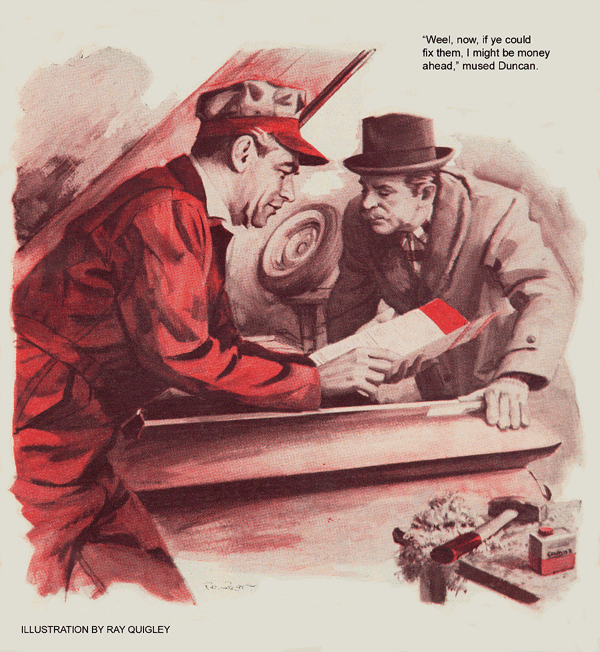
"Weel, now, if ye could fix them, I might be money ahead even after I pay for your wor-rrk" mused Duncan.
"And save yourself some trouble besides," agreed Gus. "Let's just take a quick look-see."
List in hand, he went to the car and opened the distributor. The condenser was of the listed capacity. A clip on the resistance wire leading to the coil identified it as the proper one for the car.
Gus got out a voltmeter and connected its leads across the coil's battery terminal and ground. Then he propped the meter up so that he could see it from the driver's side of the car.
Carefully he turned the ignition key past on" toward "start," but just short of actuating the starter. The meter needle surged to 12 volts. He let the key snap back to "on." The needle twitched, then held at 12 volts.
Gus repeated the test as Duncan leaned close, watching.
"There's your trouble," said Gus.
"I dinnae understand."
"Modern 12-volt ignition systems use full battery voltage at starting, to insure a hot spark while the starter is drawing current," explained Gus. "But when the engine fires and you let go of the key a different contact routes current to the coil through a ballast resistor or a resistance wire. That drops the voltage to half. Half the voltage gives enough spark and saves the points and your budget.
"Your switch is hanging up on the start side, putting 12 volts on the primary circuit all the time the engine is running. That overloads the points, so they burn fast. The meter proves it. That needle in my meter should drop back from 12 volts to 6."
"Can ye nae fix the switch?"
"They're tough to take apart and almost impossible to put together again. It'll cost you less to put in a new one."
"Aweel," said Duncan. "If it's an economy, let's do it."
"Soon as Stan can go get one," promised Gus. "It's just down the street."
Having dispatched Stan on the errand, Gus returned to the workbench. Oilcan in hand, he went on drilling the holes in the refacing machine.
"Ye've helped me with a good tip or two," said Duncan. "Mind if I return the favor?"
“Course not," said Gus, mystified. "Always glad to learn something new."
"It's unhandy and time-wasting to squirt oil by hand for drilling and tapping. I've long made a habit of keeping a can of grease drippin's on hand -- bacon fat or the like. You dip the tap or drill in it and go on with the wor-rrk. The heat o' friction melts the fat slow, givin' the tool lubrication as good as a third hand. Best of all it dinnae cost you a cent. The drippin's are free."
"A mighty good idea. Sure wish I had some now," said Gus sincerely.
When Stan returned with the switch, Gus installed it himself, then repeated the meter test. The indicated voltage dropped as soon as the ignition key was released to running position.
"Say, Gus," said Stan as the Scotsman drove out. "Now I remember. I put that hand-soap can in the washroom. Isn't that where you want it?"
"Won't do us any good there," grunted Gus. He went to the lavatory and got the can back. Whistling, he placed it on the bench and began to fit a tap in the tap wrench.
Stan brought a set of valves over to be refaced. "That the can you been wanting? Why do you keep it around? What's in it, anyway?"
Gus took off the lid and plunged the tap into the white stuff inside.
"Bacon fat," he said. "Beats anything for drilling and tapping steel. Best of all, it dinnae cost you a cent."
*******************************************************************
Gus is in a book now. Twenty-five of the best Model Garage stories from the pages of POPULAR SCIENCE are collected in a new paperback.
You may find old favorites you'd like to reread, or even some you missed. The book is a fine gift for friends not acquainted with Gus, or youngsters eager to learn more about automobiles. You can get Gus Wilson's Model Garage (40 cents) at local paperback bookshops or from Berkley Publishing Corp., 15 East 26 St., N.Y.C. (Add 10 cents for wrapping and shipping.) Please do not send orders for the book to Popular Science.
END