October 1950
GUS HAS A NOISY DAY
by Martin Bunn
In quickly diagnosing engine clatter,
the veteran garageman also saves a fellow man
from equally unnerving chatter.
It was one of those clear fall days that Gus Wilson liked. Not down to freezing, but nippy enough to make you feel like doing things. Crisp weather always put Gus in a good humor, and the problems at the Model Garage never seemed quite so bad when you didn't have to sweat over them.
It was a good thing that Gus was feeling the way he did, because right at that moment a shiny new two-door sedan rolled up to a stop and as the right door popped open Gus recognized the bulbous, overdressed figure of Mrs. Miller, the town's most talkative woman. Anyone had to be feeling chipper to take her.
"Oh, Mr. Wilson," she all but sang, "so glad you're here and not just one of your men. I've brought a customer for you. He's been having all sorts of nasty trouble with his car and I've told him there's no one like our Mr. Wilson when it comes to fixing automobiles."
As Mrs. Miller prattled on, Gus noticed a pleasant-looking, middle-aged man slide out from behind the wheel of the car and walk toward them.
"Tom," Mrs. Miller burbled, "this is Gus Wilson. Gus this is Tom Wilkins. Tom and his wife are old friends of mine from my old hometown. They've been off on a fall vacation trip and stopped by to see Henry and me for a few days. They want to get an early start back tomorrow morning and there's something or other Tom wants done on the car before they leave. Tom, you tell Mr. Wilson about it."
"Well, it's . . . " Tom began, but that was as far as he got.
"Gus does amazing things," Mrs. Miller gushed. "Why, about four years ago we were having all sorts of difficulties with our carburetor, or was it the transmission? Well, anyway, he . . . "
For the next five minutes Mrs. Miller held forth with a story about how Gus once had made a minor and obvious repair on an ancient Rolls-Royce the Millers had owned before they got their present car. Gus, bored, just puffed on his pipe. He knew better than to try and stem the flood of words once Mrs. Miller got wound up.
"Now let's get around to your trouble, Mr. Wilkins," Gus put in at the first lull.
"Well, as I started to say," Tom Wilkins began again, "it isn't much of a trouble, it's just that my hand brake doesn't hold and I don't want to start the trip home without it. I was wondering if I could leave the car with you tonight and pick it up early in the morning?"
"Oh, Tom, I do wish you and Bessie didn't have your hearts so set on such an early start," Mrs. Miller broke in. "I did so want you to meet Mrs. Thompson and her two young daughters, and they're coming over for lunch tomorrow."
"What time did you want to get started, Mr. Wilkins?" Gus asked, ignoring Mrs. Miller as best he could.
"I'd like to make it around six o'clock if I can," Wilkins replied. "That would put us on the road at about daylight."
"We don't open around here until seven," said Gus, "but I'll tell you what we can do. You park your car over there just beyond the shop doors. I won't need the ignition key, so you can take that with you. I'll fix the brake before I leave tonight and the car will be right there waiting for you whenever you want to leave in the morning."
Next morning, when Gus drove up to the garage he was surprised to see Tom Wilkins' car still parked by the shop doors and even more surprised to see the Wilkins and Mrs. Miller sitting in the Miller's car parked close by.
Before Gus could get out of his car, Mrs. Miller had her car window down and was shouting.
"Oh, Mr. Wilson thank goodness you've come. Something terrible's happened to Tom's car. We've just been sitting here hoping you'd come soon."
Gus now was more mystified than ever. The car was all right when he'd left it.
"What seems to be the trouble?" he asked Tom Wilkins.
"Well, perhaps I'd better go back a few days so you'll have the whole story from the beginning," Tom began, as he and Gus, trailed by the ever-present Mrs. Miller, walked toward the car.
"As you can see, my car's practically brand new. We've only driven it a bit over 3,500 miles, and everything was going along fine on this trip until we stopped overnight at a town about 150 miles south of here. The hotel had no garage, so I had to leave it out overnight in a parking lot."
"How long ago was that?" asked Gus.
"Let's see," Wilkins figured. "We got here last Tuesday, so it must have been Monday night."
"That's right, Tom," chirped Mrs. Miller, no longer able to stay out of the conversation. "You and Bessie got to the house just after dusk. I distinctly remember it because I recall telling Anna, that's our maid, you know, that I did so hope that you'd arrive in time for dinner."
Gus ignored the nonstop chatter and turned to Tom Wilkins.
"Next morning, after breakfast," Wilkins continued, "I went out to bring the car around to the front of the hotel. When I pushed the button she started all right even though the morning was kinda cold, but the engine made a terrific clatter.
"I knew it wouldn't be safe to drive very far with it sounding like that, so I nursed it to a garage I'd seen down the street. The mechanic there listened to it, shook his head grimly, told me to leave it, and that he'd do his best to have it ready for me by noon."
"Did he say what he thought the trouble was?" asked Gus.
"Not then," replied Wilkins. "Come noon, I went back, and sure enough he had the engine purring along just as it should. He mentioned something about valves and said the bill would be $20."
"Twenty dollars?" repeated Gus, questioningly.
"Yep, $20," Wilkins agreed. "I thought it was high too, but you can't argue when you're in a strange town and don't know much about automobiles anyway."
"Tom Wilkins," squeaked Mrs. Miller, "if you take my advice, you'll drive right back through that town on your way home and give that man a good dressing down. I'd demand that he give you your money back. It's disgraceful the way some dishonest garage owners take advantage of the public."
"Well, what happened this morning when you came to pick up the car?" Gus asked. His impatience should have been obvious even to Mrs. Miller.
"The same thing," Wilkins explained.
"We got here about six and when I started up the engine it made the same kind of noise, so I shut it off immediately. Here, you can hear it yourself," he said as he slid into the driver's seat and pushed the starter button. There was a distinct rhythmic clatter that sounded like a bad case of valve trouble.
"Tell you what," Gus said, reaching in and turning off the ignition. "There's no sense you folks hanging around here this frosty morning. Why not go back to Mrs. Miller's in her car? When I've got yours ready, I'll bring it over."
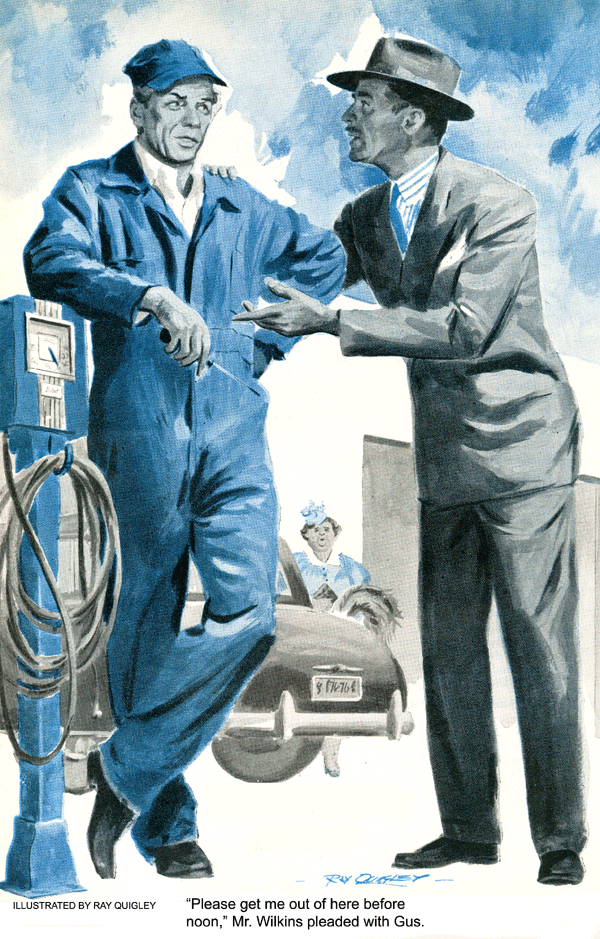
On the way over to Mrs. Miller's car, Tom Wilkins edged Gus to one side and pleaded. "Please try to get me out of here before noon. Another meal with that voice and I won't be fit to drive."
"I'll do my best," Gus promised with a knowing wink.
As Mrs. Miller and the Wilkinses drove off. Gus heaved a sigh of relief. It was almost a challenge to Gus to get the job done as quickly as possible to free Tom Wilkins of Mrs. Miller's endless gabbling -- sort of like rescuing a fellow sufferer.
About an hour later, Gus nosed the car into the Miller driveway. Tom Wilkins, who had been sitting on the side porch with his wife and Mrs. Miller, bounded down the steps.
"Did you fix her?" he called, and then, before Gus could answer, he said, "Gosh, she sounds perfect, doesn't she? Hope she stays fixed this time."
"She will. I'll guarantee that," Gus said as he handed Wilkins the keys. "I don't think you'll have any more trouble."
"What are the damages, Gus?" Wilkins asked reaching into his hip pocket for his wallet.
"Oh," Gus shrugged, "three dollars ought to about cover it."
"Three dollars -- that hardly seems like enough."
"It'll be more than enough to cover what I did."
"I don't understand," said Wilkins.
"Well, to tell you the truth," admitted Gus. "I didn't understand it either when you first started the engine back at the garage. As a matter of fact, it had me pretty well stumped until about 20 minutes ago.
"You see, that clatter, as you called it, sounded just like the noise made by an old overhead valve engine with tappets badly in need of adjustment. But I knew that couldn't very well be because your engine, like a good many modern ones, is fitted with hydraulic valve lifters."
"Hydraulic what?"
"Hydraulically operated expansion and contraction units placed between the cam shaft and the push rods that open the intake and exhaust valves," explained Gus.
"Supplied with oil from the engine lubricating system, the hydraulic valve lifters adjust their own length to make up for any variation in the length of the push rods, rocker arms, or valves. Each hydraulic lifter keeps its valve mechanism at the proper tension so there is no clearance between the various parts, and naturally, there is no valve noise."
One look at the puzzled frown on Tom Wilkins' face told Gus that he'd need more than words to get the idea across.
"Here, I'll sketch it," Gus said, pulling an old envelope out of his overall pocket, and starting to draw with the stub of a pencil he always carried. First of all, we have a cylinder fitted with a ball valve that opens and closes an oil-intake hole. A piston is held in its uppermost position by a light spring. This leaves a small chamber in the bottom of the cylinder, below the plunger."

Wilkins, following Gus's rough sketch, nodded.
"Now, this whole unit is mounted between the cam shaft and push rod, with the end of the push rod resting on the top of the plunger and the bottom of the cylinder resting on the cam. The chamber between the plunger and the bottom of the cylinder is kept filled with oil from the engine lubricating system.
"At the start of the valve-opening operation," Gus continued, "the pressure against the plunger and the plunger against the column of oil closes the ball valve and the entire lifter operates as a solid unit. Then, during the actual valve opening, a slight amount of oil is allowed to leak out between the plunger and the cylinder wall. Finally, at the valve-closed position, the pressure on the plunger is reduced, the ball valve opens, and more oil enters the chamber.
"Sort of works like an automatic hydraulic jack, doesn't it?" said Wilkins.
"That's right," agreed Gus. "Each hydraulic valve lifter automatically adjusts its length with each revolution of the camshaft to compensate for expansion or contraction caused by variations in engine temperatures. The use of hydraulic valve lifters has eliminated the clackety-clack of valve systems."
"Well, this engine sure had it," put in Wilkins grinning.
"I know it did, and that's what bothered me," said Gus. "Then as I fussed with the engine two facts began to fit together, I noticed that the longer I idled it the less pronounced the noise was. I also remembered that last Monday morning, when you had your trouble, was also a bit on the chilly side, like today,"
"Guess I'm dumb, but I still don't see any connection."
"Remember," Gus pointed out, "these valve lifters work with engine oil. By the way, Mr. Wilkins, when did you drain your summer oil and put in a cold weather grade?"
"I haven't yet," admitted Wilkins.
"And that was your trouble," said Gus, "and why I changed the oil for you. On these snappy mornings it takes a bit of time for heavy summer oil to loosen up, and until it does, the flow of oil to the valve lifters is apt to be slowed down. Without a free flow of oil they don't compensate, and you get valve noises.
"There's another factor, too," Gus added.
"When a motor sits long enough, or in just the right position, oil is likely to drain out of the chambers and isn't replenished until the oil warms up and flows freely."
"Well how the deuce did that mechanic down the road get rid of the noise to the time of 20 bucks?" asked Wilkins.
"Simply by doing next to nothing," grinned Gus. "Unless I miss my guess, you hadn't got back to the hotel before he had your car out on the road, driving it just long enough and fast enough to get it up to operating temperature. Once the oil thinned out, the noise was gone. Then, all he did was sit around and wait for you to call for your car -- and pay him $20 for his trouble."
"Why, the dirty crook," boomed Wilkins.
"Now you see, Tom," chimed in Mrs. Miller, who hadn't been able to resist the temptation of joining the two men. "It's just as I said. You were cheated and you might to do something about it."
"I'll sure enough know what to do the next time some guy wants to fuss around with the valves," said Wilkins.
"And don't be too cocky about that, either," warned Gus. "Like any moving part, hydraulic valve lifters do need some attention now and then. The important thing is to watch the condition of your oil. Just remember that valve lifters can't operate as they should if the oil is too heavy for the time of year or if the oil is dirty. It's also mighty important to change your oil filter every 5,000 miles.
"It's like everything else about a car," Gus added. "So far no engineer has been able to devise a mechanical substitute for care and common sense."
And, thought Gus as he started walking back to the garage, no one yet has devised anything -- mechanical or otherwise -- to silence Mrs. Miller.
END
L. Osbone 2019