August 1950
GUS AND THE MIRACLE JEEP
by Martin Bunn
A secret project at the Model Garage
gets the local National Guard unit into deep water.
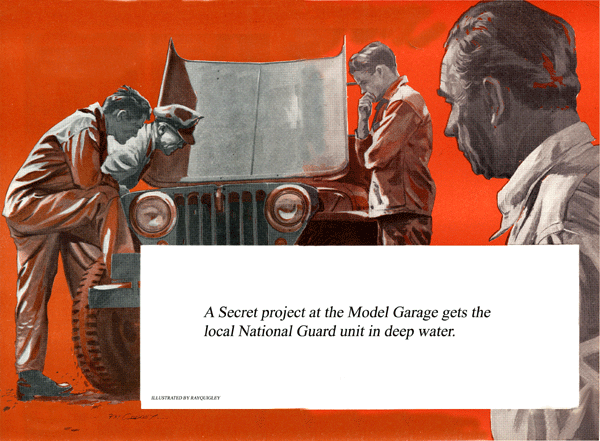
Curiosity being what it is a good many of the Model Garage's regular customers wondered what was going on one morning a few weeks ago. Gus Wilson, its well known owner, had screened off one corner of his repair shop by stringing an old truck tarpaulin from the ceiling. Then he had added to the mystery by hanging a large sign on the tarpaulin -- KEEP OUT.
To anyone who asked him about it, Gus replied with a pleasant smile and a polite change of subject. As a result, speculation as to what was going on behind the curtain ran wild -- including one, rumor that Gus was working on a top-secret invention for the Government.
Even Stan Hicks, Gus's helper, was completely in the dark. Gus would tell him nothing. All that Stan knew was that Ted Stevens, who'd served in the Army during the war and who was active in our towns National Guard unit, had driven an Army jeep into the shop late Saturday night and had gone into a long whispered huddle with Gus. When Stan showed up for work the next morning, the curtain was up and ever since Gus and Ted had been spending a good deal of time behind it. Stan guessed that the jeep was behind the curtain too, he'd heard an engine running once or twice.
"What gives?" Stan finally asked when Gus emerged from his curtained corner for lunch on Tuesday. "Why all the mystery? Can't you even let an employee in on the big secret?"
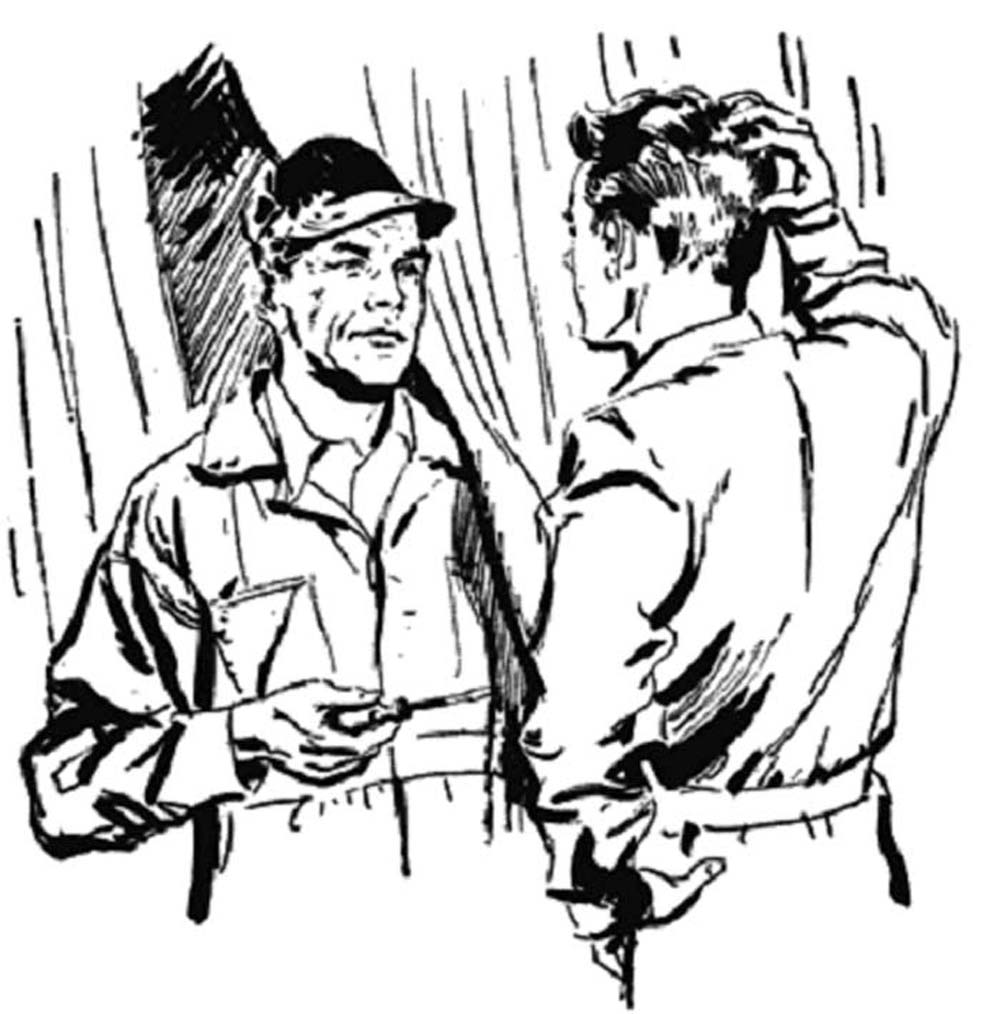
"There's no big secret," Gus grinned.
"Haven't you heard that the National Guard units in this area are holding their annual training encampment over at Danesville starting this weekend? Well, I'm just helping Ted Stevens get his unit's jeep in shape for the maneuvers."
Stan knew Gus Wilson well enough to know there wasn't much use asking more questions, so he let it go at that.
On Wednesday morning the "Iron curtain," as Stan jokingly had got to calling it, was gone. So were Ted and the jeep. They had disappeared as quickly and mysteriously as they had appeared.
Stan had pretty much forgotten the whole thing when about 10 days later, Gus made a suggestion.
"How about driving over to Danesville with me this morning, Stan? Understand the Guard is putting on quite a show, and I think we ought to see it."
"But what about all this work that's stacked up?" put in Stan.
"It'll keep," Gus assured him. "Besides, it'll do Joe Clarke good to get his nose out of those books and hold down the fort for a few hours. Wipe that smudge of grease off your nose and let's get going."
"Okay, boss, if you say so," Stan agreed as he clambered into Gus's car. Watching the boys in khaki put on a sham battle might be fun -- anyway, it was better than greasing cars on a nice summer morning.
When they drove into the Danesville camp, hundreds of visitors from the nearby towns already were wandering over the reservation. The show turned out to be a series of scattered demonstrations, with signs directing visitors to go from one to another. At one spot several squads of guardsmen were building most road blocks and tank traps. Close by, others were demonstrating chemical warfare tactics. At a third, a crew was simulating the firing of a World War II antiaircraft gun. Stan really began to get interested.
Gus however, paid little attention to anything until he spied a sign that read, "Vehicle Waterproofing Competition." An arrow pointed down a hill that led to the shore of a fair-sized lake that was part of the camp.
"This is us," he said as he led the way.
When they reached the lake Stan saw five Army cars, their engines running, lined up on the pebbled beach. There were three jeeps, a carryall, and a scout car. Gus and Stan found a spot on the hillside where they could get a good view. They had just about settled themselves on a couple of rocks when a loudspeaker boomed forth.
"Ladies and gentlemen. You are about to witness a unique exhibition and contest. Each of the five National Guard units taking part in this two-week training program has been asked to enter one Army vehicle in this competition. Each unit has prepared their vehicle for underwater operation. This procedure was common practice in landing operations during the last war . . . "
Then the voice went on to explain that on signal the drivers, wearing bathing shorts, would drive their cars into the water until they were fully submerged, except for the drivers' heads and the extended exhaust, air-intake and gas-tank-vent stacks, and would then cruise parallel to the shoreline. The car that continued to function the longest would win the competition.
As the voice went on, Stan remembered that he had read how the motors of Army trucks and cars had been waterproofed for landings on beachheads by coating their ignition systems with putty, goo, and a waterproof varnish. He also guessed now what Gus and Ted Stevens had been doing behind the "iron curtain." And he was sure of it when he recognized Ted Stevens as the driver of the second jeep from the left.
At a signal from the officer in charge, all five cars began to move toward the water's edge. With their three stacks extending above their bodies, they looked like so many waddling beetles. They all entered the water at about the same time.
The squad car stalled before the water had reached half way up its hood. It sputtered a few times and died. One of the jeeps stalled a minute or so after it got fully submerged. Within the first five minutes three of the cars were out of the race and their drivers were wading ashore. The remaining two cars -- a jeep and the carryall -- were now putt-putting up and down the shoreline. Then, finally, after about 15 minutes, the carryall conked out, and the winning driver piloted his jeep toward the shore. Even before the car was out of the water, Gus was on his feet.
"Let's get down on the beach," he yelled. "That's Ted's jeep."
By the time Stan and Gus had clambered down the steep hill. Ted's jeep was up on the shore, still putt-putting away and surrounded by an amazed group of guardsmen and officers. The jeep's hood was up and they were peering down at a completely un-waterproofed ignition system. No goo, no varnish. The ignition switch on the dash wasn't even turned on, yet the engine was running fine.
When Gus shouldered into the group, Ted waved to him and gave him the now well-known first finger-and-thumb circle that means success. Then to give added proof as to just how good his unit's unwater-proofed jeep was, Ted drove it out into the lake again parked it under about four feet of water, and swam ashore. The engine continued to run. After a few minutes he swam our again, and drove it back up on the shore to the cheers of the crowd.
"Okay, miracle man," Stan kidded after they'd got back to Gus's car and had started the drive back to the garage. "How did you master-mind that one?"
"I didn't master-mind it," Gus replied.
"It was Ted's idea. I just helped out with the details and some of the work."
"Okay, okay," Stan said impatiently. "So what's the gimmick? Automobile ignition systems just don't work when they get wet.
And besides, the ignition switch on that jeep wasn't even on. What did you do, stow away gremlins in the crankcase to push the pistons up and down?"
"Ever hear of a Diesel?" Gus asked.
"Of course I've heard of a Diesel, but what's that got to do with a gasoline engine in a jeep?"
"It's just a matter of principle," teased Gus. Then, just before Stan really blew his top, he continued. "The whole thing goes back to Ted's war experiences, when he was attached to the motor corps of the 213th Medical Battalion of the 96th Infantry.
"During training, he was stationed at a camp near San Luis Obispo in California. With the rest of his gang he'd been taught the approved way of waterproofing cars for beach landings. Then one day two Corps vehicles showed up at the camp, a jeep and a carryall. They didn't have any water-proofing, so far as the ignition systems were concerned. Still they outperformed all the regular Division cars when it came to underwater operation.
"Ted's always been an inquisitive kid," Gus went on, "so he asked questions. The underwater trick, he learned, consisted of drilling one eighth inch holes, one and one-sixteenth of an inch deep, into the centers of brand-new intake valves. With those holes in place, the engine, after it had been started and warmed up, no longer needs a conventional ignition system."
"I still don't get it." Stan said. "How in the heck can holes drilled in an engine's intake valves take the place of the hot sparks from spark plugs?"
"That's what I meant about the Diesel," explained Gus. "The simplest Diesel engine -- some people call them semi Diesels -- have hot spots in each cylinder to take the place of spark plugs. The hot spot, a knob or button of metal that retains its heat, keeps hot enough to fire the air fuel mixture after each compression stroke.
"The same thing's true of the holes we drilled into the intake valves of the engine in Ted's jeep. After a little normal running with the jeep's regular ignition system, those holes get filled at the bottom with a deposit of carbon. Carbon retains heat, so, after a normal start with the regular ignition system, the 'carbon spark plugs' continued to do the firing, so it didn't matter if the ignition system got wet and conked out.
As a matter of fact you saw Ted switch his ignition off once the engine had reached its normal operating temperature."
"Mind if I ask a couple of $64 questions?" put in Stan. "If that system works so well, how come the Army didn't adopt it instead of waterproofing? And why don't they just do away with the conventional electric ignition systems on all cars?"
"Well, in the first place," Gus explained, "it's not a particularly efficient ignition system for general use and, besides, you have to have a conventional ignition system to run the engine until the carbon spots heat up. Then there's no way to control the firing of the cylinders, so the engine is always out of time. As a result, you lose power, have a rough-running engine, and waste gasoline.
"It was just a trick the Army tried and then abandoned," Gus added. "But it was good enough to help Ted and our National Guard unit win this afternoon."
END