November 1937
WHATS INSIDE YOUR BATTERY?
by Martin Bunn
"You win, Gus," said Joe Clark, sticking his head out of the Model Garage office. Gus Wilson, his partner and the mechanic of the business, looked up questioningly from the workbench where he was tinkering with a carburetor.
"Remember when we fixed that short circuit in Evan Walsh's car and you tried to sell him a new battery, but the price scared him off?" Joe asked.
"Yeah," agreed Gus nodding. "And I bet you a dollar to a bum tire he'd go to that gyp battery store down the street and get stuck with a jerry-built job, and finally end up on the end of a low rope."
"Well, that's just what's happened," Joe laughed. "He's on the phone now, mad as a hornet. The car's stuck out on the road, just this side of Peyton's Corners. Can you go out after him?"
Gus muttered to himself as he wiped his hands on a wad of waste. "He would pick a busy day," he said, finally. "Tell him I'll be out in a quarter of an hour."
When the tow car pulled up at the roadside in front of Walsh's blue sedan, the car owner was leaning against a fender and chewing viciously on a long black cigar. "That's a fine job of wiring you did for me", he growled by the way of greeting. "drained the juice right out of a brand-new battery."
"We'll see about that when we get back to the garage," Gus replied cheerfully, as he looped a rope around the car's front bumper. "Hop in and we'll get going."
Back in the Model Garage shop, Gus lifted the car's floorboards to uncover the dead battery, and disconnected the cables. "First of all," he said, "we'll just check that wiring job." Running wires from a test battery to the loose cables, he motioned the customer to watch a meter standing on the bench.
"Do you see any reading on that meter?" he asked. "If there's a leak in the wiring, it will show there."
Walsh shook his head in bewilderment. "No, it looked all right from that angle. But if the wiring is O.K. what could be the trouble?"
"The trouble," Gus replied with a jerk of his thumb, "is in that pile of junk you let somebody sell you for a battery."
"Don't try to tell me that isn't a good battery," snapped Walsh, tilting his cigar at an aggressive angle. "The salesman weighed it for me. It was even heavier than a standard make. That shows it hasn't got undersize plates, like some of these cheap jobs I've heard about."
Gus smiled. "So you bought a battery by weight, did you? It would make things a lot easier if that was all there was to building a good battery -- making it heavy."
"Well, it gave a good, hot spark when he snapped a wire over the terminals," sputtered Walsh.
Gus's smile became a broad grin. "No matter how poor a battery is, it'll make a nice, fat spark if it's got any charge at all. As for weight, let's take a look." He reached in a drawer and pulled out a small, black book.
"These are the specifications for batteries worked out by the Society of Automotive Engineers," he explained, wiping a broad, greasy thumb on his overalls, and pointing out a column.
"Notice that it doesn't say a thing about weight."
"But it's the lead in a cell that stores up the current," Walsh objected. "The more lead there is, the more the battery will weigh. So the heavier it is, the better."
"You're confusing metallic lead with lead compounds," explained Gus, reaching beneath his battery-charging stand.
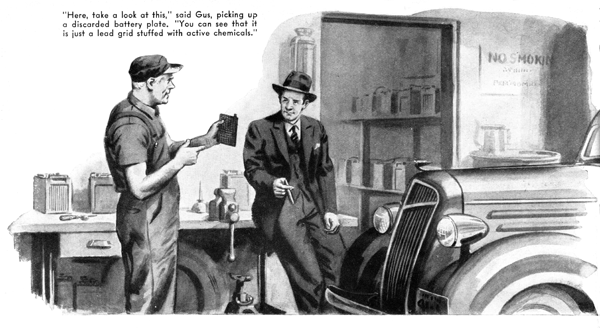
"Here, take a look at this," he continued, picking up a discarded battery plate. "That plate is just a lead grid stuffed with active chemicals. It stands to reason that if you make the grid heavy and coarse, the battery will weigh more, but it won't hold so much active material."
"Then a good battery is one with a very fine grid?" put in Walsh as he examined the plate with interest.
"It's not as simple as that," Gus countered, warming up to his subject. "If the plates are too thin they're no good, either. They buckle too easily.
"And that's not all," he continued, holding up a thin wooden plate separator. "These spacers between the plates have to be able to take it. If they break down, the plates will short-circuit against each other. And that'll be the end of the battery.
"Then there's still another thing. The active chemicals must be pure. If they're not, there'll be a steady loss of current within the battery itself.
"Even a good battery," he went on, as he threw the old battery plate and separator back into the scrap heap below the bench, "will lose about one percent of its charge every day it stands idle. So it isn't hard to see why a cheap job with poor separators and impure chemicals is no good. It has such big internal losses that it'll go dead in no time."
"Gosh, there's more to this battery business than I thought," Walsh observed, chewing the end of his cigar.
"But if the weight doesn't mean anything, how in blazes can you tell a good battery from a bad one?"
"The answer is, you can't," Gus smiled. At least, there isn't any test that the ordinary car owner can apply that will mean anything.
"Come in here a minute," he suggested, beckoning toward the little storeroom where the garage's supply of new batteries was kept.
"Take a look at these. We've got three different grades of batteries here. Can you tell me which is the best just by looking at them?"
Walsh puffed his cigar thoughtfully as he glanced over the shelves. "You've got me, Gus," he admitted, after a little deliberation.
"Of course you can't and neither can I, just from outside appearances," the veteran mechanic confessed. "The only thing you can really go by is the reputation of the maker."
"And the honesty of the dealer," chimed in Joe Clark, who was checking some of the stock in the storeroom.
Gus and his customer walked back to the charging stand. "What about a hydrometer?" Walsh asked lifting the glass and rubber instrument from a rack on the wall. "Doesn't that tell you anything about the quality of the battery?"
"Not a thing," Gus kicked Walsh's old battery with the toe of his heavy work shoe. "I could make this piece of junk give the same hydrometer reading as a brand-new, fully charged battery. All I'd have to do is add strong acid in the cells. That would make the specific gravity, which is the thing a hydrometer measures, the same as for a good battery. And, as a matter of fact, the battery would actually would give juice -- for a short time anyhow."
"But Gus, there must be some way for an expert to tell how good a battery really is," put in Walsh. "Couldn't he just connect some lamps to it, and see how long they stay lighted?"
"That would tell just one thing about a battery," Gus explained. "-- Its ampere-hour capacity. But an automobile battery has to do more than just light lamps. That's just dribbling the current out. The starter takes a whole of a lot of current out of the cells all at once. So you'd have to test the battery at a high discharge rate, too."
"That doesn't make sense to me," objected Walsh. "If a battery will hold a certain number of ampere hours, what difference does it make whether you draw off the current slow or fast?"
He pointed to a pail in the corner, "it's like taking water from that bucket, isn't it? Whether you take it out by the cupful or whether you dip it out with a spoon, you get just as much water in the end."
"Yeah?" chuckled Gus as he picked up a gallon glass jug marked "Distilled Water."
"Suppose your water was in this jug. You couldn't get the cup in at all, could you? Even if you turned the jug upside down, the water would still come out much slower than if you did the same thing to the pail. You see, a battery doesn't really store electricity -- it stores chemical energy. The speed that you can draw juice from it depends on how fast that chemical energy can be turned into electricity.
"An automobile battery," Gus went on, "is like that pail. It'll give lots of current all at once. You need it, too, for starting on cold mornings. But a farm-lighting battery is a lot like the jug. Try to run a car on it, and it'll give out in no time at all. Most likely the plates would buckle the first time you stepped on the starter."
The mechanic picked up the specification book again. "There are a lot of other tests these engineers specify for batteries. For instance, a storage cell doesn't work so well when it's cold. So they check its performance at zero temperature, too."
"Is there any way of telling how long a battery is going to last?" asked Walsh.
"That's easy," Gus replied. "All you have to do is keep charging it up, then draining all the current out, over and over again, until the cells give out. If it comes up to the Society of Automotive Engineers specifications, you should be able to do that at least 300 times before she goes dead on you."
"Good grief," exclaimed Walsh, "After you did that the battery wouldn't be any good any more."
"It certainly wouldn't" Gus agreed. "But when they give that test to a number of batteries picked at random from a manufacturer's production line, it's a pretty safe bet that the rest will last just as long."
The customer puffed his cigar reflectively for a moment. Then he smiled, "Gus," he said, "I've got it all figured out. All I have to do is to buy that battery you tried to sell me a while back. Then I won't have to think about battery trouble for another two years."
"The idea of getting a new battery is O.K." Gus called over his shoulder, as he started for the storeroom. "But don't stop thinking about the battery when you get it. Remember a battery needs a drink once in a while."
END
L. Osbone 2019