July 1937
DOES YOUR CAR HAVE NEW-TYPE BEARINGS?
by Martin Bunn
John Walton finished his supper and headed at once for his garage, where he climbed into stained overalls and jumper with a smile of anticipation on his wrinkled face.
Walton was an old timer. Automobiles had been his hobby since the days of the curved-dash, one-lung ancestors of the modern streamliner. He prided himself on the care he took of his car and on his ability to make virtually any kind of repair. Indeed, his wife always maintained that nothing made her husband happier than the discovery of a new motor noise that would serve as a good excuse for doing another elaborate overhaul job.
Now after an extended tour in his new car, he fancied he heard sounds which indicated that the connecting-rod-bearings weren't as tight as they might be. He was going to give himself the pleasure of taking a look at them.
"Might as well see, at the same time, if the piston rings are all right," he muttered to himself, as he lifted the hood and got out his tool kit.
In a short time he had the cylinder head off, the oil pan removed, and was taking off the first of the connecting-rod caps.
"What in blazes is the matter here?" he sputtered, as he removed the cap and the thin half shell of a bearing dropped out. "Looks like the whole works has gone to pot. Bearing metal came loose from the rod and everything. It's lucky I got at it in time."
He removed two more connecting-rod caps, with the same result. He couldn't find any shims under the bearing cap, where they had been in his old car.
Still muttering angrily to himself, he slid out from under the car, went into the house, and growled the number of the Model Garage into the telephone. "That you, Gus?" he asked as Gus Wilson, half owner of the establishment answered.
"Can you stop in on your way home? I'm in trouble. All the connecting-rod bearings on my car are on the blink!"
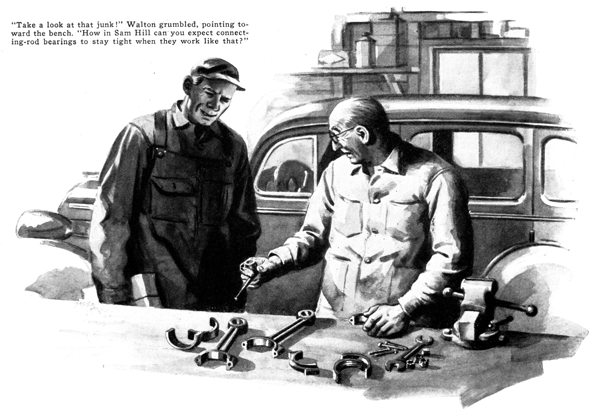
Walton was nervously puffing away at a large briar pipe when the veteran auto mechanic showed up a little later. "Take a look at that junk," he grumbled pointing toward the bench on which he had laid out a couple of connecting rods, together with four bearing sections.
"How in Sam Hill can you expect connecting-rod bearings to stay right when they work like that?" he sputtered indignantly. "Look how the bearing metal has broken away from the rods. Why, the bearing itself has been turning with the crankshaft till it's got the whole inside of the rod surface shiny!"
"They haven't come loose," Gus grinned, "They're made that way in the first place. Take a look at these."
Gus lifted a package onto the bench, unwrapped the paper and spread out a whole set of new connecting-rod bearings.
"Knowing how you used to take pride in scraping a bearing, John," he smiled, "I was wondering what you'd do when you tried to work on this new type."
Walton picked up one of the new bearing sections and carefully compared it with one he had taken from his own car.
"Well, if that isn't a crazy way to make a bearing!" he exclaimed in amazement, "How can you get it tight with the bearing metal floating loose like that? I should think it would pound itself to pieces. And how do you adjust it? There aren't any shims, so far as I can see."
"It's all in the way they're made and what they are made of," Gus explained.
"The kind of bearing you know how to fix is one where the Babbitt metal is fastened to the inside of the connecting-rod big-end bearing and its cap. When it wears, you can take out a shim or two and let the cap part squeeze down on the crankshaft, and then scrape it by hand.
That kind of a bearing was used for years and gave good service. Its only fault is that it takes a lot of work to tighten it and it isn't every mechanic who has enough skill to scrape a bearing to a fit.
That means that tightening bearings was expensive if it was done right, and if you merely tightened the caps without scraping, in, the bearing wouldn't last, because all the wear would come on a small part of the bearing surface."
"But when you did the job right, you had a real bearing," Walton interrupted.
"Sure," Gus readily admitted, "but you get just as good a bearing and in some ways a better one by the modern method."
"Well, if that is just as good a way to make bearings, why wasn't it done before?" Walton grumbled. "Surely, bearing makers didn't go to all the trouble they took to anchor the bearing metal just to amuse themselves, did they?"
"They did it because they hadn't found out how to make a loose bearing shell that wouldn't pound to pieces," Gus replied. "You couldn't make sections of bearing like this out of Babbitt metal and get away with it. Watch this."
Gus picked up one of the old bearing sections that Walton had removed from his car, and pounded it with a hammer. Instead of smashing, as it would have done if it had been made of pure Babbitt, the bearing merely bent.
"The secret of the new connecting rod bearings is in knowing how to coat steel with Babbitt metal or one of the other new bearing metals they are using nowadays, such as copper-lead and cadmium-silver alloys, and also in learning how to make the parts so accurately that the fit will be right without any handwork.
"You remember how," Gus continued, "when you used to scrape in a connecting-rod or main bearing, you always shimmed it after you finished scraping, so that the shaft would turn easily? You did that so there would be just enough play to let the oil get into the bearing."
"And how do they get around the need for scraping now?" Walton asked.
"I was coming to that," Gus smiled. "In the first place, they've developed machinery for finishing the bearing surfaces of a crankshaft by grinding and then by lapping, so that they are dead round -- as smooth as glass, and true to size to a fraction of a thousandth of an inch. The same thing applies to the connecting-rod bearings. So your shaft size and the connecting rod big-end size are exactly right, and the surface is mighty near perfection. The floating bearing is steel, with a heavy layer of Babbitt or one of the new bearing metals put on so that it can't possibly come loose. All you need to do is to make the bearing section exactly the right size to fill the space between the outside steel surface of the shaft and the inside steel surface of the connecting-rod, with the proper amount of play to provide for the flow of oil, and you have a bearing that can be renewed in just a few minutes by slipping new bearing sections into place."
Walton gazed solemnly at the mirror-like surface on the inside of the big end of the connecting rod, then crawled under the car and ran his finger over the shining steel of the crankshaft.
"I should have doped that out for myself, he grumbled, as he got to his feet again.
"How do these bearings stand up?"
"As well as the best hand-scraped job, considering that motors now run at much higher speeds than they used to," Gus replied. "Of course, bearing wear depends on lubrication, mostly, and there's where the modern car shines, with oil being forced into the bearings under pressure every second the motor is running. As a matter of fact, the use of pressure-feed oiling was one of the things that helped along the standardization of bearings. You see, the pistons are lubricated by the oil that is constantly being forced out of the connecting rod bearings and flung off over the inside of the engine. Naturally, the amount of oil that comes out of a bearing depends on how much play there is. With hand-fitted bearings, you never could be certain of anything except that no two bearings would ever be exactly alike. That meant that some cylinders would get more oil thrown on their walls than others, and if a couple of bearings next to each other happened to fit exceptionally tight, the oil supply to the cylinder walls might even fall so low that there'd be excessive wear of the piston rings in that cylinder."
"Then," Walton observed, "if a bearing happens to wear loose, wouldn't so much oil come out at the ends of it that the cylinder directly above would be flooded and foul the spark plugs?"
"You forget that all modern motors are fitted with oil-scraper rings designed to keep the oil from getting up past the piston. As long as that ring is working right, there's not much chance of flooding," Gus answered.
"Of course," he went on, "if the ring were a bit worn, and the bearing too, then there'd be trouble. Sometimes that's what's the matter when one cylinder shows oil pumping much more than the others. However, since you have to take off the cap on the connecting-rod bearing to pull the piston out through the top of the cylinder to get at the oil ring in order to replace it, you're sure to catch the trouble, whether it is in one place or both."
"Humph!" Walton grunted, as he reached down from the shelf over his bench a long, thin cardboard box labeled 'Bearing Scrapers -- Best Tool Steel.' "Think of all the work I put in learning how to do a bang-up job of scraping a bearing! Now these things won't be any use any more."
"But think of all the time and trouble you'll save," Gus grinned.
"I suppose so," Walton sighed wistfully, "but where's the fun in just sticking in a lot of new parts? Any dumb mechanic can do that!"
END
L. Osbone 2019