January 1929
HOW YOU CAN TEST ANTIFREEZE
by Martin Bunn
"Some people," grumbled Gus Wilson, "sure do waste a lot of time finding out what they want to know."
The veteran auto mechanic disgustedly shoved the telephone away from him.
Joe Clark, his partner, who had called him into the office of the Model Garage to answer the phone, grinned sympathetically. "What did that bozo want?' he inquired. "If I'd known he only wanted to ask a bunch of fool questions. I wouldn't have bothered you."
"Funny you didn't recognize him," replied Gus. "That was old Dexter, the bird who's always spouting theoretical stuff about calories, thermo-something, or other, and the rest of it. He'd rather mess around for hours with a pencil trying to figure out something than to ask someone who knows."
"Then what's he pestering you for?" Jose asked. "Why don't he figure it out if he's such a shark at it?"
"He didn't ask any questions," grunted Gus. "He says he's coming here to get me to help him on some of his blasted calculations. I didn't get what he was driving at except it had something to do with specific gravity. I just told him to come ahead and I guess he's on his way now."
A few minutes later Dexter drove up and insisted on bringing his car inside instead of parking it in front of the garage. It was below freezing outside he explained and he was afraid the radiator might freeze.
"I am sorry to bother you, Mr. Wilson," he said, as he reached into his car and dragged out several thick and musty looking scientific books. "It is just a relatively simple problem in specific gravity. That is, it should be simple enough, but there are several confusing factors that complicate matters."
"What are you trying to do, figure out what makes ice float?" smiled Gus.
"No," replied the other. "You recommended that I use glycerin in the radiator this winter and I took your advice. The results have been excellent until day before yesterday, and then I unfortunately forgot to open the radiator shutter until the motor became so overheated it began to boil, and I am afraid that a large part of the solution squirted out the overflow pipe with the steam. Now I don't know what actually is left in the radiator. I looked up the specific gravity of glycerin and found it was 1.265 degrees at ordinary temperatures. It occurred to me to calculate the specific gravity of the mixture I was using and then by test see what I actually had. But these books show that it is rather complicated."
"Bumped right into a tough one, didn't you?" said Gus. "Seems to me I remember reading some place that 'a solution is a uniform mixture that doesn't follow the law of definite proportions.' That floored you, eh?"
"That's it precisely," said Dexter," and now I am unable to find a formula to fit the case. Perhaps you can help me?" "Sure," Gus replied. "Chuck those blame books back in the car. We won't need 'em. Hey, Bill" he called to the youngster who was sweeping the other side of the garage. "Chase yourself down to the drug store and buy me a couple of ounces of glycerin and a test tube. Make it snappy!"
"Now," Gus explained when Bill returned a few minutes later, "all we've got to do is to take the hydrometer float out of this storage battery hydrometer and see how it floats in different mixtures of glycerin and water. What's the matter with that way of finding out what you want to know?"
"But will the results be sufficiently accurate?" Dexter objected doubtfully.
"Why not?" countered Gus. "You could wear out a couple of pencils figuring it closer than the paper on the wall, and even then you wouldn't be dead sure. These cheap hydrometers are no great shucks for accuracy. Your figures might be all right and a bum hydrometer would throw you way off. But if you make up the actual mixtures and float a hydrometer in 'em -- any old hydrometer -- you can keep that hydrometer just for testing your radiator solution, can't you?"
"You've proved your case," admitted Dexter.
"These storage battery hydrometers," Gus continued, "don't read much below 1.075, so you won't be able to tell anything about very weak solutions of glycerin and water. Let's start with one part glycerin to two parts water. That's a thirty three percent solution."
"Reads about 1.080," said Dexter, bending over to get his eye on a level with the top of the solution in the test tube.
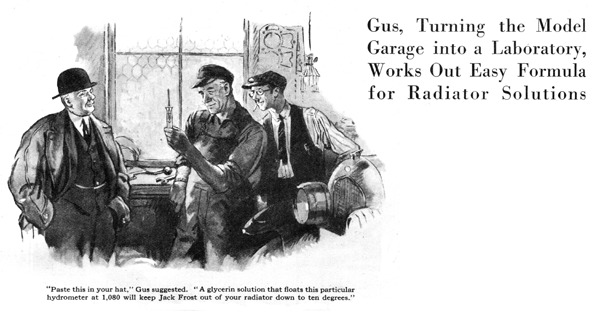
"Paste that in your hat," Gus suggested. "A glycerin solution that floats this particular hydrometer at 1.080 will keep Jack Frost out of your radiator down to almost ten degrees."
"But we occasionally have colder weather than that in this latitude," Dexter objected.
"Sometimes," agreed Gus, "let's see how it reads in a forty percent solution. That won't freeze down to zero. And if we add one third of a part more glycerin to what we've got in the test tube already we'll have mighty close to a forty percent solution."
Dexter did a bit of figuring while Gus was stirring in the added glycerin and found that the auto mechanic was right.
"There you are," said Gus, as he jiggled the test tube to make the hydrometer float without sticking to the glass walls. "Just 1.100 on the scale. Nice easy figures to remember. Keep the solution at 1.100 if you want zero protection."
"Excellent!" Dexter exclaimed. "Now I have merely to insert the hydrometer in the radiator at any time to determine the strength of the solution."
"Not any time," answered Gus. "You forget that a hot solution is expanded and the hydrometer will sink down below where it ought to float. That reading is only good at about sixty degrees."
"Would that reading also apply to that new antifreeze, ethylene glycol?" Dexter asked.
"I should say not!" replied Gus emphatically. "It's good only for a mixture of glycerin and water. Ethylene glycol is just as good as glycerin as an antifreeze, but the pure stuff reads only 1.120, so you'll have to use a hydrometer that reads lower than the storage battery hydrometer to test it when it's thinned with water. Plain water reads 1.000 on the hydrometer scale, you know.
"And if it's alcohol you're trying to test, you'll have to have a hydrometer that reads even below that, because alcohol is lighter than water."
"If glycerin and ethylene glycol do not evaporate as does alcohol, I suppose there's no necessity for testing quite frequently as is the case if you are using alcohol," Dexter observed.
"Depends a lot on how hot your motor runs, "Gus explained. "If you don't go spraying the road with expensive cooling solution through a leak, or by boiling it over as you did, and the motor doesn't run so hot that it evaporate a lot of water, you can just squint in the radiator once in a while to make sure that the solution is still there.
"Either glycerin or ethylene glycol will last almost forever if you don't lose 'em through leaks. There's no reason in the world why you shouldn't use the same solution winter after winter, adding a little antifreeze each year to make up for leaks if the hydrometer tells you it's needed."
END
L. Osbone 2019