October 1929
KNOCKS THAT TELL OF MOTOR ILLS
by Martin Bunn
Unusual Noises Are Symptoms of Trouble, Says Gus,
But Don't Let Your Ears Spoil the Fun of Driving
There! Hear that? There it is again!" Bancroft exclaimed, as he singed the tip of his ear on the hot exhaust manifold in the attempt to listen more closely. "I tell you there's something wrong with that motor."
Gus Wilson listened intently for a few moments.
Mr. Bancroft," said the veteran auto mechanic, "there's nothing wrong. What you hear is the clicking of the valve tappets. I can set 'em tighter if you want me to, but I'd advise against it. If the tappets are set too tight the valves may not seat when the motor is cold, and the valve seats and the faces of the valves get burned. I'll check 'em to make sure they are as tight as they ought to be."
After Bancroft was convinced that his motor was properly adjusted and had driven away, Gus turned to Joe Clark, his partner in the Model Garage. "It's all right for a man to be fussy about the condition of his car," he growled, "but that bird Bancroft makes me tired. He's always got his car working overtime trying to hear knocks and things in the motor."
"They're not all that way," grinned Joe. "Fellow left a car here last night just after you'd gone. The windshield wiper was on the blink and he wanted it fixed. He spent ten minutes bragging about what a fine car it is. There it is over in the corner. Start the motor and see what you think of it."
Gus reached in and pushed the starter pedal with his hand and the engine started at once.
"Suffering cats!" he shouted, to make himself heard above the clattering and thumping of the motor. "I don't see that the owner of this car has anything to be proud of. Sounds terrible to me."
"Is that so!" snapped the sarcastic voice of the owner, who had arrived just in time to catch the end of Gus's remarks. "Trying to drum up trade are you? Maybe the car is a bit noisy, but I wouldn't hesitate to start for the coast in that bus any day."
"You could start easy enough, Mr. Dobey", noting the name of the owner on the repair ticket, "but it's kind of doubtful if you'd get there. Too many things in the motor in bad shape. Let's take it out on the road so I can hear what's wrong.
"Now," said Gus as they started down the road, "keep it running smoothly at about fifteen miles an hour till we get to the top of that hill."
"What's the sense of going so slow?" Mr. Dobey inquired.
"At fifteen miles the normal motor noises don't amount to much, and you stand some chance of hearing the queer ones."
They drove on for a short distance, and as they started up the grade Gus said: "It's kind of hard to dope the knocks when there are so many different ones, but that light knock is either loose piston rings, a loose piston, or both. Those muffled knocks indicate that at least two of the connecting rod bearings are loose, and that thump like somebody pounding on a block of wood with a mallet is the main bearing. The other jumpy thumping noise means the motor is loose on the frame. Of course the sharp, metallic knock means thick carbon deposits on the cylinder head and the top of the piston. The rest of the clatter comes from the valve mechanism. You might as well turn back now."
"What are you trying to do, kid me?" sneered Dobey. "The motor couldn't be as bad as that. How do I know you're not just trying to get away with a fat bill for overhauling?"
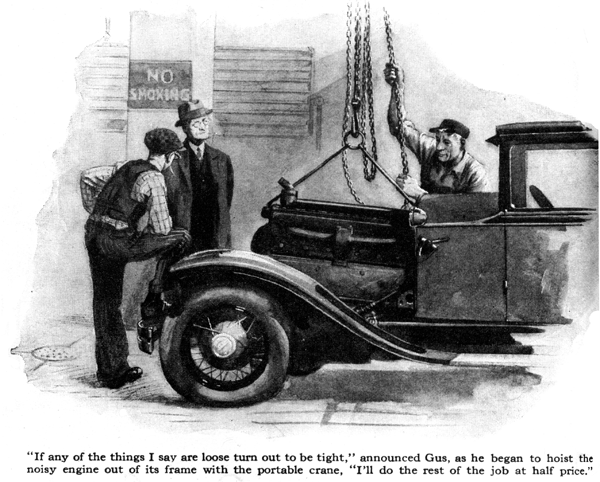
"Say, mister," Gus smiled. "I've been in this business long enough to know what I'm talking about. You stick around while I yank the motor out of the frame, and if any of the things I say are loose turn out to be tight, I'll do the rest of the job at half price.'
"Fair enough," Dobey admitted as they rolled into the Model Garage. He watched closely as Gus got the portable crane ready to hoist out the motor.
"Of course if only piston rings and a loose connecting rod needed to be replaced," said Gus, "there'd be no sense in going to all this trouble. We fix things like that by dropping the oil pan. But your main bearings are in bad shape and I'd rather get the engine out where I can do the job right.
"Now before I start," Gus continued, "Take a look at the bolts holding the motor in place. This one here is so loose you can turn it with your fingers. If you'd kept on running the motor in that condition, the pounding would have busted the motor support and then you'd have been up against a man's size repair bill."
"No doubt about the looseness there," Dobey admitted glumly after he had turned one of the bolts with his fingers. "I thought this talk about telling what's wrong with a motor by the sound was bunk, but I guess there's something to it after all."
"Like most things," Gus smiled, "there's some truth mixed with the bunk. Any smart Aleck who tells you he can spot any trouble in a motor right away just by listening to it is shooting hot air. But a smart mechanic should be able to locate anything that's really loose, by the sound.
"Then there's ways of running down particular troubles. For instance, if you hear a knock that you think is a loose connecting rod bearing, and you can hear it with the motor idling, short circuit the spark plugs one at a time. When you cut out the explosions in the cylinder with the loose connecting rod, the noise will stop or get weaker. If shorting the plugs doesn't affect the noise, you can be sure something besides loose connecting rods is setting up most of the clatter."
"Loose connecting rod and main bearing cause most of the noise in motors, I suppose," suggested Dobey.
"Some people have that idea," Gus replied, "and the minute they hear a clank in the motor they suspect the bearings. Most times the noise comes from the valve operating mechanism. There may be too much play in the tappets, the push rod guides may be worn or the cam shaft bearings may be loose. Of course no one wants to ride in a car that rattles and clanks like an old junk wagon but noises from the valve mechanism are not so important as loose connecting rod or main bearings. When bearings get so loose that you can hear them they ought to be fixed right away. If they're not, pounding may crystallize the shaft and break it, and that is serious. The valve mechanism can be loose enough to make a lot of clatter without causing any particular damage. Timing gears can rattle mighty loud without breaking."
"Gee!" exclaimed Dobey, "I don't think I'll get any fun out of driving if I have to keep listening for noises all the time."
"Neither would I," Gus agreed. "What you want to do is to get your ears accustomed to the sound of the motor when it's running right. Don't keep trying to hear funny noises -- just let your cars tell you of noises that really are loud enough so there's no doubt about you hearing them.
"You'll notice too, that the motor always seems to sound quiet when you're in traffic, but after you've driven for an hour or two at a steady pace on a trip your ears begin to pick out and magnify little sounds that don't mean anything.
Then, when you start out again the next day, you wonder where all the noises went to that you heard near the end of your trip the day before."
"I get you," nodded Dobey. "Your idea is to mix a little common sense with the listening."
"Common sense is handy -- even in a car," grunted Gus. "But we'd go out of business if it got too common!"
END
L. Osbone 2019