February 1969
GUS SEALS A
USED-CAR BARGAIN
by
Martin Bunn
(Ron Benrey)
Gus felt more like
a secret agent than a mechanic
as he kept a rendezvous
to inspect a mysteriously ailing auto.
The loud crash of a falling stack of oil cans in the back room heralded the arrival of Pete Thompson at the Model Garage. It was lunchtime, and both Gus Wilson and his assistant, Stan Hicks, were in the office, munching sandwiches and sipping coffee, when they heard the clatter. A moment later, Thompson poked his curly-haired head through the office door.
"Sorry about the noise, Gus," he said. "I tripped." He nervously eyed Main Street through the big glass window. "I used the back door so that no one would see me come in. Can we talk for a few minutes -- out back?"
Sure thing, Pete," answered Gus. "But why is the front office off limits?" "Because if Mr. Taylor, my boss, knew I came to see you, he'd fire me on the spot," Thompson said glumly. "He wouldn't appreciate his chief mechanic asking another mechanic for advice -- especially about the car."
"You mean old man Harper's '63 Pontiac?" Stan asked. Thompson nodded.
"Ha!" Stan exploded gleefully. "So you're ready to give up! I figured that sooner or later Gus would get a crack at it."
Outside, a car pulled up to the gas pump island. Thompson ducked. Gus chuckled. "Okay, Pete," he said "If these cloak-and dagger games will keep you happy, let's go back to the store-room and chat while Stan takes care of the customers. At least it will give you a chance to restack those cans that you kicked over." Stan jogged out to the pumps.
"It really boils down to a warranty problem," Thompson explained. "The used car agency I work for issues a 90-day parts and labor warranty on any car that is in outstanding mechanical condition -- Mr. Taylor calls them "Tip-Top" cars in his ads. It's one of my jobs to decide which cars qualify."
"And you certified the '63 Pontiac that Mr. Harper bought?" Gus asked.
"Uh-huh," said Thompson. "It was in absolutely great shape when I examined it -- less than a month ago. But about two weeks ago, the trouble started. When the engine is cold, it starts, and runs perfectly. But after running a few minutes, it dies, and it won't start again until it cools off. Then it runs okay for another few minutes and quits. I'm stymied, Gus. The symptoms are always the same. We've towed the car in four times so far -- it's in the shop right now. Mr. Harper wants his money back, and Mr. Taylor is boiling mad at me.
"You heard the way Stan talked earlier," he continued sadly. "Almost everyone in town knows about the car. It's no secret that my job is on the line."
Gus lit his pipe. "I can't do much by long distance," he said.
Thompson's face brightened. "I'm sure I can get the car to a neutral point -- say, the ice-rink parking lot -- running on its own power."
"It's a deal," said Gus. "Meet me there in a half-hour.
After watching Thompson skulk out the back door, Gus turned to Stan. "I'm going out on a road call. Any problems?" Stan was bent over the tire-changing machine, wrestling with a heavy wheel, and the the icy glare he shot back at Gus proved that that was the wrong question. "I've demounted and remounted this darn tire twice already," he said, "and here comes number three."
Harry Lyons was leaning, arms folded, back against the fender of his '67 Ford wagon, watching Stan work. He returned Gus's greeting with a grunt and held up a two-inch-long finishing nail. "My expensive new radial-ply tires attract these things just like my old-fashioned cross-plies." His eyes narrowed. "Hope they don't cost any more to patch."
"Price is the same as always," said Gus. "Your new inner tubes are made of a special rubber designed to withstand the greater sidewall flexing of a radial tire, but an ordinary cold patch will handle any simple puncture."
"There's nothing simple about this puncture! said Stan. "I'll show you what I mean."
He dripped a few dollops of soapy water around the base of the valve stem. "See the bubbles?" he asked sourly. Gus nodded.
"Somewhere near the base of the stem there's a pinhole leak, But I can't find it. I partially inflated the tube outside of the tire, and dunked it in the water tank, and nothing-no bubbles, no his, no pin-hole. But as soon as I put it inside the tire again, it starts to leak."
Harry Lyons tapped Gus's shoulder. "That valve was okay when I drove in. The nail was clear around on the other side of the tire."
Gus looked questioningly at Stan, but Stan just shrugged his shoulders.
"I'll say one thing," Lyons added. "These tires may improve road-holding, but my old tubeless tires were sure easier to mend."
It was the word "tubeless" that did it. Gus and Stan looked at each other, and almost with one breath said, "There is no leak."
Gus explained the mystery to Lyons as he bolted the wheel in place.
"This wheel is designed for tubeless tires, so all of its internal seams are air-tight. What's more, even though this radial-ply tire is a tube-type design, its bead is able to form an almost airtight seal along the wheel rim.
"This means that when Stan mounted the tire on the wheel, a lot of air was trapped inside. Then, when he inflated the inner tube, this trapped air was compressed between the outside of the tube and the inside of the tire. It's leaking out slowly past the valve stem, since the stem base doesn't form a perfect seal to block off the valve hole in the wheel. The hissing and bubbling will stop when the trapped air is all expelled."
The Harper Pontiac sedan hood raised, was parked in a secluded corner of the ice-skating lot when Gus arrived.
"I figured the engine would lose heat faster with the hood up," said Thompson. "You'll want to see the whole cycle, beginning with a cool engine."
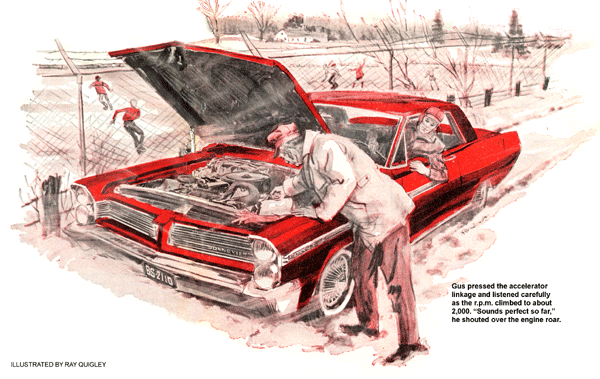
With Gus peering intently at the engine, Thompson hit the starter switch. The big V-8 spun to life and settled into a silky-smooth idle. Gus pressed the accelerator linkage, and listened as the r.p.m. climbed to about 2,000.
"Sounds perfect so far," Gus shouted. "Hold it at this r.p.m. for a few minutes."
Suddenly -- without any rough-running warning -- the engine died.
Gus whistled softly. "She quit cold -- as if you flipped the ignition switch off."
"Yeah," agreed Thompson, "and it'll stay off. Watch." He worked the starter, but the engine wouldn't catch. It cranked at normal starting speed without even a cough. Gus straightened up, a puzzled expression on his face.
"I know exactly how you feel," said Thompson. He slid out of the driver's seat and slammed the hood shut. He reached into his shirt pocket and took out a slip of paper. "Here's a list of the fixes my shop tried-none worked."
Gus scanned the list quickly: "Rebuild the carburetor . . . overhauled fuel pump . . . replace ignition wiring, points, and plugs . . . check fuel line . . . check valve tightness, test PCV valve . . . ” The items went on and on.
"Did we miss any bets?" Thompson asked.
"Doesn't seem so," replied Gus.
"There goes my job," Thompson said.
Gus was too lost in thought to respond. "It's got to be an electrical problem," he muttered.
"The questions are how and where. Let's think about where."
"Right, said Thompson. "I'm willing to try anything -- even thinking out loud."
"The trouble is closely related to engine temperature," Gus said. "What components of the ignition system are mounted on the engine, besides the plugs?"
"The coil and the distributor," said Thompson, "but my shop assistant tried a replacement coil, and I personally checked every part of the distributor, from rotor to vacuum advance . . . "
"Lift the hood again," Gus interrupted. "I spotted something."
Gus's practiced eyes raced across the top of the engine for a moment, and settled on a small puddle of oil just below the distributor. He pried loose the distributor cap, and rubbed a finger along the breaker-point assembly surfaces.
"Crank the engine, Pete," he said. "And keep cranking until I say stop."
With the starter motor spinning the engine, Gus waited about 30 seconds, until the oil pressure had built up. Then he stared into the distributor.
A steady stream of oil droplets had begun to spin off the distributor shaft.
"There's your answer," he said. "Oil . . . Engine oil is a good electrical insulator. The seals on the distributor's drive shaft are bad. When the engine warms up -- and the oil thins out – oil squeezes by the seals and ends up on the shaft. Some of the oil droplets that are spun off hit the breaker points, coating them with a thin, insulating oil film."
Thompson nodded, "and the film interrupts the ignition current, so the engine dies."
"And it won't start again," Gus added "until the oil cools down enough and thickens so that there's no more oil leakage past the seals. When the droplet spray stops, the hammering action of the point surfaces pound through any remaining film, and the ignition current can flow again."
Gus chuckled for a good part of the drive back to the Model Garage. He was thinking of the note in his pocket:
"Dear Gus:
My chief mechanic Pete Thompson has too much pride to admit he can't solve an auto problem all by himself. I don't dare suggest he ask you for help, since he might up and quit. He's too valuable to risk that.
"Can you drop by this afternoon for a 'social call' and peek over his shoulder, and maybe give him a helpful hint? Whatever you do, though, don't tell him it was my idea.
Lou Taylor."
END