September 1949
GUS FIXES A TRAFFIC RAP
by Martin Bunn
Smoky exhausts ad expensive repair jobs usually go hand in hand,
but the smoker a state cop drags in needs only the quick treatment.
Trooper Jerry Corcoran likes action. And that was exactly what he hadn't been getting for the past few weeks. All the action he'd seen recently was his regular patrol. Corcoran was bored. In fact, he was more than bored. He was irritated.
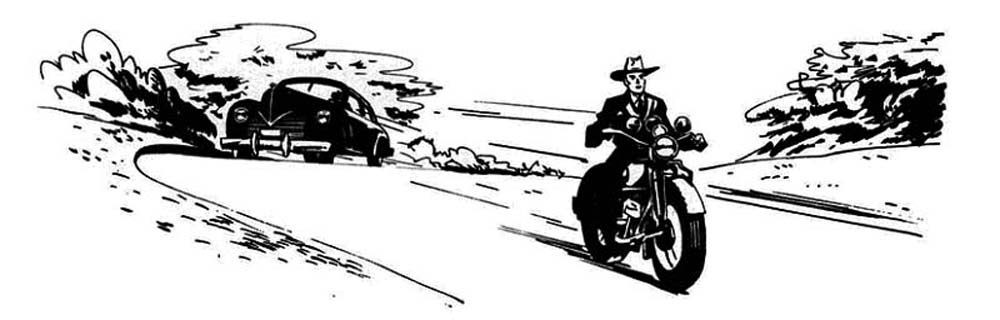
He sat his parked motorcycle just off the highway at an intersection, watching the late afternoon traffic outbound from the city. An old sedan, trailing dense smoke from its exhaust, rolled down the side road. It was almost to the highway when Corcoran kicked the starter and roared in pursuit. He sped through the acrid smoke and drew abreast of the sedan. The driver, a thin-faced young man, stared straight ahead. When Corcoran sounded the siren, the startled driver jerked his head around and slowed his car. The trooper waved him to the shoulder of the highway, Jerry parked his motorcycle in front of the sedan and walked back. The driver had his head out the window.
"What's the matter?" he asked excitedly. "I wasn't going too fast."
"Let's see your registration and driver's license," Corcoran ordered. The young man fished them out of his wallet with shaking fingers and handed them over. "Henry Sutter," the trooper read.
"What's the matter?" Sutter repeated, apprehension in his voice. "I haven't done anything wrong. I'm in a hurry. I've got to get to the city right away."
"Your registration and license seem to be in order," Corcoran said, "but running that stop sign back there was certainly out of order."
"What stop sign?" I didn't see any sign."
"Where you turned into the highway."
"I just didn't see any sign," Sutter said. "All I remember seeing at that intersection was a lot of bushes and weeds."
"And besides," the trooper went on, "there's a law in this state against driving a car that's in such bad mechanical condition that it's a menace to other traffic."
"What do you mean -- a menace to other traffic?" Sutter demanded indignantly. "There's nothing wrong with this car. It's nine years old but it runs okay."
He Didn't Know It, He Says
"I said," the trooper repeated heavily, "that your car is a menace to other traffic. It's throwing enough smoke out of the exhaust to pass for a regulation Army smoke pot."
"This car never smokes," Sutter said flatly.
"Get out and look for yourself," Corcoran told him.
Sutter climbed out of the driver's seat, walked around back, and returned with a puzzled expression on his face. "It's never done that before. Something most have gone wrong since I left home."
"I've heard that one before," Jerry commented.
"Honestly, I didn't know it was smoking," Sutter said. "It wasn't when I backed out of the garage. I got out to see if the trunk was locked, and there wasn't any smoke."
Jerry gave the young man a long, hard look. The trooper knew very well that the stop sign was partly obscured by brush. He didn't want to press that point too much, but he didn't want Sutter to think he'd forgotten it.
"Maybe I'm a sucker," he told Sutter, "but I'm taking your word about the smoke."
"Then I can go now?" Sutter's face brightened.
"No," Corcoran said. "There's still that stop sign and, anyway, you can't drive this smoking car. You'll have to get a garage car to tow you in."
"A garage car!" Sutter almost screamed. "I can't take the time now. It's getting late. Everything depends on me getting to the city. Everything!"
Corcoran froze up again. "That car's a menace," he snapped. "If you try to drive it, I'll arrest you. Make no mistake about that."
Sutter pleaded and argued so earnestly that Corcoran finally weakened. He said it would be all right if Sutter followed him to the nearest garage and had the smoking fixed right away.
A couple of miles down the highway they reached the Model Garage. Stan Hicks stepped to the shop door as they pulled into the drive.
"Hi, Jerry," he called. "Know there's a smoke screen following you?"
"I want this car fixed right away," Sutter cut in. "I've got to get to the city."
"Right away?" Stan laughed. "How long do you think it takes to rebore cylinders and install new rings?"
"New rings!" Sutter gasped.
"I never saw a car smoke like that if the rings weren't shot," Stan said.
"What's up?" Gus Wilson asked, stepping up beside Stan.
Sutter cut the ignition, got out, and told Gus the story of the smoke.
"The car was all right when you left home," Gus summed up, "but started smoking after you'd driven awhile?"
"That's right."
"Could be rings," Gus said, "but I doubt it. They usually show up gradually."
Just then a convertible whizzed into the drive and jolted to a stop at a gas pump. Stan stepped over with his best smile when he saw the driver was a pretty girl.
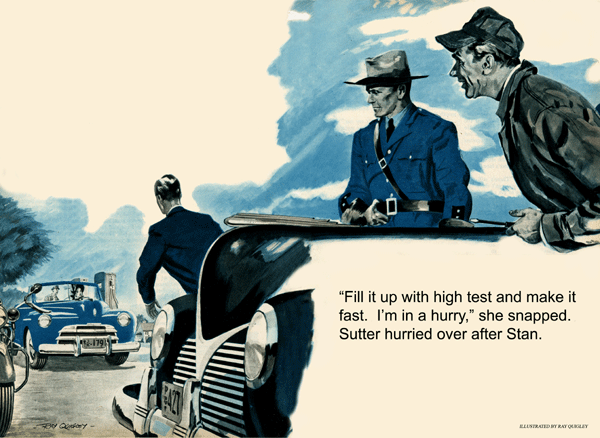
"Fill it up with high test and make it fast. I'm in a hurry," she snapped.
Sutter hurried after Stan. Jerry strolled after Sutter. When the girl saw Sutter, her mouth tightened.
"There's something wrong with my car," Sutter told her abruptly. "It may take some time to fix it. You know we're after you. Will you take me to the city?"
"Here's your money," the girl said to Stan.
She turned to Sutter: "I have to pick up Mr. Johnson, and anyway, if you're late, it'll be just too bad." Then the convertible was gone.
Who Murdered Staunton?
"Check the plugs, Stan," Gus told him when the old sedan was in the shop.
"Number one's oily," Stan reported in a couple of minutes, "number two is oily, too, but not as bad. The rest are okay."
Gus walked to his workbench. He rummaged through a drawer picked up two small pipe plugs, and returned to the car. Sutter was pacing up and down nervously. Stan heard him talking to himself and edged over to Corcoran.
"You'd better watch that guy, Jerry," he advised. "He's talking to himself about some body being dead and some money being gone. And he told that girl in the convertible, we're after you."
"I thought there was something queer about that guy," Corcoran muttered.
Sutter had stepped to an open window and was starting out. Jerry drifted to the water cooler near the window. He heard Sutter say: "He's dead. Staunten's dead. In my apartment. And the money's gone. That girl's got it."
Just then Gus called to Sutter.
"Watch this," Gus said, pointing to the fuel pump. Gus disconnected both ends of a copper tube that ran from the pump on the intake manifold. Then he screwed the pipe plugs into the openings in the manifold and pump. "Start her up, "Gus told Stan.
The engine ran smoothly and no smoke came from the exhaust
"So it wasn't the rings," Stan said, much puzzles. "But what was it?"
"If you were familiar with this model," Gus explained, "the cause of the smoke wouldn't be tough to guess. The fuel pump is a dual unit. It's both a fuel pump and a vacuum-booster pump. The line from the windshield wiper runs to the vacuum side of the unit. Another line from that unit goes to the opening in the manifold. It keeps the vacuum up on the wiper when manifold vacuum is weakened by tromping on the throttle or, when you're pulling hard in a hill."
"But what's that got to do with the smoke?" Sutter asked.
"The vacuum pump diaphragm developed a leak," Gus went on. This allowed oil to be pulled from the crankcase and fed into the intake manifold. From there the oil went into the first two cylinders, where it burned, causing smoke."
"I see," Stan put in, "Disconnecting the line stops the oil and the smoke."
"Can I drive it now?" Sutter cut in impatiently.
"Sure," Gus said, "but the windshield wiper won't work until a new diaphragm has been put in the vacuum pump and that line has been reconnected."
Under Arrest
"You can fix it tomorrow; "Sutter said. "I haven't got time now." He started to get in the car, but Corcoran caught his arm.
"You're under arrest."
"Under arrest?" Sutter yelped. "What for?"
"For driving an unsafe vehicle," Corcoran told him. "That'll hold you for now. What about Stauntom? He's dead in your apartment. And the money's gone. What about that?"
The trooper expected Sutter to cringe in dismay. Sutter didn't. Instead he started to laugh. He laughed until tears were running from his eyes.
"I'm sorry," he said at last, "but it is funny. Staunton's dead and the money's gone."
"All right, all right," Corcoran said peevishly. "Let's go to the station house and see how funny that is."
"Keep your shirt on," Sutter said between chuckles. He reached in a pocket and pulled out a printed folder and several typewritten sheets. "That business about Staunton being dead and the money being gone are just lines from a play we're putting on tonight."
The trooper took the folder and read aloud; "Twenty-fifth Annual One-Act Play Tournament. Final round. Avon Little Theater presents Another Way Out . . . Richard Davis, a lawyer . . . Played by Henry Sutter."
Sutter pointed to one of the typewritten sheets. "Here are my lines . . . Staunton's dead, and so on. Satisfied?"
"No," Corcoran said, "I'm not. What about that girl? You said you were after her."
Sutter laughed again. "I meant that our play went on after hers. She directs the company that's in the finals with us. She wouldn't take me to the city, figuring that if I didn't get there her company would win by default when our play didn't go on."
"Well, you better get going," Jerry grinned wryly. "How wrong can I get?"
"Afraid it's too late now;" Sutter glanced at the clock.
"Suppose the girl were late, too?" Corcoran asked.
"They're on first. If they start late, then I can make it."
"Who'd she say she had to pick up?"
"A Mr. Johnson," Sutter said. "In Newtown."
"Then she's got to pass that same stop sign," Jerry grinned.
"That's right," Sutter agreed.
"On your way," Corcoran said. "I better go talk with a girl about a stop sign she isn't going to see."
END
L. Osbone 2019