May 1959
GUS REVEALS A TRADE SECRET
by Martin Bunn
The man behind the wheel of the elderly sedan honked his horn as he drove into the Model Garage.
Gus Wilson, walking over to where the car had stopped just inside the doorway, saw his young assistant, Stan Hicks, frantically beckoning to him from behind the glass office partition.
"Be with you in a minute," he called to the customer and joined Stan.
"Turn that job down Gus. It's loaded."
"Loaded?" Gus asked.
"Yeah," Stan explained. "Bill Dart down at the City Garage has been stuck with it for more than a week. The guy driving it is Dart's brother-in-law from Belleville, Al Pierce."
"I got it," Gus said, rubbing his chin Bill Dart, a young mechanic who had recently taken over the rival garage, was all out to cut into Gus's business.
"Sure, Gus. You fix it, Bill Dart takes the credit. You fail, and he'll spread the word one way or another."
"What tipped you off, Stan?"
"Oh, I get around. Dart sold that car to Tom Morgan with a guarantee. Now some trouble has developed that he can't fix. He's stalling Morgan off, saying he's too busy to get at it. Won't admit being stumped as a mechanic."
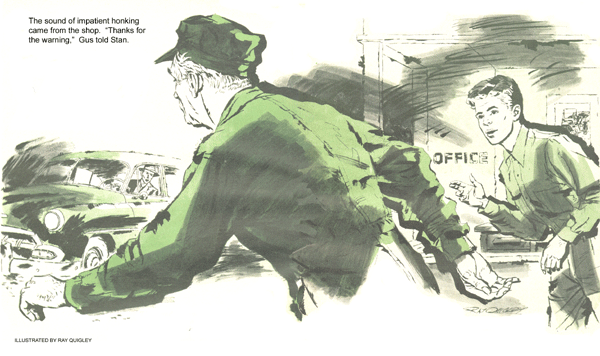
The sound of impatient honking came from the shop. "Thanks for the warning," Gus said.
As he went into the shop, the man sidled out of the sedan and introduced himself. "Just came in for a tune-up before leaving on a trip."
"Okay, Mr. Pierce," Gus said, lifting the hood. "Start the engine."
The garageman listened to a smooth idle. He reached over and slowly advanced the throttle at the carburetor. The engine picked up nicely, then roughened, shook on its mounts, getting rougher as speed increased. Either the high-speed jet was fouled, Gus figured, or the carburetor float level was set too low, so the motor starved for gas at higher speeds. He began to pull the carburetor.
"Spotted something right away, eh?" Pierce remarked.
Gus detected a note of sarcasm in the man's voice, and as he took the carburetor down on the bench he realized that Bill Dart had undoubtedly already gone over it several times. Pierce knew that Gus was wasting his time. And as it turned out, he was. The float level was set to factory specifications and the high speed jet was clean as a whistle.
"Sure you can put it together again?" said Pierce as Gus began to reassemble the carburetor. "Good as it was, I mean."
Gus ignored him. Then, still working on the theory that the car was starving for gas at high speeds, he ran a test on the fuel pump, checked hoses and gas lines for lose connections, brakes, air leaks, hose breakdown, flattening or obstruction. He checked the gas-tank air vent, then tightened the manifold studs, went over the gasket for leaks, ran a vacuum test. Everything seemed to be in order. He started the car, and again it roughened with the engine speeding.
"Have fun," Pierce said smugly, crossing his arms over his chest. "I drive the car in here, running fine, and ask for a simple tune-up. Now listen to it."
"You're welcome to try the City Garage down the street." Gus said patiently.
"Take your time. I'm in no hurry."
Now Gus knew that Stan Hicks had been right and that he had to find the trouble. Otherwise the rival garage-man's brother-in-law was all set to spark snide rumors about the Model Garage. Gus wasn't worried about that. He just refused to let himself be flummoxed by a couple of smart alecks.
Just then Stan Hicks, who had been watching from a corner of the shop, tumbled up the test machine. "Thought you might be needing this, Gus," he said, giving his boss an I told-you-so look.
"Thanks," Gus said, turning his attention to the ignition system. He checked the timing points, distributor cap, ran a test on the coil and condenser. Nothing wrong. In each place there were indications that Bill Dart had been working there before him. Gus removed the spark plugs, cleaned them, ran a breakdown test. Glancing up, he caught Pierce grinning.
"Let's take her for a run," Gus said.
Out on the street he tooled the car through traffic. It ran as smoothly as a jeweled railroad watch. On the road, Gus stepped on the accelerator. The car picked up nicely, then roughened, slowed, missed, threatened to quit entirely with a hollow sound that seemed to signal gas starvation.
As he drove, his companion silent at his side, Gus recalled several cases where the hollow sound had signaled ignition trouble instead of lack of gas. But there was nothing wrong with the ignition system of the car. Or was there? His eyes on the ammeter, he picked up speed. Just as the car began to run rough there was a flickering of the ammeter needle. With a clean ignition system it shouldn't have occurred. Still, the flicker could have been caused by a slight short somewhere else in the car under speed pick-up vibration, or even by a bouncing generator brush.
Back at the Model Garage, Gus stuck his head under the hood again. He spotted a new gasket under a cylinder head that also seemed to be new. "Had a new cylinder head put in recently, I see."
"Yeah," Pierce said. "It had a weld and I wouldn't buy it until the used car dealer installed a new head."
With this clue, Gus was off on a new tack. As he inspected the new head, it seemed that the coil mount was a bit farther from the distributor than the original had been. If so, the primary wire from the coil to distributor might be a bit short.
He started the engine. As it speeded up, he noticed that the automatic spark advance caused the distributor to rotate, increasing the distance between the coil and where the wire was attached pulling it taut. "Could be," Gus said to himself, picturing the wire tightening and loosening with every change of speed.
With his back to Pierce, he removed the wire and replaced it with a jumper wire. "Okay, Mr. Pierce, let's take another drive."
This time the car accelerated with velvet smoothness from 10 miles an hour to 60. Gus turned around taking silent satisfaction from the surprised look on the face of the man next to him. When he drove into the Model Garage and got out. Pierce slipped behind the wheel, taking out his wallet.
"How much do I owe you?"
"Not so fast," Gus said, reaching over and turning off the ignition. "You tell that brother-in-law of yours, Bill Dart, that I'll deliver this car to him personally -- and the bill, too."
The man's face reddened. He started to protest, thought better of it, and got out. "Well," he said, shrugged his shoulders, "it's no skin off my back. I'll tell him all right."
When Pierce was gone, Gus called Stan over. Together they examined the old piece of wire, cutting open the insulation. As Gus had suspected, all but a few of the copper strands inside were broken. He explained to his assistant.
"You see, at slow engine speed, with the automatic spark retarded, the broken ends of the wire came together so that it delivered normal voltage. But at high speeds, with the ends pulled apart it wasn't capable of carrying full voltage to the ignition points."
Gus replaced the jumper wire in the car with a new wire having the same colors as the old one.
He rubbed it with dirt and grease to hide the newness.
Stan chuckled. "Bill Dart will never know what was wrong."
Gus pulled out his pipe and began filling it. "Well, Stan, that was my idea, but I've changed my mind." He rubbed the dirt and grease off the new wire.
"Young fellows like Bill Dart, just starting, can use all the tips they can get."
"Wait a minute, Boss," Stan objected.
"This turning the other cheek' can go too far. Bill Dart will take all the credit and Morgan won't even know . . . "
"I'm not so sure about that, Stan."
"What makes you think so?"
"Well, a couple of things. For one, as we drove through town just now Tom Morgan was coming out of the Post Office. I'm sure he recognized the car. If he can add two and two . . ." Gus struck a match and held it to the bowl of his pipe.
Stan waited. Then: "You said a couple of things?"
"Yes, reckon I did," Gus said, puffing a cloud of smoke. "I was thinking of you, Stan. I've never known you to hide our Model Garage light under a bushel."
END