January 1947
GUS DROPS IN FOR PIE
by Martin Bunn
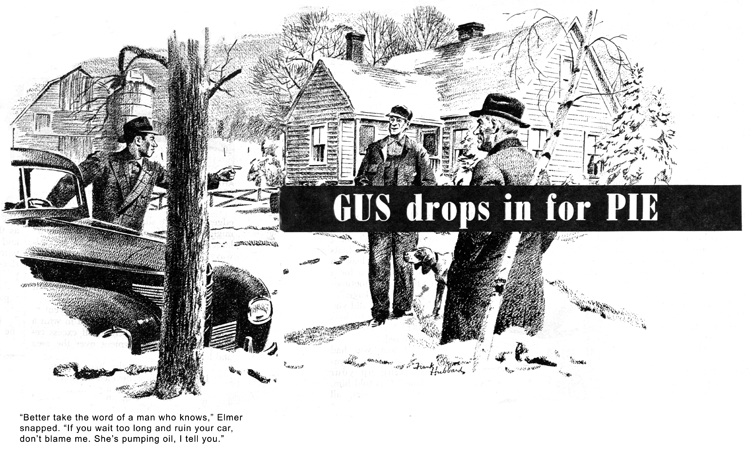
Mel Mowbray runs a farm quite a distance from our town, but he stops at the Model Garage to fill up with gas whenever he is down our way. In the course of the past 10 years he and Gus have built up a strong friendship.
One winter morning Gus looked up from a job in the shop and saw Mel's car through the window, so he strolled out to the gas pump for a chat. Stan Hicks, the Model Garage grease monkey, had been checking Mel's oil and was holding out the bayonet gauge for the big farmer's inspection.
"All right, put in a quart," Mel told him sourly and turned to Gus. "My car is using a lot of oil," he complained, "a quart every 200 miles."
"How long has that been going on?" Gus asked.
"Oh, just the last couple of weeks," Mel replied absently.
"It's probably your winter oil," Gus said reassuringly. "This unusual warm weather thins it out quickly. If you don't notice an improvement when it turns colder, you'd better have a check."
Then he changed the subject as Mel nodded because Mel has always had repairs done at the country garage in his neighborhood and Gus didn't want to cut in.
"Get that washing machine for Mrs. Mowbray yet?" he asked.
Mel shook his head a disappointed look on his ruddy face. "That's what I came to town about," he said. "We've been promised the machine for the past six months, and now the dealer says we'll have to wait another month at least."
He paid Stan for his gas and oil and got into his car. "Stop by and visit us when you're out our way," he told Gus cordially. "Mary says to tell you she hasn't forgotten how to bake pie."
Gus's grin was full of fond recollection. "I'll be dropping in one of these days, all right," he promised. "Tell Mrs. Mowbray her pie is worth a trip twice as far."
That day arrived some three weeks later. The unseasonable weather had changed and to balance his books Old Man Winter had sent along a heavy snowfall and followed through with a seemingly endless succession of days on which the mercury never climbed as high as the freezing mark.
Gus had been on a business trip and was driving home when he reached the crossroads near Mel's little farm late on a bitter afternoon. The red sun had sunk below the hills in the west, leaving behind a gray-green sky against which the bleak pines on the snow-clad ridge stood out black and hard. A little tired and a lot hungry, Gus pictured himself in Mel's old fashioned kitchen, a wood fire blazing in the big range, and stout, rosy-cheeked Mary Mowbray plucking a steaming pie from the oven. He turned from the clean-swept concrete highway to the snow-rutted country road.
After 20 minutes he came to a poplar-bordered lane leading from the road a couple of hundred yards to Mel's farmhouse. Gus looked up the single set of ruts and saw a strange car at the house.
"Guess I'd better get out and walk," he said half to himself. "There's no way to get past that fellow, and I don't want to back the whole way down here."
A biting wind smacked him in the face as he got out of his car. He bowed his head and started trudging. Pretty soon his eyes caught a small dark spot on the ice-glazed snow halfway between the deep ruts. Then 100 feet farther on he saw another, and then another, another, and another, all about the same distance apart.
Gus was near the house when Mel came out with a sharp-featured young man who was wearing a sporty overcoat over coveralls.
"Hello, Gus!" Mel boomed. "You're a sight for sore eyes. Come on in and have supper. But where's your car?"
"Down at the far end of your one-way street," Gus grinned. "I didn't think there was room for two of us to pass."
The young man looked inquisitively from Gus to Mel, but the farmer, though his face grew a shade redder than years of sun and wind had turned it, made no move to introduce his visitors.
"Thanks for bringing the battery over, Elmer," Mel said. "I'll have to think about that other job."
"Better take the word of a man who knows," Elmer snapped. "If you wait too long and ruin your car, don't blame me. She's pumping oil, I tell you. That war gas and oil filled your piston-ring grooves with gum, and the rings can't move -- the oil just blows past them."
"But $90 is a lot of money," Mel demurred.
"Sure it's a lot," Elmer agreed, "but it's easier to pay for tearing down your engine, cleaning out the grooves, and installing new rings than it is to get a new car," He turned to Gus, "Am I right, mister?"
"Well," Gus hedged, "new cars are hard to get."
"You're right, they're hard to get," Elmer snorted. "I'll take you down to the road, mister, if you want to drive your car in."
"Thanks," Gus said, and got in with him. "I'll be back in a minute, Mel."
"Peters is my name -- I'm in the automotive line," Elmer announced importantly as he let in his clutch. "I do business up here in the sticks, but I do it in a big-shop way. My toughest job is selling these farmers preventive maintenance. Mowbray's car, for instance, is pumping oil -- "
"Have you tested it?" Gus asked innocently.
"Test!" Elmer retorted scornfully. "I know what's wrong without wasting time on tests."
"That's a gift," Gus said mildly. "Well, thanks for the lift."
Elmer regarded him with suspicion. "Up here on business, mister?" he asked.
"No, just paying a social call," Gus replied, and got out.
He drove his own car slowly back to the house, his eyes on the snow between the ruts. Mel was waiting at the door, and Mrs. Mowbray welcomed him in the kitchen with: "Supper's on the table, Mr. Wilson. Make yourself at home and fall to."
Gus did that with a right good will, Mel was looking worried but his wife chatted happily. Then after dessert -- her famous deep dish apple pie -- she burst out with a piece of news.
"The dealer phoned today," she beamed. "He has the washing machine."
Mel mumbled something and then, when Gus had finished his coffee, he led the way to the parlor. "I hate to disappoint Mary," he told Gus quietly. "But $90 to repair the car means no washing machine."
Gus lit his pipe. "Mel," he said, "I'm going to do something I've never done before -- butt in on another shop's job. Can I take a look to see what's wrong with that car of yours?"
"Of course," Mel agreed eagerly.
They went into the barn, Mel with a lighted lantern. Gus had him race the engine while he watched the exhaust. There was no telltale blue smoke. Then Gus crawled under the car. "Push the lantern a little closer so I can see the crankcase pan," he said. The bottom of the pan was streaked with wet oil.
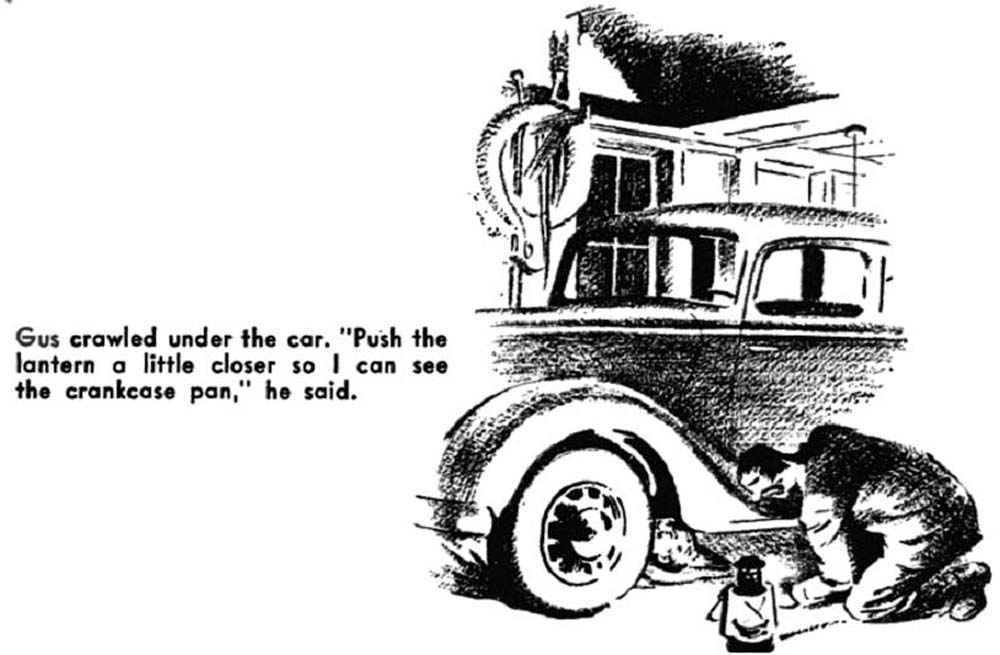
Gus backed out from under the car, got a socket wrench from his own tool box, and crawled back under. The first pan bolt he tried required a full turn to tighten, and some were so loose they took more than two full turns.
"Go ahead and buy Mrs. Mowbray her washing machine," Gus grinned as he got up, brushing his trousers. "You aren't going to have any more trouble. The oil-pan bolts are apt to loosen up and cause a leak on almost any car after it's been driven for a time -- sometimes from vibration, sometimes gasket shrinkage."
"But how did you know what to look for?" Mel asked bewildered.
"I saw you had a leak when I was walking up your lane," Gus told him.
"It was yours, all right, because there were no more spots after Elmer drove down -- just one spot every hundred feet."
"Doesn't sound like much of a leak," Mel said doubtfully.
"No?" Gus went on. "Well, a drop every hundred feet is 50 drops a mile. You said you need up a quart every 200 miles. Let's see, 200 times 50. I don't know how many drops there are in a quart, but 10,000 drops make a lot of oil."
Mel grinned. "Gus," he said, "you're the best friend I've ever had. Make out your bill, and I'll pay you -- even if it's $90"
"Bill?" Gus laughed. "I'm not on shop time now. Just call the job my thank-you gift to Mrs. Mowbray for the pie. And when she gets that washing machine, she'd better invite me back here for another slice."
END