February 1946
A NUT GETS LOOSE IN THE MODEL GARAGE
by
Martin Bunn
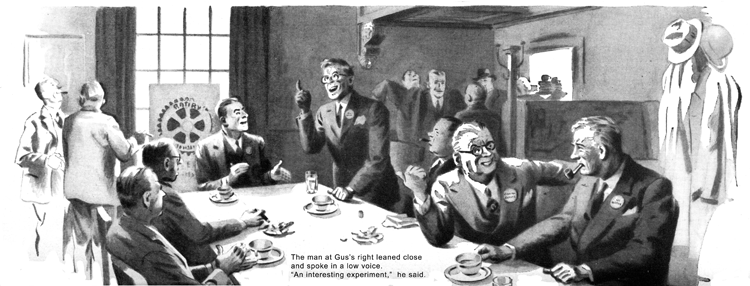
"And that, gentlemen," wound up the speaker, blinking his pale-blue eyes rapidly and running nervous fingers through his unruly mop of sandy hair, "that is the mission of the psychiatrists of the professional staff of Walnut Lodge -- to restore to those unfortunates their priceless heritage of mental stability and emotional tranquility. Gentlemen, I thank you."
He sat down and modestly sipped water as the patter of polite hand clapping mingled with the scraping of pushed-back chairs.
A man who had slipped into a chair at Gus Wilson's right just as the speaker started leaned close and spoke in a low but deep voice. "An interesting experiment," he said. "Or, more accurately, a convincing demonstration of what the scientific treatment at Walnut Lodge accomplishes."
Gus looked attentively at his neighbor for the first time. He was portly and well dressed, apparently in his fifties. A bald spot bordered by fringes of graying hair added to a high and bulging forehead. Keen blue eyes peered through rubber-tired spectacles. His manner was portentous but at the same time placid. Gus couldn't remember having seen him before, but the name "Dunbar Coleman" lettered on his visitor's badge jiggled some faint recollection.
"You agree with me, I hope, sir?" his new acquaintance inquired.
"I'm afraid," Gus had to admit, "that I don't quite understand."
"Of course -- of course," the portly man interrupted in a soothing tone. "I'll explain. But first allow me to introduce myself -- Dr. Coleman Dunbar, chief of the Walnut Lodge psychiatric staff."
Gus's jaw sagged, and he took a hasty look at his luncheon program. "I'm afraid that I still don't get it," he said weakly. "According to my program, Dr. Coleman Dunbar is the man who talked to us."
"Ah -- that's the point," his new friend told him. "Mr. Dunbar Coleman, the gentleman who spoke and is now congratulating himself -- and justly -- on being a very clever fellow, is one of our patients. He is recovering -- no, he has recovered -- from a mental maladjustment, resulting from his parents refusing to permit him to suck his thumb when he was a small child, which made it impossible for him to talk to more than one person at a time.
"The inverse similarity of our names -- Coleman Dunbar, Dunbar Coleman -- ha, ha! -- suggested to me an experiment to demonstrate Mr. Coleman's complete cure and to convince him that he is cured. I exchanged visitors' badges with him and induced him to address this gathering under my name. Mr. Coleman now knows that he can talk to more than one person at a time.
"Momentarily he thinks that he is Dr. Coleman Dunbar and that I am one of his patients, but that mild delusion is inconsequential. You follow me, I trust?"
"Oh -- of course," Gus said uncertainly.
The portly man's eyes were on his badge. "Gus Wilson," he beamed. "Can it be that I am so fortunate as to meet the Gus Wilson of whom I have heard so much -- the mechanical wizard who cures all automotive troubles in the wink of an eye?"
"I wouldn't say that," Gus protested.
"Fortunate," the other rejoined. "Distinctly fortunate! My car is causing me serious annoyance. Under certain road conditions it is subject to convulsive contortions. If you will pardon a vulgar but expressive phrase, it gives me the jitters -- ha, ha! Before I return to the tranquility of Walnut Lodge, I shall stop at your establishment and ask for a diagnosis. Until then, Mr. Wilson, good day."

Gus scratched his head as he watched him make his way to the luncheon speaker. "I'd better get back to the shop," he muttered, "before I go nuts."
An hour later Stan Hicks came into the Model Garage shop with a wide grin on his grease-streaked face.
"Mr. Clark has a pair of screwballs in the office," he told Gus. "They've got a car they want fixed, but they can't make up their minds what their names are or which one owns it. He's bringing 'em in here."
Joe Clark, looking somewhat dazed, came into the shop with Gus's acquaintance and the man who had addressed the luncheon. "Two gentlemen who want some work done," he said weakly. "Gus, meet Dr. Dunbar."
Both stepped forward and shook Gus's hand.
"And Mr. Coleman," Joe added.
Neither caller moved. Then the man who had addressed the luncheon jerked an elbow viciously into his companion's ribs.
"Pleased, I'm sure," the portly man said as he again shook Gus's hand. He added in a whisper: "I'll humor him -- it's safer. The transitory delusions, which are a common aftereffect of the Von Affengesicht treatment, occasionally result in violence."
"Excuse me," Joe Clark put in. "I hear the phone ringing." He left hastily.
"Dr. Dunbar told me this noon," Gus said, "that he wanted me to look at his car."
"I told you!" the sandy-haired man shrilled. "I never laid eyes on you before."
"Pay no attention to him -- poor fellow," the portly man said. "Yes, Mr. Wilson, I would appreciate it if you would examine my car, and -- "
"Your car!" the sandy-haired grated bitterly. "Why, you . . . "
Gus was dizzy. Stan, pale around the gills, was edging toward the door.
"There's someone wants gas at the pump," Stan muttered, but Gus grabbed him. "You stay here," he snapped.
"Come, gentlemen, let us tranquilize ourselves," the portly man said finally. "That unfortunate similarity of names -- Dunbar Coleman, Coleman Dunbar, ha, ha! -- not infrequently causes confusion. By dispensing with formality we will both dispel that confusion and create an atmosphere of simple friendliness in which we can transact our business . . . Just call me Dunbar."
"And just call me Coleman!" his companion added.
Gus's brain went into a tailspin, "That's -- that's just dandy," he said, and let go of Stan's coveralls. "If there's a car outside," he ordered, "bring it in!"
A half minute later Stan drove a blue coupe into the shop. "Runs swell," he told Gus as he got out of it.
The portly man looked at Stan as if he were some breed of mildly interesting insect, and then turned to Gus.
"As I told you at luncheon," he said, "under suboptimum road conditions my car indulges in convulsive contortions which are disturbing even to a person, such as myself who enjoys perfect mental balance. In spite of all my efforts -- and I may say without false pride that I am a skilled driver -- the car continually swings from one side of the road to the other.
"It has been thoroughly examined in several reputable repair shops; its wheels have been checked and rechecked for balance and trueness. The last mechanic I consulted said that the trouble -- weaving, he termed it -- was caused by worn kingpins. New pins were installed, but there was no improvement."
He leaned close to Gus and lowered his voice to a whisper. "Slowly but surely," he confided, "it is driving me as daffy as my poor patient over there who suffers from the delusion that he is I and my car is his. Do know where I can get some Little Neck clams?"
Gus jumped as if a bee had stung him.
"What!" he yelped. "What have clams got to do with -- Try a sea-food store!"
The portly man nodded. "A most intelligent suggestion," he said placidly. "I'll telephone for them."
He disappeared into the office. The sandy-haired man, his pale eyes blinking furiously, grasped Gus's arm.
"This is our chance to accomplish something," he said hurriedly. "You understand the situation, of course -- that it is advisable for me to humor my poor patient until I get him safely back to Walnut Lodge . . .
"What he told you about the steering difficulty with my car, which on occasion I have permitted him to drive under my close supervision, is quite correct and accurate. But he failed to tell you about a much more serious trouble. When the road surface isn't perfectly smooth, the car squeaks and groans like a lost soul. I've had it lubricated and sprayed again and again, but nothing does it any good." His voice grew shriller. "It's got on my nerves so badly that I can't bear to drive it or even ride in it. I tell you, it's driving me mad. Where can i get some Little Neck clams?"
Gus felt a prickling at the nape of his neck. "Why," he demanded, "do both of you nu -- both of you fellows want clams?"
"I don't want them -- I hate them," the sandy-haired man told him. "It's my wife who wants them -- she's giving a dinner party tonight. She told us to bring home two dozen. But my poor patient can't be trusted to remember anything, and I forgot all about them. She'll be furious!"
"Oh, that's it," Gus said, greatly relieved. "Well, now, you step into the office and phone a sea-food store to send them here. While you are waiting for them to be delivered, I'll try to find out what's the matter with your car."
Gus watched him go into the office.
"Quick, Stan," he told the grease monkey, "lock both the office door and the street door so they can't get back in here. Then we'll have a little peace while we check their car and get rid of them."
Stan locked the doors. "Say, boss," he asked, "which is the nut?"
"Take your pick and you won't be wrong," Gus growled. "Get moving and jack up the front end of their car."
When the car was jacked up Gus carefully measured the distance between the tops of the front wheels, and then between their bottoms. It was exactly the same.
"No camber," he told Stan. "The tops of the wheels aren't farther out than their bottoms as they should be. That's nearly always an indication of loose or worn bearings, which allow the wheels to change their camber continuously and so cause weaving and other varieties of shimmy. Only new front-wheel bearings will cure the trouble. Now let's try to find out what's causing the squeaks and groans."
He got an oil gun and thoroughly sprayed all the little pieces of leather fixed between the fenders and the body and along the frame where the body was fitted on it. Then he checked all the spring leaves and the action of the shock absorbers.
'Everything seems O.K.," he told Stan, "but I'd better take a little ride."
He was back in five minutes. "Still noisy," he said. "Now let's see -- " He was interrupted by a tremendous knocking on the office door. "Better let them in."
Stan opened the door, and the two customers hurried into the shop, the sandy-haired man carrying a box that obviously contained clams.
"Got my car fixed?" he asked.
Gus told him about the worn front-wheel bearings.
"You'll have to let us have your bus for a day if you want us to install new ones," he added. "And so far I haven't been able to locate the source of the squeaking you complain about."
The portly man looked pityingly at his companion. "Does he mean that slight noise which you so foolishly have allowed to disturb your tranquility?" he asked. "Why, I located the cause of that the other day, but I forgot to tell you."
He lifted the hood and pointed to the lacing near the radiator. "There it is."
"By gum, he's right!" Gus exclaimed.
"The lacing has been worn flat and pushed out of position so it doesn't support the hood, and that causes the squeaks. It's a frequent cause of squeaks, but one that is difficult to locate."
"I didn't find it so," the portly man said calmly. "Just a simple process of elimination."
"We'll install a new lacing when you bring the car in," Gus told him.
The sandy-haired man nodded and slipped behind the wheel, and his companion got in beside him. "Home, Coleman," he said.
"Yes, Dunbar -- we're late," the sandy-haired man replied.
They drove out of the shop.
"Say, boss," Stan asked, "which is the crazy one?"
"Well," Gus said, "I figured it probably was the big one -- until he found the cause of that squeak after I'd missed it. Now I don't know. Maybe it's me.
END
L. Osbone 2019