August 1938
GUS GIVES SOME TIPS ON OUTBOARD MOTORS
by Martin Bunn
It was a midweek afternoon in the Model Garage. In the little office, industrious Joe Clark was happily engaged in making out the customers' monthly statements. From the depths of the greasing pit outside came, hollowly, the voice of Harry, the musical mechanic, raised in lugubrious song.
Gus Wilson listened to it as he took apart a balky carburetor. "Why don't these kids ever sing anything cheerful?" he wondered, his thoughts on the ragtime of his youth.
A car stopped in the driveway, and Gus heard the crunch of footsteps on the gravel of the yard. Then a peppery voice snapped.
"Mr. Wilson, I've been defrauded!"
Gus didn't have to look up to know that it was Professor Clapp. The professor had been staying up at his cottage at Coldspring Lake since the closing of the local high school over which he tyrannized, and the Model Garage hadn't seen much of him.
"Hello, Professor," Gus said, grinning. "What's that -- you've been defrauded? Well, just step into the office and talk to Joe Clark about it. He's the fellow who takes care of that branch of our business!"
Professor Clapp refused to smile. "It isn't the Model Garage that has defrauded me -- this time," he conceded grudgingly. "It is another -- another dealer in motors. And in addition to being cheated, I have been made to look like a fool before every one at Coldspring Lake!"
Gus had to bend over his workbench to hide a grin. Before he dared to raise his head, another voice joined in the conversation with: "Why Father, it really wasn't that bad!" The voice belonged to an auburn-haired young woman with violet eyes and a piquant, freckled face, dressed in a play suit that revealed a generous length of sun-browned legs.
"Why, Bev!" Gus said, wondering at the remarkable transformation that a couple of years away at school had made in the professor's scrawny, red-headed daughter. She smiled at him, and called "Bring it in, Harry, please."
Harry, beaming through the black grease with which his face was liberally smeared, came in carrying a large brown canvas bag that seemed to be heavy.
"It's just this outboard motor, Mr. Wilson," Beverly Clapp started to explain. "Father has had a little trouble -- "
"My dear, I'm quite capable of explaining this unfortunate affair to Mr. Wilson!" the professor snapped. "For many years, Mr. Wilson, I have been an ardent devotee of the pastime of rowing. But my daughter, like all the young people of this unfortunate time, has succumbed to the lure of speed.
All summer she has been pestering -- has been trying to induce me to buy an outboard motor for my boat. While we were spending a few days at the seashore last week, I yielded. From a dealer said to be reputable I purchased, second-hand, this outboard motor.
"I took it to our cottage at Coldspring Lake. Following the dealer's instructions to the letter, I attached it to the stern of my boat. After some little effort, I started it. For a few minutes it ran smoothly, and I confess that I found the swift motion through the water enjoyable. But my enjoyment was short-lived. The motor began to make a terrible rattling racket. It would slow down, nearly shaking me to pieces, almost stop, then run again at its full speed.
"The erratic movements of my boat, together with the insufferable noise of the motor, attracted the attention of my neighbors sitting on their lakeside lawns and of the crowd of young idlers on the yacht-club float, who soon were roaring with empty-headed laughter. Hoping that among them there might be one with sufficient intelligence to adjust the infernal contraption, I headed for the float.
"When I was close to it, I pressed the button marked 'stop,' as directed by the dealer. The motor did not stop. Instead, it speeded up without warning. I crashed into the side of a canoe, doing considerable damage. In my frantic efforts to turn back into open water, I somehow reversed the motor, causing my boat to run backward into a new mahogany runabout, and seriously mar its finish.
"At last I succeeded in getting my boat back into the open lake. My further efforts to stop the motor were fruitless. So I had to circle around and around now fast and now slow, listening to the laughter and jeering remarks of the idiots on the float. It wasn't until my fuel was exhausted, and the motor stopped, that I was able to row back to my cottage. Never have I been so humiliated!"
Harry was grinning openly. Gus tried to keep his face straight as he leaned over the outboard and started to take it out of its bag. "It's been a long time since I've had anything to do with these put-puts," he said, "but maybe I can put this one right."
"Put-put it right," Bev said demurely. That gave Gus and Harry a chance to laugh -- and they took it.
"My guess, Professor," Gus remarked as he lifted the engine up on his bench, "is that your trouble was caused by pre-ignition. Let's see, now." He disconnected the spark-plug wires took out a plug, glanced at it, and held it up for Clapp's inspection. What little of the porcelain insulator hadn't been burned away was covered deeply with gummy black carbon.
"There's the cause of your troubles," he explained. "With burned-up plugs like this, your motor may start a little hard but once you get it going it will run well enough until the plugs get hot. Then pre-ignition will start, and your engine will slow down, and vibrate, and act as if it were starving for gas. But when the engine slows down, the spark plugs cool off, and then the engine runs normally again -- until the plug's temperature goes back up. After a while, when the plugs and the engine are real good and hot, cutting the ignition off doesn't have any effect -- she goes right on firing. That's what happened to you. I'll put in new plugs, and we'll try her out. Fill a barrel with water, will you, Harry?"
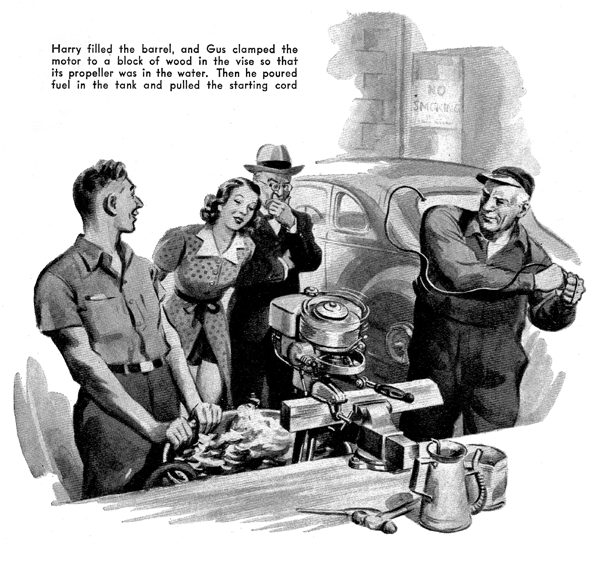
Harry filled the barrel, and Gus clamped the motor to a block in the vise so that its propeller was in the water. Then he mixed some gasoline and oil, poured it into the fuel tank, and pulled the starting cord. The engine took off easily enough, and the water in the barrel started to churn. Gus with his head cocked to one side, listened for perhaps a minute, and then shut it off.
"That's a good engine, Professor," he said, "but it's had darned bad treatment. Better leave it here for a day or two, and let me go over it for you."
"Nonsense!" snapped Professor Clapp. "So long as it runs -- "
"That will be fine, Mr. Wilson," Beverly interrupted sweetly. "I'll stop for it tomorrow, and take it out to the lake with me. Oh, I forgot to tell you, Dad, I'm staying with Aunt Molly tonight. Seems like a year since I saw a really good movie. Mother's alone, so I asked Mr. Jones to take you out with him -- that must be he honking the horn outside now. I'll drive out tomorrow afternoon."
Considerably to Gus Wilson's surprise, Harry had the shop open when he drove up at a quarter to eight the next morning, and the outboard was out on the workbench.
"Hey, what's the meaning of all this industry?" Gus demanded.
"Bev's coming in to see you about that outboard early this morning," Harry explained. "I thought you'd like to give it the once-over before you talked to her about it."
"Bev, hey!" Gus said. "You're getting sort of familiar with the customers' daughters, aren't you?"
"Shucks, I've known her all my life!" Harry told him. "Say, Gus, do you know why she talked her father into buying this outboard? Because she's going to the girls' race up there at the lake Saturday -- that six-mile race they have every year."
"Well, she won't get anything out of it," Gus said. "Not to the professor's old rowboat. She'll be up against a lot of those little doodlebug hydroplanes that can do twenty-five easy."
Harry grinned. "She's got a hydroplane -- only her father doesn't know it yet," he explained. "That old one of Bill Hazzard's -- the one he ripped the bottom out of in the marathon last year. He gave it to her, and she's had it fixed up so it's as likely as not to hold together for six miles. So now it's up to us to fix up this engine. She's not going in that race to lose."
"And that's the honest truth," said Beverly, from the doorway. "How about it, Mr. Wilson -- you're with me, aren't you?"
"Well," Gus said, "I'll see what I can do."
With Harry helping, and the girl keeping up a rapid fire of not-so-dumb questions, Gus took out the fuel line and blew it clear. Then, picking up the gasoline strainer, he showed Beverly the dirt caked in the mesh. "This thing's put in to keep the dirt out of the carburetor," he said, "but hardly anybody ever thinks of cleaning it off occasionally.
"Here now, watch how I take this fly-wheel off. You can't pry it." Removing the nut, he struck the shaft end on top with a hammer. The flywheel came off easily, exposing the magnets.
"In the magnets, trouble usually comes from the contact points," the veteran mechanic went on. "Clean them off with 00 sandpaper, like this, and if they're worn or pitted put in new ones. And be sure to check up on the width of the gap from time to time."
Beverly put in a question. "Is vibration, like Father noticed, always caused by -- what do you call it? -- pre-ignition?"
"Oh, no," Gus replied. "It could have been a loose bearing on the steering pivot, a bent propeller, loose mounting on the boat, or poor compression in one cylinder."
By this time, Harry had the carburetor taken apart. "This is just a simplified version of the carburetor on your car," Gus pointed out. "It needs an occasional cleaning of this needle valve that regulates the gas flow. And use your head when you prime it. The only time you need to do this is when the motor is cold. More outboards are kept from starting by priming them when they're hot than by almost any other cause. Then there's overheating -- "
"And what makes an outboard overheat?" Beverly wanted to know.
"Same as in a car -- running out of oil or water."
Harry chuckled. "Imagine a boat running out of water."
By way of reply, Gus dug into the motor's cooling system. "Easiest thing you know," he said. "If the water pump isn't clean, and the feed pipe and connections aren't tight, it's a case of 'water, water everywhere' and not a drop for the cylinder jacket where it's needed. Just look at the dirt and hunks of string in this feed pipe!"
With deft, sure motions, he removed the cylinders to inspect the pistons and rings. "You're lucky," he commented. "The rings seat well, and the cylinder walls gleam all over, showing that they're not scored. Now let's take a peek at the gear box." Removing the cover, he washed out the box with kerosene and inspected the gears closely. "Everything's O.K. here," he reported. "No pitting, no chipping."
Packing the gear box with grease and oiling the cylinder walls and bearings, Gus reassembled the motor. He signaled Harry to put the motor back in the barrel, put in fuel, and started it.
Gus listened to the motor for a couple of minutes, and then nodded his satisfaction. "She'll do," he said. "Maybe she'll kick that patched-up hull along too fast for it to hold together. Know how to swim, Bev?"
"Of course," said Beverly, "but this is a boat race. Oh, and Mr. Wilson, I'll need Harry to help me get the motor adjusted on the boat. Saturday morning -- early -- would do."
"That's a busy day around here, Bev. Well, all right. But he's got to be back Saturday evening -- sure!"
It was a little after four o'clock Saturday afternoon when the telephone rang. Gus went into the office and took up the receiver.
"That you, Mr. Wilson?" said the voice at the other end of the wire.
"Well, I won! The old boat just held together long enough. You certainly put-put that outboard right! Next time you come up this way, I'm going to mix you something nice in the silver bowl they gave me."
"That's fine!" Gus said. "I'm glad you won -- mighty glad, Bev! And now do me a favor, and start Harry home."
"Oh, Harry," Beverly said. "It would be a shame to make him start home now, Mr. Wilson. He's got that power lawn mower we bought three years ago going! No one ever has been able to start it, so now Dad thinks he's just grand. Couldn't you get along without him until Monday morning, please?"
"What's the use?" asked Gus, and hung up.
END
L. Osbone 2019