|
July 1925 - December 1970 |
|
|
Gus Wilson's Model Garage |
|
|
Alphabetical List of Stories Monthly Illustration Galleries Index Links-All Stories |
|
|
August 1925 |
|
|
|
ARE YOUR HEADLIGHTS SAFE? by Martin Bunn |
Gus, the Veteran Mechanic,Shows How to Adjust Them to Avoid Dangerous Glare |
|
|
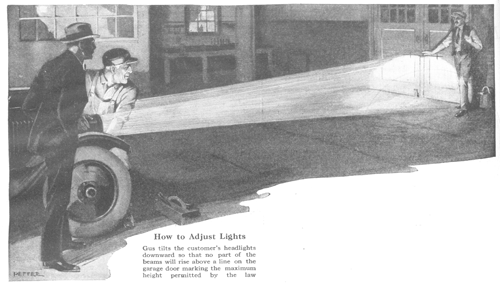
It was eight o'clock at night, but Gus Wilson and Joe Clark, proprietors of the Model Garage, were still at work. Gus the mechanic of the firm, was putting the finishing touches on a car he had promised to deliver in the morning to a man who was starting on a vacation tour, and Joe, who ordinarily held up his end of the partnership by taking care of the office work only, had been forced by the midsummer rush of repair jobs to roll up his sleeves and become, for the time being, a mechanic's helper. A smart touring-car suddenly shot in from the street and came to a stop in the center of the garage floor. "Hey, how about some gas?" called out the young chap behind the driving wheel. "I've been tooting my horn out in front for the last five minutes." "Never heard you, son," responded Gus, while Joe hurriedly wheeled the portable gas tank around behind the car. Gus stood surveying the car reflectively while the filling process was going on. Then, as Joe began to screw the cap on the gas tank, Gus wiped his hands in a bit of waste and strolled over to the front of the car. "Say, young fellow," he said," why don't you fix those headlights? You're due for a ticket if you leave them like that." "What do you mean, 'fix'?" demanded the owner indignantly, "Those are darn good lights. See how they light up your garage." "Sure they're good lights," nodded Gus with a grin. "Good for you, that is, but how about the other fellow? He has some rights, too, you know. Swing your car around so that the lights will be facing the back door, and I'll show you what I mean. There, that's far enough," called out Gus, as the beams from the headlights lit up the white-washed door. "Now step up close here. See that black line across the door? The law in this state says that no part of the beam should go higher than that. Your lights, though, are adjusted so that at least half the beam is above the line." "I know that," the car-owner broke in, "but if I tip them down, I can't see the road far enough ahead when I drive fast." "Quite true," admitted Wilson. "But you're violating the law just the same. Suppose everybody else thought as you do, and used blinding lights and drove like -- er -- lightning? Why, there wouldn't be hospitals enough for the victims -- or tow cars enough to drag away the wrecks!" "The days of fast night driving with dazzling lights are gone forever. There are too many cars on the roads now. A driver has to think of the other fellow and adjust his headlights so that he'll get all the light he needs without blinding everybody he meets."
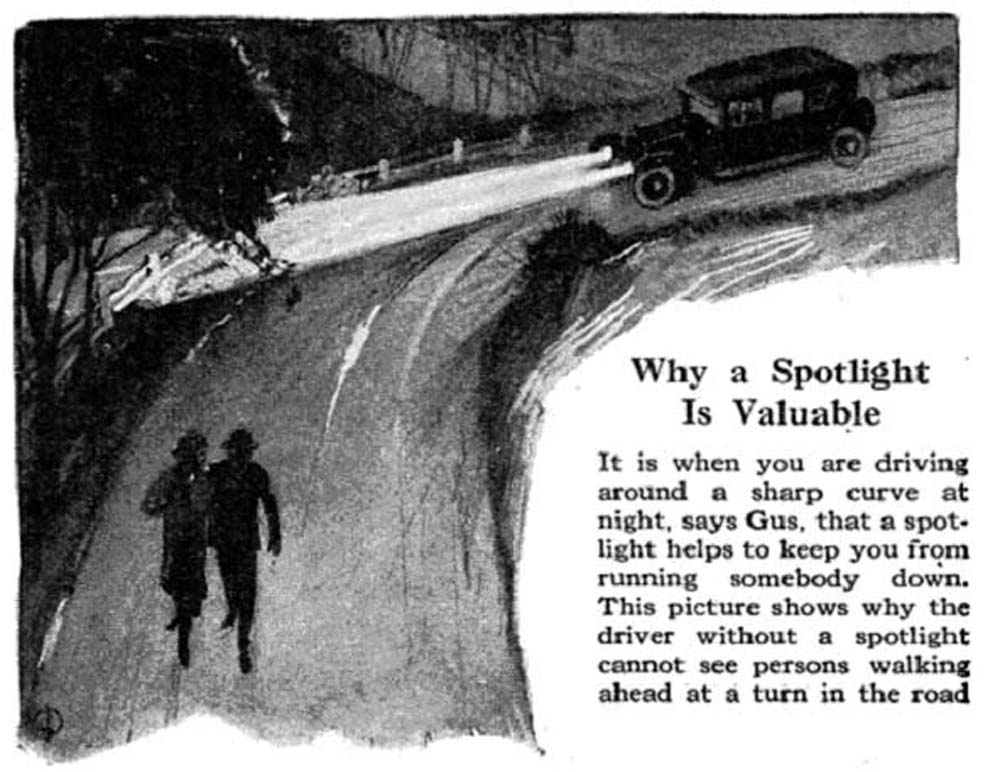
The car-owner smiled derisively. "That sounds all right," he said," but it just can't be done." "It can't, eh?" snapped Gus. "I wish you'd give me five minutes on those lights! If I can't make better lights of them and still have them comply with the law, I'll make you a present of my time -- and throw in that gasoline you just bought!" "Fair enough!" grinned the owner. "Go to it!" Wilson got a toolkit, stepped to the front of the car, and removed the front flange and lens from each headlight. Then he took out the bulbs and examined them carefully, holding them up to the big electric light in the center of the garage ceiling. "There -- see how much darker one of them is," he said, offering them so that the owner might observe also. "That's caused by little pieces, or molecules, or whatever you call 'em, that fly off the hot filament and stick to the glass. A few more days and this dark bulb will be ready to pass out for good." "Phew, better let me have a new one!" exclaimed the owner. "In fact, you'd better make it two. They've been on the job more than six months now, and I do a lot of driving at night. Put in good big ones so I'll have a lot of light." "Nothing stirring," said Gus: "21-candlepower is all the law allows you, and you have that size now. Of course, some of the 'gyp' dealers will sell you bulbs marked with a higher rating than 21-candlepower, but the extra candlepower is mostly in the label on the box!" "Twenty-one for me then -- got two tickets for speeding this year and I certainly don't want another chance to say 'Good morning, judge!'" "It wouldn't be healthy for your pocketbook," Gus chuckled. "Joe, get out two bulbs -- make it three -- you ought to have a spare." While Joe went after the bulbs, Gus carefully dusted out the reflectors with a clean silk handkerchief that had appeared miraculously from a concealed pocket in his greasy overalls. "Speaking of reflectors," said Gus, "one of those scientific sharps told me once that an automobile reflector that had lost enough of its shininess so that you could tell that it was not quite new would reflect only about 50 percent as much light as when it was new." "Well," the owner observed, "who'd expect a rusty old reflector to give much light?" "Who mentioned rusty junk?" demanded Gus: "I meant a reflector that has lost its first brilliancy -- just a bit foggy -- not really had at all. Take your reflectors. They look like new, but I'll bet they're lost at least 10 per cent of their light-reflecting power." "Well, what can I do about that?" asked the owner. "Nothing," Gus answered. "Special buffing apparatus is needed to bring full polish back to a reflector, and it takes an expert to run the apparatus. The best way for the rest of us to treat a headlight reflector is to leave it alone. Anyway, never do more to it than dust it off us gently as you can every now and then. Then when the shine goes, after a year or two, send it to some firm that makes a specialty of refinishing auto lamps." "Leaving them alone ought to be easy enough," laughed the owner, "but isn't there anything I can do to keep them from getting dim?" "Yes. Have the front lenses fit as nearly airtight and watertight as possible." "Why not use a rubber gasket in place of that piece of cord, then?" "Not on your life!" Gus said emphatically. "Don't use rubber on any account. It would make a water-tight fit all right, but after a while the sulphur in the rubber would discolor the silver plating on the reflector. The cord will do the work well enough, provided it is not squashed down so that it does not have any spring left in it." He fished a screwdriver out of the tool-kit, and fitted it to the screwhead that projected from the center of the back of one of the headlights. "See what happens to the beam of light when I turn this screw," he bade. "Notice how it contracts and then spreads all over the door again. We will leave it where it makes a smooth, uniform band across the door. That happens to be an extra good bulb -- nice, even light. It's almost impossible to focus the cheap bulbs some of the 'gyps' sell you." "There!" Gus said as he tossed the screwdriver back in the toolkit after focusing both headlights properly. "Now we'll see about turning those beams down so that they don't hit the door above the line." He examined the lamp bracket carefully. "This is going to be easy," he said; "the brackets are adjustable, so all we have to do is to loosen up the bolts and set the headlights where we want them. Joe, just hold your hand on the door there so I can see where the top of the beam ought to come -- there, that's right." "But you have the lights pointed too low now,"" complained the owner as Wilson tightened the last nut. "No, they're just right. You have to make some allowance for the effect of loading down the back end of the car with three people. You want them right when you have a full load of passengers aboard." "Gosh, I never thought of that," said the owner after studying the light on the door for a moment. "They seem to give a pretty good light at that. Maybe I won't have to dim them every time I pass another car now that they are on the right side of the law," he suggested. "Not unless you are going over the top of a hill," said Gus. "That makes the beam shoot up in the air a bit. By the way, why don't you fit a spotlight?" END
|
|
|
L. Osborne 2019 |