April 1948
GUS UNTANGLES A DOUBLE CROSS
by Martin Bunn
When in-law trouble makes an outlaw of a respectable battery,
there's a mix-up to straighten at the Model Garage.
Gus Wilson was trying to give a finicky little speedometer repair job the 100 percent concentration it demanded, but the horn outside the Model Garage shop hooted and squawked practically continuously.
After a full two minutes Gus gave up, slammed his pliers down on the workbench, and pushed the door open.
A man and a woman were getting out of the opposite front doors of a big, expensive car that had slumped into shabby old age. The man was burly, scarlet-faced, and obviously hopping mad; the woman was small, sharp-featured, and even madder.
Neither of them gave him so much as a glance. They were too busy glaring at each other. “It’s driving me nuts!” the man yelled. “If that dopey brother of yours—“
“Of course, Harold dear, it’s all George’s fault,” the woman cooed. Then her voice jumped an octave. “That’s you all over, you big drip! If it wasn’t for George—“
“If it wasn’t for George,” Harold sneered, “I’d be a lot better off. I ain’t sore at him. I’m just sorry for him because he has to try to run a garage when everyone knows he ought to be in a home for the feeble-minded. Why, that—“
His eyes met Gus’s, and his voice trailed off. The woman smiled sweetly. “Tell the man what’s the matter with the car, Harold dear,” she advised.
Harold dear glared at her. “I have the devil’s own job getting it started—have to crank it oftener than not,” he growled. “Battery must be run down again.”
“Had it checked lately?” Gus asked.
“Checked?” Harold smiled balefully. “I had it recharged two weeks ago—but my brother-in-law who did it must have— “
“I’ll check it,” Gus broke in. “Drive into the shop, and cut your engine.”
Stan Hicks came in and Gus told him to take up the car’s floorboards. Then he got a voltmeter and tested all three of the battery’s cells. “It’s way down all right.”
Harold grunted. “That’s what dopey George said, but this time I had sense enough not to let him monkey with it. Last time after he had recharged it, it wasn’t much better than when I took it to him—and now it’s next door to dead.”
“It could be that you’ve got a defective switch that has discharged your battery,” Gus told him. “Or perhaps your battery is just plain worn out and you need a new one—how long have you had it?”
“Only five months,” Harold said, “and it was okay until Mrs. Smith’s bright brother went to work on it.”
“Never mind my bright brother!” Mrs. Smith snarled. “Tell the man why you had to have the battery recharged—because you came home plastered and forgot to turn the car’s lights off after you managed to get it into the garage, and they burned all the rest of the night and half of the next day, and ran the battery down!”
“Me plastered!” Harold said in an outraged voice. “I have a couple drinks just for sociability and you say I was plastered!”
“Plastered—pifflicated—call it anything you want to!” his wife shrilled. “Why, two days later you still were seeing things—after George had recharged the battery you were afraid to drive the car because you thought the whatd’yacallit—the ammeter was reading the wrong way!”
“So it was!” Harold howled.
Gus switched on the lights and watched the ammeter indicator move over to discharge.” “Well, it’s reading right now.”
“Yes,” Harold admitted, “but that’s because the battery’s in the wrong way.”
“Huh?” Gus grunted.
“The only way George could get the ammeter to read the right way was to put the battery in backside front,” Harold explained.
How George Made It Work
Gus stared at him. Then he checked the cable connecting one of the battery terminals to the car frame. It was a little corroded, but its connections were moderately clean and tight. He put the positive terminal of his voltmeter on the post, the other across the cell, and saw the indicator move in the right direction. “The positive pole of the battery is grounded to the frame,” he told Harold. “That’s right for this model car.”
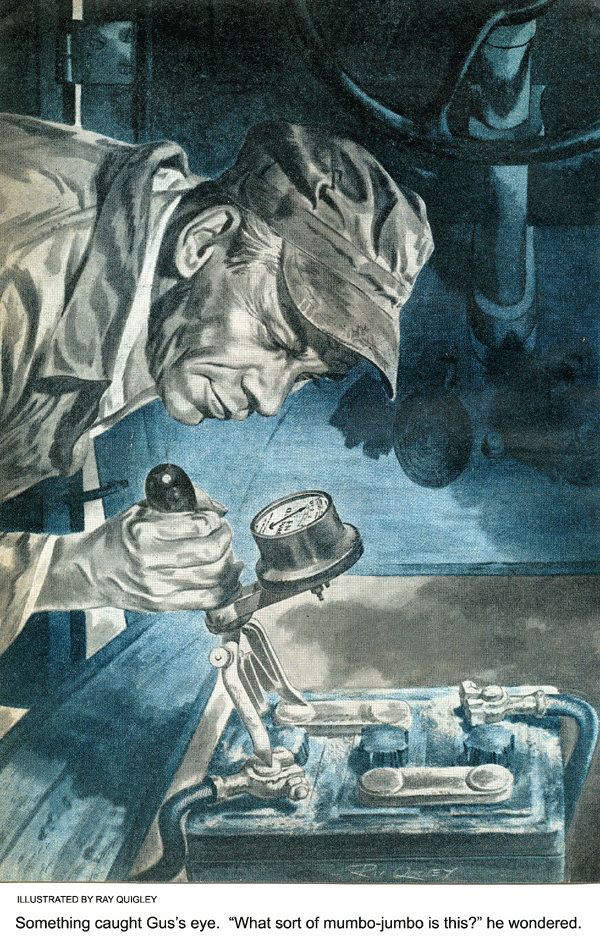
The battery terminal connections caught his eye. He examined them more closely, and saw that the smaller cable’s lug had been forced over the larger terminal, and that the larger lug had had a shim inserted in it to make it hold on the smaller terminal. “What sort of mumbo jumbo is this?” he wondered out loud.
Harold laughed gratingly. “That’s dopey George’s work,” he said. “When he had to switch the leads to make the ammeter read the right way, he did it to make ‘em hold.”
Gus scratched his head. Then he looked at the shop clock and saw that it was close to four. “There’s something screwy about this,” he told Harold. “You’d better leave your car. Maybe your battery is worth recharging—do you want me to do it if I think it is?” Harold nodded assent. “All right, then—come in late tomorrow.”
The Smiths departed, still bickering noisily. Gus went back to the job they had interrupted. By the time he got back to the Smith car it was near quitting time.
“Put this battery on the charger, and see what happens,” he told Stan. “It’s probably pretty near done for, but maybe there are a couple of months more service in it.”
Gus was plenty busy the next day—so busy that it was along toward three o’clock before he thought of the Smith job. “How about that battery I told you to put on the charger?” he called to Stan.
“It’s okay, I guess,” Stan reported. “It took a charge.”
“Good enough,” Gus said. “Put it back and call me when you’ve got it hooked up.”
Ten minutes later Stan called him. Gus got into the car and pressed the starting button. The starter had a good kick to it, and the engine took off promptly. Gus speeded it up, and watched the ammeter.
The indicator moved over into the “discharge” division of the scale!
“Hey!” Gus yelled. “How the heck did you hook up this battery?”
“Just exactly the same way it was hooked up before I took it out,” Stan told him in an injured voice.
Gus switched off the engine and then switched on the lights.
The indicator moved into the “charge” division of the scale!
Gus turned off the lights, and sat thinking. Then he took up the floor boards and put his voltmeter across the end cell, its positive terminal on the grounded post, just as he had the day before. The indicator jerked below the scale. He put the same meter terminal on the post at the other end cell. The needle moved the right way.
Gus laughed, and rapped the side of his head hard with his knuckles. “The old bean sure is slowing down,” he told his puzzled helper. “Switch the battery around.”
When Is a Positive Not a Positive?
“Okay,” Stan said obediently. “But I don’t get any part of this, boss. Yesterday the ammeter read the right way. I hooked the battery up just the same way today—and now the ammeter reads the wrong way. And yesterday when you checked the battery pole that’s grounded to the frame it was positive—and today it’s negative. But I don’t see what I did wrong.”
Gus gave him a friendly poke in the ribs.
“The only thing you did wrong,” he said, “was charge the battery right…. I’ll tell you about it afterwards.”
Stan reversed the battery in the car. Then Gus checked the job. With the lights off and the engine on, the ammeter indicator moved into the “charge” division of the scale, with the engine off and the lights on, it moved into the “discharged” division.
“Okay,” Gus said. “And just in time. Here come the Smiths—still scrapping!”
And still scrapping they drove out in the car. While Gus was washing up later that afternoon he noticed that Stan was very busy making diagrams with a red and black pencil. “Hey, kid,” he reminded him, “It’s time to go home.”
“Yeah,” Stan muttered absently. “I’ve been tryin’ to dope out about that battery. You said you’d tell me about it, but—“
Uncrossing the Doublecross
“Sure I’ll tell you about it,” Gus said.
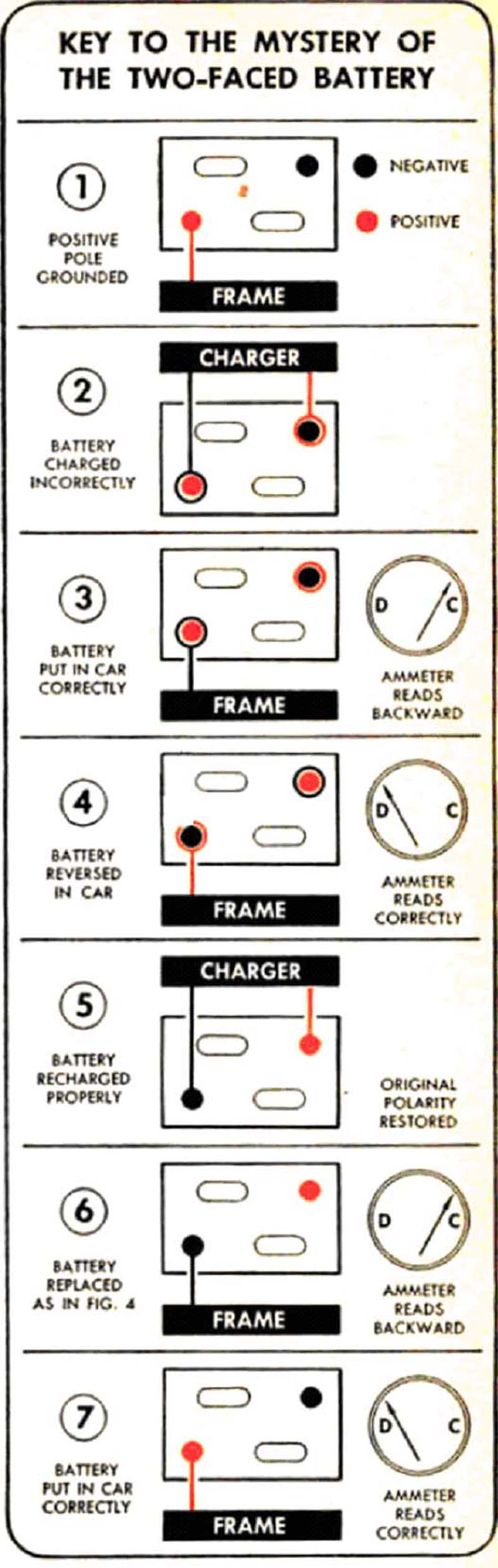
“It’s not so tough if you start at the beginning—which was when our friend Harold got plastered and ran his battery down by leaving his lights on for several hours. Well, he took it over to his brother-in-law George, who put the battery on the charger the wrong way—with the charger’s positive lead connected to the battery’s negative pole.”
“Gosh!” Stan
gasped. “What would you do to me if I ever did that, boss?”
“Shoot you, or bash your head in,” Gus assured him cheerfully. “A battery treated that way isn’t long for this world . . . Well, George’s charger overpowered the battery and gave it a reverse charge, which changed what had been the positive pole to the negative, and the negative pole to the positive. When he put the battery back in the car and connected it the right way, the ammeter read the wrong way. So he turned the battery around—botching up the terminals to do it—and the ammeter read the right way.
“Of course that poor misused battery didn’t have much moxie, but with a little help from the hand crank it started the car—for a while. Then it gave up the ghost, and Harold brought it in here. You put it on the charger the right way—and the charger overpowered what was left of the reversed charge, changing the original positive pole back to positive, and the original negative pole back to negative.”
“I hooked the positive lead of the charger up to the bigger terminal post on the battery. That’s right, isn’t it?”
“Sure. But when you put it back and connected it up just the way it was before you took it out, the ammeter read the wrong way again. And then when you reconnected it in the opposite way—the way it always should have been connected—the ammeter read the right way, because the battery polarity was back where it belonged . . . Got it, kid?”
“All I got,” Stan groaned, “is a heck of a headache!”
END
L. Osbone 2019