October 1955
GUS STARTS THE MUSIC
by Martin Bunn
When the immaculate 1940 Plymouth sedan drove into the Model Garage, bearing a Missouri license plate, Gus Wilson grinned. With the fall tourist season in full swing you could expect all sorts of peculiar customers.
"How much," the driver of the Plymouth demanded, thrusting thin, irascible features out the window, "do you charge for cleanin' up a set of spark plugs?"
"Four bits," Gus said amiably, "with a breakdown test thrown in for free."
"Breakdown test," the character retorted. "That's the scheme you fellers use to wangle a man into buying new plugs -- I'm wise to it. Nothin' wrong with my plugs that cleanin' won't fix. Clean 'em myself when I'm home on the ranch."
Looking at the car, Gus had an idea of how much of a ranch this man had in Missouri. It was 15 years old, yet the speedometer read only a little over 30,000. Its original tan paint shone from infinite care. The rear upholstery was immaculate, a blanket protected the front seat. It had the look of a car used by a small farmer or rural retired couple to go to town in on Saturdays. "
"Me and Myra," the old fellow volunteered, are bound east to see our daughter, and we don't reckon to be held up along the way by none of you slickers."
"Fine," Gus said, lifting the hood and snapping a long spark plug socket on his power bar.
"Most folks," the driver went on conversationally, "don't know how to handle slickers, and get stuck by 'em. But me, I'm too smart, I got a mite of a miss, now and then, and right off I know what's the trouble. I know what I want done, so I ask fer it and git it. Name's Morton -- Henry Morton."
"You certainly do, Mr. Morton," Gus said, as he took out the first plug.
The condition of the plugs indicated that the old Plymouth was using a little oil, but not much. They were carbonized a bit, but otherwise in fair shape. Gus ran a breakdown test, and found two that he would have normally recommended be changed. However, considering the attitude of his customer and the fact that the plugs should give considerably more service in a motor that undoubtedly did not carry top compression, Gus thought it wise not to press for two new plugs.
"You folks are a long way from home," Gus commented as he replaced the cleaned plugs. "Everything else all right?"
"Right as rain," Morton said firmly.
"Now you know better than that, Henry," the gray-haired wisp of a woman sitting beside the driver suddenly interjected. "Every time we hit a rough road our radio makes the most awful racket. I wish you'd have it fixed."
"Fixed!" Henry Morton snorted. "Now don't start that again, Myra. I let you waggle-jaw me into having it looked at a hundred miles back. That whipper-snapper back there charged me two dollars and said the thing was in good shape."
"I don't care if he did," the little old woman insisted. "It still raises Ned on rough roads, and I like music while we drive."
"I don't," Morton snorted. "I wish the danged thing would squawk and crackle all the time, then you'd never turn it on."
"It's about closing time," Gus said, looking at the office clock, "but maybe you'd better have me take a look at that radio. Sometimes when a radio cuts up on rough roads it could be . . . "
"There you go," Morton interrupted sarcastically, stepping on the starter and shifting into gear. "You fellers are all alike, tryin' to hook tourists for somethin' as they pass through. A man's lucky to get home with his hair."
"You didn't have no hair to start with, Henry." Mrs. Morton reminded him. Gus had a time keeping his face straight.
"Now," Morton said, ignoring his wife's remark, "if you've got a eating house in this town where they don't rob nor poison a man, me and Myra'll eat."
"If you're going east," Gus said mildly, "you'll hit a reasonable place called the Twin Pines Inn. Take it easy, though. The town's putting in a new sewer line, and the street's torn up for a ways."
As the Plymouth backed out and went down the street, Stan Hicks, Gus's young helper, looked up from the grease rack with amusement.
"That guy," Stan commented, "just don't like music."
"Before he is through," Gus said thoughtfully, "he may wish he did."
It took Gus and Stan perhaps 30 minutes to clean things up a bit and get ready to close shop. Stan had just started up the tow truck to drive it inside, while Gus went to lock the office, when the wail of a fire siren came over the clear fall air.
Stan, a new and dutiful member of the town's volunteer fire company, scrambled out of the truck and reached the phone in six leaping strides to dial the operator and find out where the fire was. Then, brushing past Gus in the doorway in a dash back to the truck, he shouted,
"Car on fire up by the Twin Pines Inn. I'll bring this bus back later."
"Hold it, Stan!" Gus yelled. "I'm going this time -- you lock up!"
With surprising speed, Gus trotted to the back room, grabbed his tool kit, emerged again at a lope, vaulted into the cab, half-shoved Stan out the other door, gunned the engine and roared up the street in a rubber-burning take-off.
Stan gaped after him in stunned surprise since Gus had never been to the habit of chasing fire wagons.
"Car on fire . . ." Stan mused, half aloud. "Twin Pines… "
By the time Gus hit Main Street he could see the flashing lights of the fire truck. He slowed down when he reached the section where the new sewer line was being installed, then speeded up again.
Coming to the edge of town he could see the fire engine pulled up at the Twin Pines Inn. From the center of the crowd of spectators a column of black smoke poured into the balmy evening air. As Gus drove up, Sgt. Jerry Corcoran wheeled in with siren wailing, leaped from his vehicle and began clearing a path through the spectators.
"Stand aside folks," Corcoran roared, but when he saw Gus, he waved him on.
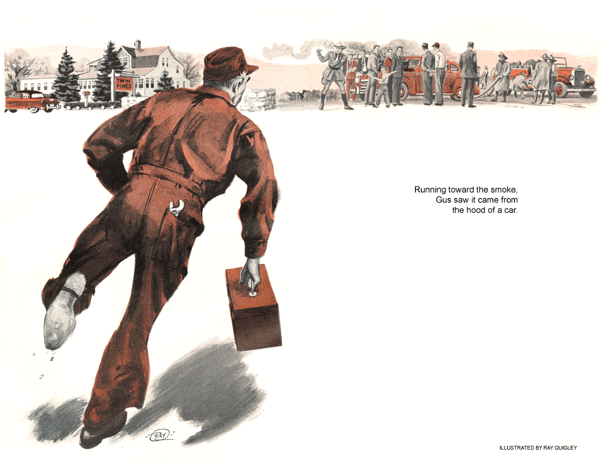
Running toward the smoke, Gus saw that it came from beneath the lifted hood of the Missouri Plymouth.
"Hello, Gus," Fire Chief Maloney greeted him. "You're just in time for a tow job -- fire's about out."
Henry Morton was jumping about his beloved Plymouth with cries of anguish.
"Hah!" Morton exclaimed seeing Gus, "I'll bet this is some of your doin!"
"I wouldn't say that," Gus told him mildly, probing beneath the hood with his flashlight. "Hmm, there isn't much damage here. I'll tow you back to the shop and fix you up in no time."
"Right handy for a tow job, ain't you?" Morton said suspiciously. "By cracky . . . "
"Henry!" Mrs. Morton cut in sharply. "I'm not going to stand here in the street all night while you argue. Mister, get your truck and tow us in."
As the fire truck wheeled away and the crowd dispersed, Gus hooked onto the Plymouth and towed it back to the Model Garage. When Stan Hicks saw Gus pull in with the Missouri car in tow, his eyes had a look of astonishment.
Gus got the Plymouth unhooked wordlessly and went to work with purpose.
He removed the battery cable from battery post to starter button, finding that the terminal at the battery post end had been melted off by the heat. He threw the cable on the floor, where newly melted solder gleamed the insulation on the battery end burned off.
"When that stuff burns, "Gus remarked, "it makes a sight of smoke."
Gus got a new battery cable from the stock room and installed it. He taped up a few wires that had been singed around the source of the fire, tested the battery and filled it with water. Then he got into the car and stepped on the starter buttons. The motor ran smoothly.
"Well!" Gus said to Morton, getting out of the Plymouth and digging out his pipe. "I guess you folks are ready to roll again. That'll be six dollars. Three for the tow and three for a battery cable."
Morton's thin features lit with astonishment.
"You mean," he queried, "that after all that fire and smoke six dollars fixes everything?"
"Sure," Gus told him, his leathery features illuminated by the match he applied to his pipe. "Radio and all, unless I miss my guess."
"Radio and all," Mrs. Morton echoed.
"Why, you didn't touch the radio."
"Right," Gus said. "You see, the way I had it figured, there never was anything wrong with your radio, seeing that you had a man check it and he said it was all right. When you told me the radio cut up only on rough roads, I had a hunch that you might have a hit-and-miss short somewhere in your car, which would make the radio squeal and squall as well as produce your occasional miss.
"It turned out your battery cable was shorting out on the edge of the battery box, but only now and then, on rough going. Finally, after you hit the rough stretch between here and the Twin Pines Inn, it happened to stay shorted when you stopped and went in to eat. That caused the fire. Lucky you didn't ruin your battery. I could have saved you three dollars by looking things over when you were in here the first time."
"Well, I'll be . . . " Morton began.
"Henry!" Mrs. Morton warned. "You talk too much. You'd do a lot better if you'd do more listening."
Morton shelled out six dollars and got into the Plymouth without saying another word. Looking after him as he drove out, radio playing full blast, Stan Hicks chuckled.
"There goes a man," he commented, "who has learned to like music."
END