May 1957
GUS TACKLES AN ANTIQUE
by Martin Bunn
When Gus attempted
same roadside repairs
on a 33-year-old car,
he drew a crowd of hecklers -
just what he had in mind.
Billy Knowles was 11 years old, tanned brown as a hazel nut, with wide, blue eyes and an expression of extreme innocence. He came into the Model Garage, knelt on the cement floor to peer beneath a car at Gus Wilson.
"Hello, Mr. Wilson," he called. "What are you doing?"
"Bearing job, Billy," Gus told him.
"Work like that must make a person awfully hungry," Billy said. "Aren't you hungry, Mr. Wilson?"
Gus pondered a moment. Then he shot out from beneath the car, grasped Billy and rumpled his carroty hair.
"A nice question to needle a man with just before lunch," he roared in mock anger. "What are you trying to sell this time?"
"I'm not selling anything," the kid giggled squirming mightily.
"Oh, no!" Gus declared. "Come clean now. What's this all about?"
Billy drew in his breath, as if he were getting ready to take a deep dive. "Well," he explained. "Mr. Perkins said that you could eat more than anybody in town. So we thought that you might be extra hungry today and we wouldn't go busted and all."
"Busted and all!" Gus exclaimed.
"What kind of language is that? And what's my appetite got to do with this?"
"Us fellows are raising money for our baseball team," Billy said. "You know, Mr. Wilson -- the Blue Eagles. We've got a lunch stand out in front of our place on the highway."
"I see," Gus said.
"Our folks will only let us run the stand over this weekend," Billy went on. "We've got to sell enough in these two days to buy our gloves and balls and such. Then we'll have to close up. We haven't sold anything, so far, and our ice is melting, and all."
"And," Gus said, "you expect me to come out there with my ferocious appetite and eat up the whole works, is that it?"
"Stay with him, Billy," Gus's helper, Stan Hicks, called from the bench. "A gallon of lemonade and a dozen pies are just a starter for Gus."
Gus shot an outraged look at Stan. "Hah," he snorted, "Al Perkins and his jokes. Maybe I will drop out to your stand for lunch after all, Billy."
At 10 minutes before noon, Gus called Al Perkins. "Al," Gus said over the phone, "we've still pretty well snowed under, but if you'll run that car that misses over here at noon, I'll try to take care of it on my lunch hour."
Al Perkins, who ran a restaurant down the street, was a nut on old cars. He owned several, one of which was giving him trouble. He arrived at the Model Garage at noon, driving a 1924 Flint touring car. A rakish vehicle, it was as sleek as the day it came from the factory: gleaming paint, fawn-leather upholstery, huge polished headlights.
"Whew!" Stan Hicks exclaimed admiringly. "That thing is enough to stop traffic anywhere."
"Isn't it, though!" Gus said thoughtfully as he slid beneath the wheel. "Let's give this thing a road test, Al."
The Flint, manufactured in the mid-twenties, was a sweet-running job in its day. It didn't run sweetly now. It leaped forward in a series of missing gallops.
"Should be easy to find the trouble," Gus commented.
"Easy!" Perkins protested. "I've had one mechanic after another work on it. They went over it with fine-tooth combs."
"You don't tell me!" Gus said, as he continued to drive haltingly down the highway. "In that case I guess I've a tough nut to crack here, haven't I?"
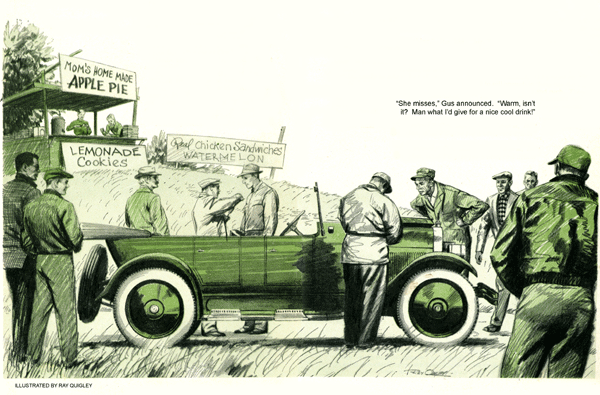
He pulled off the highway a mile out, near a tree in front of the Knowles' farm. Across the highway a rickety stand announced with crudely lettered signs that here one could purchase "Mom's Home Made Apple Pie," "Real Chicken Sandwiches, Watermelon," " Lemonade, Cookies." Without a glance at the lunch stand, Gus lifted the hood and peered at the motor with a look of complete bafflement.
While he was cleaning and checking the spark plugs a Cadillac, sedan slowed, swerved to the highway shoulder and halted. Four men hastily descended and approached the gleaming Flint.
"An old one!" one man said admiringly.
"She misses," Gus told him, as he slipped a thickness gauge between the electrodes of a plug. "Twenty-five thousandths' gap is about right, don't you think?"
"Thirty," the man said positively.
"You don't say!" Gus replied, giving him a long handled Flint crank. "Turn her over for me, will you, mister, while I check the compression."
While the Cadillac driver was enthusiastically cranking the old motor, two more motorists pulled up to inspect the Flint. And as Gus checked the wiring and connections, timing and ignition points, several more cars stopped when their drivers and passengers spotted the old automobile. Gus straightened from beneath the hood with a friendly smile for all.
"She misses," he announced. "Warm isn't it? Man, what I'd give for a nice, cool drink!"
"Those kids over there," the man with the crank said, "are selling lemonade."
"By golly, so they are!" Gus exclaimed. He strode toward the lunch stand, calling, "Let's wet our whistles, Perkins."
The Flint's owner followed. So did the onlookers. When Billy Knowles saw them crowding up, his blue eyes held a look of astonishment. It altered to a sly grin when Gus winked at him.
"Lemonade, sonny," Gus said enthusiastically. "And how about a piece of pie and one of those chicken sandwiches."
Suddenly, the Blue Eagle baseball team found themselves dipping lemonade, cutting pie, serving sandwiches and watermelon to a gathering engaged in deep mechanical discussion.
"If you ask me," a lean, long-nosed man asserted, "it's a loose connection at the ammeter. Reminds me of my Durant. I was courting Myra Phelps that evening when it began to miss. I crawled under the dash and . . ."
"Ammeter!" Gus exclaimed. "I'll have to check that."
"Could be," another bystander said doubtfully, waving a half-eaten sandwich. "But I'd be more inclined to think it a cracked distributor cap."
These people Gus thought, were getting him all confused. He wondered what really was wrong with the car. Maybe, he figured, it was time to quit fooling around and get on the ball. He couldn't let an antique like this stump him.
Gus went back to the Flint and started the motor, under the interested eyes of a group who gulped lemonade from paper cups, munched sandwiches, and spat watermelon seeds at random. The motor still missed. A quick check, by shorting each plug, proved to Gus that it wasn't missing on any particular cylinder, but on all cylinders, erratically, between periods of regular firing. To Gus this meant an intermittent break in the primary ignition circuit, eliminating the possibility of trouble in the secondary circuit.
Gus found himself stumped by the very care that Perkins had been giving the old car. New wiring, coil, carefully adjusted and cleaned parts -- there simply was no place to hunt trouble. Yet there had to be an interrupted flow of primary ignition juice somewhere. Gus's mind went back over the years to when cars like this were coming from the factories.
What had been their troubles then?
He thought of the low-voltage generators, the poor batteries, the hand cranking and that trick of retarding the spark at the wheel to escape a kick and a broken arm. His mind focused on that manual spark-advance-and-retard system. The Flint had seen many changes since its youth, but was still equipped, Gus noted, with an ignition system featuring a manual spark control through a lever at the distributor, which was attached to the ignition-point breaker plate grounded to the distributor body.
Regardless of new wiring, coil finely honed and set ignition points, intermittent missing would develop if that movable breaker plate upon which the ignition points were mounted did not have a proper and continuous ground.
Gus was eager now. He started the motor, grasped the spark-control arm where it issued from the distributor, wiggled it back and forth rapidly, then bore down on it to throw it into a bind. Instantly the Flint motor smoothed out, purred like a kitten. The onlookers were quick to catch the change in rhythm.
"Ah!" they breathed in unison.
Gus hooked a weak coil spring from spark-control arm to splash pan below. It would hold the arm in a grounding bind until he could drive back to the Model Garage for a permanent repair. Billy approached to whisper in Gus's ear.
"Thanks, Mr. Wilson," he whispered. "We're all sold out. Gee willikins, that Mr. Perkins must have been pulling my leg. He ate three times as much as you."
"This was one of my off days," Gus explained.
Driving back to town, Al Perkins leaned back in the seat and loosened his belt from his rotund stomach. He sighed with content as he listened to the motor purr.
"Sweet job, isn't it?" he said. "They don't make them like this one any more. Gone but not forgotten, eh?"
Gus had to agree with him -- gone but not forgotten, at least by those who had known these cars back when they, and the cars, were young.
END