July 1966
GUS TRACKS DOWN
A COLD CLUE
by Martin Bunn
It looked like brake failure
when the convertible
broke away and rolled downhill.
Was Gus's relining job at fault?
Tree Shadows lay long in the late afternoon sunlight as Gus Wilson swung the Model Garage tow truck into a pleasant residential street. Two blocks farther on, Marlow Lane made a sharp right turn and began to climb. A block after that, it came to a dead end.
There Gus pulled up just below the driveway of the last house. Above the driveway, front wheels cramped against the curb, stood a small convertible. A girl wearing slacks and a floppy hair-do came down a long flight of steps, closely followed by a sulky-looking youth.
"C'mon, Karen," he pleaded. "Just a short hop to the malt shop."
The girl shook her head. "Hi, Mr. Wilson," she said. "You sure were quick.
But it isn't my car this time; it's Dad's, there in the drive. He wanted to go out for cigarettes, and it wouldn't start. So I got them in mine. It's lots nicer to drive since you relined the brakes."
The boy bent close to whisper urgently in her ear. She shrugged her shoulder.
"Flake off, Eddie. I'm not allowed to lend you my car and I'm all dated up for the dance Friday. Okay?"
The boy, a lanky figure in very tight pants, glared at her, then at Gus.
"That your last word, Karen?"
"Do you want to have it in writing?"
The boy's face flushed darker. "You're going to be sorry about this."
Gus, who had been busy taking out his tool kit and helper battery, looked at the lad for a moment. Black eyes glowered back.
Then the boy strode off down the street.
"You don't leave the keys in your car, do you?" Gus asked the girl.
"Never. But I have to park it in the street because we've only got the one garage. Don't worry about Eddie Larkin. He's a drip, but harmless. Only why should I lend him my car, when he's just smashed up his own? Or date him, when there are so many dreamier boys around?"
Gus lugged tools and battery up the short but very steep driveway, where a 1964 Chevelle stood nose down.
"We just had the garage floor painted," the girl chattered on. "So Dad parked it here. He was afraid to try to start the engine by coasting, he said, on account of having an automatic transmission."
Gus turned the ignition key to "start." There was a hard thud in the engine. He turned the key off and opened the hood.
Battery, solenoid, and ground connections were all tight, and the cables apparently in good shape. That solid thud suggested two possibilities other than a poor starting circuit. One was a stuck starter pinion. The other…
Gus pulled out the engine dipstick. The oil level was at the full mark.
Full, with the car at this angle?
The thin fluid on the stick dripped freely, and smelled of gasoline. Gus put the dipstick back and got out a wrench.
As he disconnected the fuel line at the carburetor, gasoline flowed out. Gus plugged the line with a pencil stub.
"Please call your father, Karen."
The girl scurried off. Gus removed a spark plug. It came out dry. The second one oozed gas. Hastily Gus screwed it back. A heavy-set, gray-haired man came out.
"Got the battery boosted already?"
"It isn't a weak battery, Mr. Bronson, but hydrostatic lock. Watch this."
Holding a can under it, Gus removed the loose plug. Fluid gushed into the can.
"There's probably that much gas in three or four cylinders," explained Gus. "The starter can't turn the engine over, because you can't compress a fluid as you can the normal air-fuel mixture."
"It was running fine two hours ago," protested Bronson. "When I stopped to fill up on the way home, it started right off."
"Sure, but then you parked at this steep angle," said Gus. "That put your full gas tank higher than the carburetor. Maybe the float valve stuck open, or its seat is bad. Anyway, the hydraulic head from the full tank was strong enough to lift the fuel-pump check valves. Gas dribbled through, into the carburetor, then into the cylinders with open valves, and the crankcase."
"Can you fix it tonight?" asked Bronson. "I have appointments at three of our branches tomorrow. I need the car badly."
"If I tow it in now," mused Gus, "I should have it back this evening."
Easing the car down into the street, Gus hoisted it up behind the tow truck. In the Model Garage Stan Hicks, his helper, drained out the gas-diluted oil.
Two other cylinders were partly flooded. Gus drained them, blew in air to dry out any remaining gas, and squirted oil into each cylinder to restore lubrication. Stan put fresh oil in the crankcase.
At quitting time he left, while Gus went out for a light supper. Returning to the shop, he removed the four-barrel carburetor, which had two separate float systems. He wasn't surprised to find a little gas in the primary float, and a groove on its arm where it bore against the needle valve. Gus replaced the defective float and installed new seats and needle valves in both systems. Then he made the float settings.
It was dark by the time Gus drove the Chevelle out and road-tested it. Then he turned into Marlow Lane. Lights glowed in its houses, but the last street lamp, well up the hill, left the Bronson house shadowed. The convertible stood in the same spot as before. Gus drove beyond it, turned, and parked behind the smaller car.
Once more Karen greeted him, this time at the door. "Dad heard you come. He's calling a taxi to take you back."
At that moment a look of incredulous horror transformed the girl's pretty face.
"Oh, no -- no -- it just can't . . ."
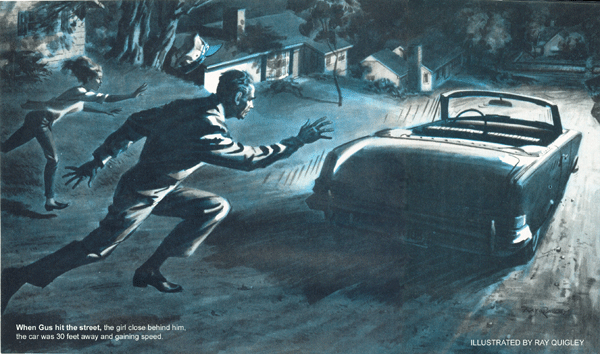
Swinging around, Gus followed her transfixed stare. What he saw sent him flying down the long flight of steps. But the convertible had too much of a start. When Gus hit the street, the girl close behind, it was 30 feet away and gaining speed.
He pounded after it, stopped as Karen clutched his arm.
"What's going to happen?" she gasped.
"It may run into a curb. We better keep after it. Come on."
They ran on. Rolling surprisingly straight, the car climbed the curb beyond the curve, and crashed into a hedge.
A scream rang out. A porch light went on and people spilled from the house.
"It's Eddie! Looks like he's hurt," shouted a man's voice. "Call a doctor!"
A woman ran back into the house. As Gus ran up, a stout, bald-headed man in shirt sleeves swung toward him.
"This your car?" he demanded.
"It's mine," cried Karen.
"Kid drivers! You the Bronson girl?"
"Yes. Oh, Eddie, I'm so sorry."
Beside the car, which was jammed into the hedge, lay the boy Gus had met that afternoon, his body twisted, his breath coming in harsh gasps.
"Don't touch him!" warned the big man.
A middle-aged woman ran out of the house and sank down beside the boy. "Eddie, where does it hurt?"
Groans were the only answer. The woman shuddered. "Oh, Eddie, if only you hadn't gone out to find that lighter!"
"How could it happen?" Karen sobbed to Gus. "I left it in low gear, like Dad said, and put the brake on hard, too. I know I did! If -- if Eddie doesn't get well, I'll never drive again."
A big sedan with MD plates swept up to the house. Gently, Gus led the girl off.
Her father met them at the house door and glanced toward the curb.
"Where's your car, Karen?" he asked.
The girl ran past her father, tears running down her face. Gus explained.
"You relined those brakes," said Bronson. "Did the hand brake hold right?"
"It held fine," declared Gus.
"Or did you bump her car with mine when you parked it?" pursued Bronson.
He walked down the steps. The Chevelle's wheels were turned well into the curb.
"Sorry," muttered Bronson. "Guess I better phone and report to the police."
"Wait," said Gus, starting downhill.
He flicked on the Chevelle's lights. They illuminated a glistening object Gus had seen reflecting the distant street lamp. It was a plastic bag, edges fluttering a little in the breeze. Gus walked down and picked it up thoughtfully.
"Yes," he said, the bag limp in his fingers. "Ask Chief Eldon to come here."
Sam Eldon made the scene in minutes.
More than an hour later, after Gus had returned to the garage for his truck and towed the convertible back to it, the office phone rang.
"Come to Bronson's," said Chief Eldon, "so I can explain to everybody at once."
"I'll be there," agreed Gus.
He was surprised, on entering the living room, to find Eddie Larkin present.
"I just drove Eddie back from the hospital," said Eldon. "Thought you'd like to see he's okay, and hear what he has to say."
The boy looked from Gus to a red-eyed Karen, her anxious mother, and Bronson.
"Just that I'm sorry," he muttered. "I'll pay for the damage. Can I go?"
Eldon nodded, and the boy walked out.
"You hit it, Gus," said Eldon as the front door closed. "Eddie faked being hurt to pay Karen back for brushing him off. He probably thought it would get him lots of attention from her from now on. But when I told him what we knew, there in the hospital, he confessed the whole thing.
"He's an orphan, recently came to live with his aunt and uncle. He hasn't adjusted to them very well as yet, they told me. He's moody, so when he rushed out in the middle of a TV show, saying he wanted to look for a lighter he'd lost, they weren't surprised. Actually he'd been watching the street through a window. The moment he saw the car roll under the street light, he ran out. When it crashed into the hedge, he went into his act."
"But he couldn't have known the car was going to run away," said Karen.
"He sure could," said Eldon. "He rigged it. He'd gone out about an hour earlier. He came up here, straightened the wheels, let the brake off, and put the shift in neutral."
"But you said he was in the house when the car rolled down," Bronson objected.
Eldon grinned. "You tell it, Gus."
"He used a timer," explained Gus, "cracked ice in a plastic bread bag, jammed in front of one wheel. When the ice melted down enough, the car took off. What gave it away was the cold water left in the bag."
Chief Eldon rose. "That winds it up, unless you want to press charges. Eddie's folks will pay for the car repairs, and they've promised to get the boy psychiatric help."
Eldon shook his long, heavy-jowled head. "Beats me, but he told me he got the idea from seeing that ice-cube trick on a TV murder show."
"What's more amazing," put in Bronson, "is that Mr. Wilson caught on to it."
"What's amazing about it?" asked Gus with a grin. "I saw the same show."
END