Alphabetical List of Stories Monthly Illustration Galleries Index Links-All Stories
January 1961
GUS TAMES A TOUGH BIRD
by Martin Bunn
Bucking and snorting, a Thunderbird rolled up the apron of the Model Garage, stalled, and slid back a trifle. Stan Hicks, Gus’s assistant, hurried up to it. “Oh, it’s Mr. Kenquist,” he said. “See you got another car.”
The lean, lantern-jawed driver angled himself out past the windshield corner. “Need a new fuel pump quick. Got one?”
“Yessir. Are you sure it’s pump trouble, though? I could check -- “
“No time. I know what I want.”
Stan looked appealingly at Gus, who had come out to read the pump registers.
“Morning, Mr. Kenquist,” said Gus. “Does sound as if gas isn’t getting through, but why not let us make sure before you pay for a new pump?”
“Give you five minutes,” agreed Kenquist grudgingly. “No more.”
Stan disconnected the pump line at the carburetor, held a can under it, and briefly cranked over the engine. A scant trickle of gas came out. “Sure isn’t pumping,” he said. “Could be a plugged gas line.”
Kenquist snorted. “Sooner you put in a fuel pump, sooner I can go.”
Nevertheless Stan began to loosen the coupling between pump and tank. Then, abruptly, it stopped. Not a drop of gas appeared at the open coupling. Thoughtfully Stan retightened it.
“Well, what now?” asked Kenquist.
“Would you try your engine again.”
Black eyebrows scowling, Kenquist got in the car and turned the starter on briefly -- without result. “Told you I need a new pump.”
“Try a bit longer,” urged Stan.
Angrily, Kenquist resumed cranking. Suddenly the engine fired up. It ran smoothly, but Kenquist got out no more pleased than before.
“It ran this morning. It runs now. That’s no proof it will keep going.”
“Don’t suppose it will,” returned Stan. “Let’s see.” He held the throttle rod at a fast run. The engine first took it well, then began to run rough.
“There!” cried Kenquist. “If that doesn’t prove I need a new fuel pump, what does it prove?”
“Maybe that you need a gas cap,” remarked Stan. “Did you change it?”
“It fell off on a trip,” said Kenquist, following Stan to the back of the car. “Of course I got a new one.”
Quietly Stan began to twist off the tank cap. As it came free, there was a whoosh of inrushing air.
“They sold you an un-vented cap,” explained Stan, “one for a car that has a separate vent tube. This cap has no hole to let air in as gas is pumped out. When the vacuum inside is the same as your fuel pump’s pull, you get no gas.
“What! It’s acted up several times, but the engine always started again.”
“Sure. Air slowly leaks in. You drive a while, and then the vacuum builds up. When I disconnected the tank line up front, it drew in air. Then the pump could deliver gas again.”
“Hmmph. Got the right cap?” asked Kenquist. “I’ll demand a refund on this one.” Grinning a bit smugly, Stan returned to the shop as Kenquist drove off.
“Isn’t he the one who wouldn’t change his engine oil?” asked Gus.
“Yeah. He swapped cars but not dispositions. Sour as ever. All set to buy a fuel pump, but not a kind word when I fix him up for the price of a gas cap.”
“I heard it all,” Gus admitted. “Good job. You didn’t even waste time, as I would have, doing the one thing that wasn’t necessary.”
“What’s that you’d leave have done?”
“Checked the gas gauge first,” answered Gus with a grin. “To make sure there was gas to pump.”
Darkness lay on the suburban countryside as Gus drove back from a road call late afternoon. Rounding a curve, he came on a pair of tail lights stopped ahead. Beside them a tall man waved an urgent signal. Coming to a halt, Gus recognized both the sports sedan and its gaunt owner. “Trouble again, Mr. Kenquist?”
“Told your young smart aleck I needed a new fuel pump,” snapped the black-browed man. “It used to start up again in a while after it quit. Now it won’t even do that.”
“Glad I happened along,” said Gus, peering at the dash. “Got plenty of gas, I see. Is this gauge reliable?”
“Absolutely. Besides, I filled up just this morning. Haven’t gone far enough to burn a tankful.”
“Just let me get a trouble light and we’ll see what can be done.” “No you don’t,” snapped Kenquist. “Got a dinner engagement -- business dinner. No time to fool around. You tow me back, keep the car overnight. See you in the morning.”
“If that’s how you want it,” agreed Gus. “But I might be able to fix it right here -- save you a tow charge.”
Lantern jaw set, Kenquist shook his head. Gus backed the wrecker into position for the tow, and hauled the Thunderbird in. But neither he nor Stan got around to checking it then.
“Plenty of gas on the gauge,” Stan reported the next morning. “But none pumps through. Sure is no air block now. Nothing’s plugged either. I put air on the tank line, and could hear it whistle way back in the tank.”
“That’s interesting,” said Gus. “Because it ought to gurgle.” Stan looked at him, then burst into a laugh. “Oh, no! You mean the gauge is stuck and old beetle-brows simply ran out of gas?”
“That’s not possible,” said a frigid voice. Morning sunlight threw Kenquist’s long shadow on the shop floor. “I filled the tank and drove only 150 miles.”
“Suppose we put in one gallon and try the engine?” suggested Gus.
“Go ahead,” grumbled Kenquist. “Then install a new fuel pump.”
From a can, Stan poured one gallon into the tank. After moderate cranking, the engine took hold with a deep roar.
“Doesn’t seem like a bad fuel pump,” remarked Gus. “It’s your gas gauge.”
“Fill the tank,” ordered the lantern-jawed man. “It holds 20 gallons, but you won’t get in 10.”
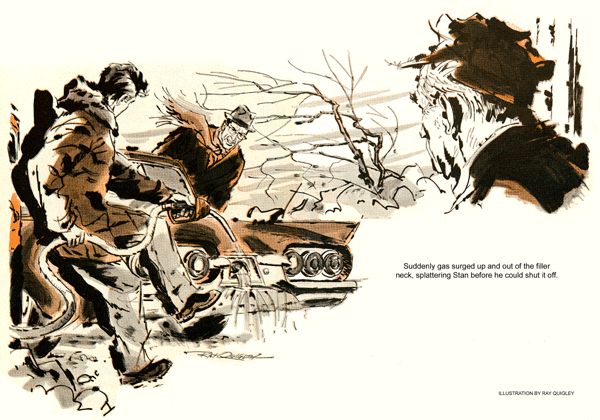
Obediently Stan ran the car to a pump and started fuel flowing in. Kenquist watched the pump meter. Ten gallons poured in. With an inward grin Stan opened the hose valve farther.
Suddenly gas surged up and out of the filler neck, splattering him before he could shut it off. The tank was brim full. Without a word Kenquist returned to the shop.
“She took 10 1/2 gallons, Boss,” reported Stan a minute later. “Full up.”
Gus frowned. “But that model does have a 20-gallon tank -- and the air didn’t gurgle. You’d better put it on the lift.”
Lips pursed Kenquist stood by as Stan raised the car. Gus walked under it with a light. The tank showed no trace of leakage. But one side of it was caved in.
Stan whistled. “Looks like one of those sideshow boys who can suck in his stomach.”
Cautiously Kenquist ducked under the lift. “What is it?”
Gus flashed the light on the collapsed tank. “With that unvented cap, the fuel pump created quite a vacuum in the tank. That let outside air pressure shove in this wall, and that’s why the tank holds only 11 gallon.”
“Not enough. Going to be a nuisance on long trips,” said Kenquist.
“Maybe we can pull it out,” mused Gus.
“Shall I hook an air hose to it, Boss?” asked Stan.
“There’s a tool might do it faster,” mused Gus. “Go get it, Stan. It’s in the store room.”
Stan was momentarily puzzled. Then his face lit up. “Oh, that one!”
Kenquist retreated into frowning silence. In a moment Stan was back with a common “plumber’s helper” -- a big rubber suction cup on a stick.
Wiping the tank clean, Gus applied a smear of grease around the suction cups, seated it firmly in the center of the tank, and gave it a sharp pull. With a loud click the dent snapped out.
“There’s your 20 gallons back,” said Gus, wiping the grease off. “That dent is probably what jammed your tank float. I think your gas gauge will tell the truth from now on.”
Kenquist’s lips quivered in a ghost of a smile. “Hard thing to get at -- the truth -- isn’t it, Mr. Wilson?” he grunted. “Would have been easier for you to sell me a new fuel pump . . . But it wouldn’t have solved my problem.”
“Not only that,” Gus grinned. “But now I’ve got a full-size tank to fill up when you stop in for gas. I’d rather sell 20 gallons than 10, any day.”
END