January 1927
WHAT'S WRONG
WITH THE CAPTAIN'S CAR?
by Martin Bunn
See If You Can Figure Out What Happened to His Motor
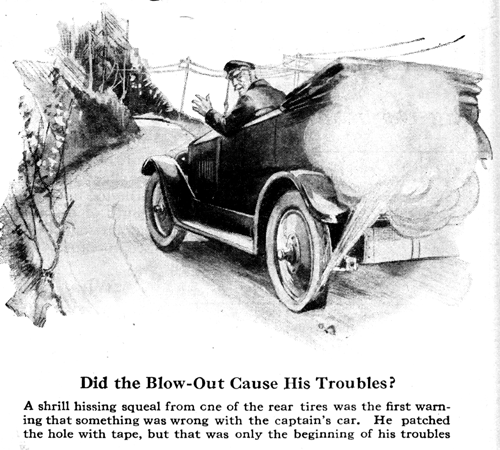
"Blamed if the old craft ain't sprung a leak again!" muttered Captain Horne as a shrill hissing squeal indicated the sudden departure of the air from one of his rear tires. He jammed on the brakes and steered the car to the side of the road. "Reckon I'd better drop anchor here while I fix the dad-blasted 'baloney'," he grumbled.
Captain Horne was no expert on autos, but thirty years spent in sailing the seven seas had instilled in him more than the usual share of resourcefulness and ingenuity. And the old sea-dog needed every bit of it to keep the car he was driving in running order.
He had been beguiled into buying a "reconditioned" machine, and the "reconditioning" had consisted mostly of a cheap paint job with little or nothing done to the badly worn mechanical parts.
"Holy mackerel," he snorted, as he found the blow-out. "The whole side of the tire is coming apart!"
The actual blow-out was only about the size of a pencil, but all around the hole, the tire bulged ominously. It was quite evident that even a blow-out shoe would soon let go, and the old tar did not have one anyway. The spare tire had been used to replace a severe blow-out earlier in the day.
Captain Horne scratched his grizzled head reflectively. "I can fix the hole in the tube, but it'll only blow out again through the hole in the shoe -- I've got to brace it somehow," he decided. "Let's see what's in the locker."
He Prodded around in the tool box for a few minutes, until his hand closed over a large roll of friction tape.
"I've got it," he said. "I'll just patch the hole and then sort of splice it by winding a couple of layers of tape right on the tube. Seems to me I ought to be able to pump the tube to about the size it is in the tire and then if I wind the tape on carefully it ought to take most of the strain off the shoe,"
The captain took care to see that the tube was inflated just enough to fit the inside of the tire, and the job was successful.
"There," he exclaimed, as he finished pumping it up. "That ought to hold together till I can raise the price of a new shoe. Now let's see if the old boat won't sail along."
But the captain was doomed to disappointment. He had proceeded about five miles when the motor suddenly appeared to lose power. It seemed to be running smoothly, no cylinders appeared to have quit the job, and the captain could detect no unfamiliar noises.
"Must be running out of wind or something," he observed uneasily. "Guess I'd better make for shore and tie up at the next repair station."
It happened to be a rather uninhabited part of the country, and the captain passed one or two garages that catered only to the summer trade and were now closed tight. Every mile or two, something seemed to happen inside the motor and it would lose more power, until finally he had to drop into first speed to climb a long but rather easy grade.
"If I don't make port soon I'll be becalmed here for the night," he gloomed, and his prediction seemed well-founded, for at the top of the hill the motor stopped firing completely. No garage was in sight, but the car had passed over the ridge and he let it coast down the other side. The grade was so slight that the car barely kept in motion. In fact, at one place that was nearly level the skipper had to get out and put his shoulder to his craft to push it over. But his hopes perked up at the bottom of the hill, where there appeared a brand-new garage with a young fellow standing in front of it garbed in new, clean overalls.
"Run out of gas, did you?" the young man greeted the captain as he ran out and helped push the car to the garage.
"I don't see how that could be," Horne answered. "I filled up the tank just a way back."
"Well, anyway, you came to the right place," the young fellow assured him. "I can fix anything on wheels. Just you watch."
The captain lighted his pipe and prepared to learn something about auto repairing. The young fellow brought out a new and shiny kit of tools and lifted the hood in a very businesslike manner. He stepped on the self-starter and the motor turned over at normal speed; but it did not start. Then he tested the ignition system. It, too, appeared to be in running order.
"Here's your trouble," he announced finally, pointing to the carburetor filter screen he had just removed. "Look, it's full of dirt and the dirt interfered with the flow of gasoline. I'll clean it out and the one on the vacuum tank, and then blowout the gasoline pipe with compressed air. She'll run fine after that."
But the motor refused to start. In fact, the young repair man wasn't able to get a single explosion out of it.
"That's strange," he said. "Maybe it's one of the valves. I'll look 'em over." And he took off the plates that covered the push rods. While the captain pressed the starter pedal, the young man watched the valves carefully. They moved up and down perfectly. A test of the compression was his next step.
"The compression doesn't amount to much," he observed, turning the motor over by hand a few times. "Still I never saw a motor stop just because the compression was a little weak. It's just as good in one cylinder as another, too."
By this time the young man had lost his swaggering assurance. "It's got me licked," he confessed humbly . . .
What was wrong with the captain's car?
END

L. Osbone 2019