February 1926
DOES YOUR CAR FIT YOUR PURSE?
by Martin Bunn
Gus and Joe Tell How a Log Book
Can Help You Run Your Auto with More Efficiency
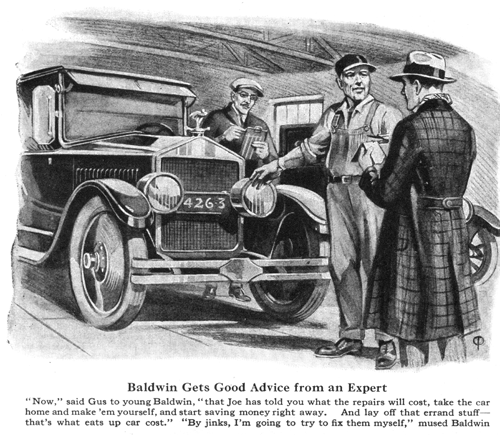
"This job is going to nick your bank roll good and plenty," said Gus Wilson, half owner and chief mechanic of the Model Garage, as he looked up from young Baldwin's car. "Your motor is full of carbon, the valves need grinding, the bearings ought to be taken up, and the brakes relined, and I think, from the way she pumps oil, that you need a new set of piston rings."
Joe Clark, who ran the office and sales end of the garage, was figuring rapidly on a piece of paper.
"Let's see," he said, as he totaled the various items Gus had enumerated. "I think a hundred and sixty-five dollars ought to cover it, unless Gus finds something else that needs fixing -- and I'm making the price as low as possible at that."
"Holy smoke!" gasped Baldwin. "I guess I'll have to park the car here for the rest of the winter while I try to raise the dough. How about giving me a little time on the bill, Joe. Can you do that?"
"I'd like to," replied Joe. "But Gus and I have to eat, too, so I guess we can't let you have more than thirty days. By the way, Baldwin, seems to me you are running yourself into a hole with that machine. Haven't you found it a bit more expensive than you figured on?"
"You said it!" Baldwin answered gloomily. "I'm making fifty bucks a week and I had a bit saved up, so I made the first payment easily enough. But there have been so many expenses that I never thought about when I decided to buy a car."
"That's just the trouble," stated Joe emphatically. "You buy a car on a shoe-string and you're in up to your neck before you realize it. A lot of people own autos who really can't afford a car at all, and a lot more buy expensive cars when they ought to get cheap, light once. And all because they never stop to do a little arithmetic beforehand.
"Look here," he continued slipping his pencil out of his pocket again. "Unless you're a millionaire, you ought to look at this automobile proposition as transportation at so many cents a mile. And you're kidding yourself if you dope out the cost per mile in gas and tires and let it go at that. Take depreciation for instance. That car of yours cost around fifteen hundred. In five years it will be about ready for the scrap pile. You may be able to sell it at the end of that time for, say, two hundred dollars. That means you have to charge up thirteen hundred against the miles you travel in that length of time, and if you cover thirty thousand miles it comes to a bit more than four cents a mile.
"Gas at present prices works out to around a cent a mile. Tires -- if you are lucky -- may cost as little as two cents a mile. That makes seven cents a mile and we have not included insurance, storage, or repairs.
"Insurance runs to about a cent and a half a mile, storage at ten dollars a month comes to two cents a mile, and repairs certainly will mount up to another two cents on a car like yours. Throw in another half cent for oil and miscellaneous items and the total figures up to the flat sum of thirteen cents a mile. You'd kick like a steer if a railroad charged you that!
"Can you and the wife and kid live on thirty-five dollars a week? That's all you have left out of your salary if you spend about fifteen dollars a week on a car."
"Gee whiz! You sure are one cheerful guy, Joe!" croaked Baldwin dismally.
"Well, what's the answer? Should I sell the bus as soon as I get it paid for?"
Joe scratched his head thoughtfully, "No," he said, "don't do that. It wouldn't help any now. The biggest depreciation comes the first year and if you have got along so far, I guess you'll make out without going to the poorhouse.
"If you'd asked my advice before you bought the car, I'd have told you to get a cheaper and lighter make -- and that doesn't necessarily mean a flivver. What you can do, though, is to use the car a lot less than you do. Why, most every night I see you go by on your way to the stores for some errand. Lay off that errand stuff unless it's raining."
"Humph!" growled Gus as he jammed another load of tobacco in the bowl of his vile smelling pipe. "That's a heck of a way to tell a fellow to economize! Still -- lots of men would rather ride fifty miles in a heavy car than a hundred in a light one. Tell you what, though, Baldwin, you can economize right now by doing most of the repair work on this car yourself. You are right handy with tools and I've got more work than I can handle anyhow. In fact, I really couldn't get at your car till next week."
"I wonder if I could?" mused Baldwin. "By jinks, I'm going to try it! It's either that or go without lunches."
"Go to it," Gus encouraged. "If you get stuck, we can always help you out."
"Thanks for the advice, Gus, I'll take the boat home and make a start tonight," said Baldwin more cheerfully.
"By the way, Joe, speaking about the cost of running a car, you seem to have all the dope right at the end of your pencil. Why not show me a good way to keep track of how much it's costing me to run the bus?"
"That's easy," replied Joe, pulling out his notebook. "Of course there have been a lot of systems worked out to keep auto records and some of them are fine, but so complicated.
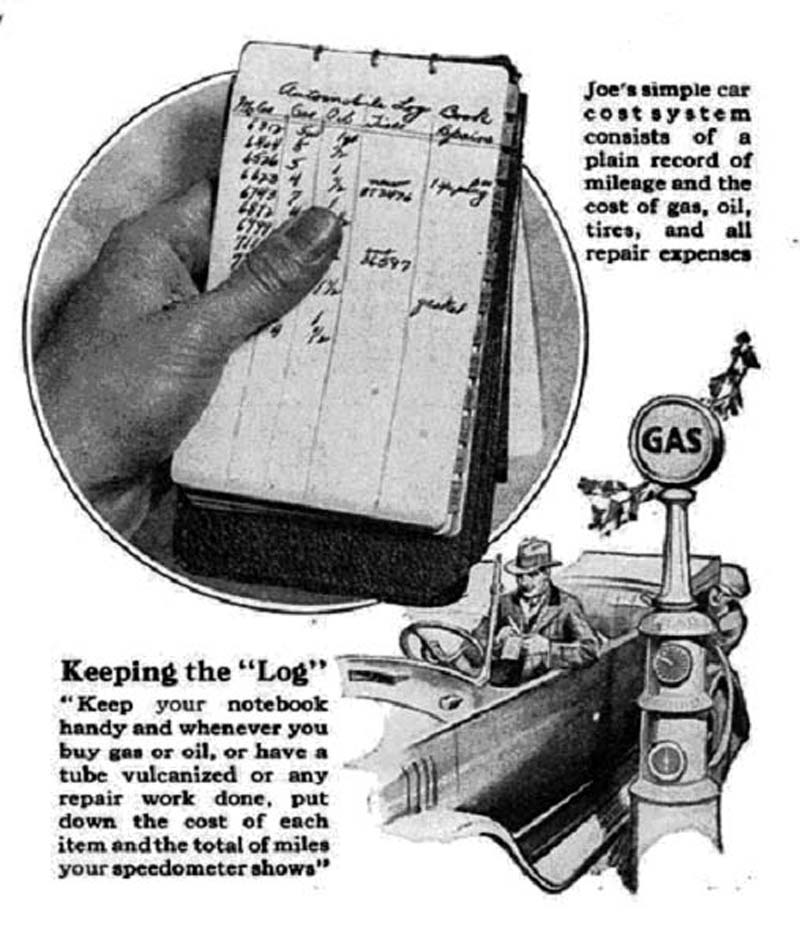
"My system, though, is really nothing but a logbook such as the mate of a ship keeps. Only I use the miles on the speedometer instead of the dates on the calendar. It is so simple that you don't need any complicated forms, and you can make it just as complete as you want.
"Take one page in your notebook and label the column at the left 'miles.' Mark the next column 'gas,' the third 'oil,' the fourth 'tires,' and the fifth 'repair.' Keep your notebook handy and whenever you buy gas or oil, or have a tube vulcanized, or any repair work done, put down the miles your speedometer shows and the amount and cost of the gas or whatever it is that you are spending money on. For instance, suppose you make a stop for gas. While the gas is being pumped into your tank you'll have plenty of time to make a note of it."
"What about those other expenses you mentioned -- depreciation, insurance, and so forth?" Baldwin inquired as Joe paused to catch his breath.
"I don't put those down on my regular auto log page," answered Joe. "I use another page and simply jot down each item as I pay for it, with the date and the speedometer reading. That applies to everything except depreciation. You can't tell what depreciation amounts to until you have sold or junked your car.
"Everything about a car can be figured on a mileage basis except depreciation. Theoretically, at least, depreciation is determined by the number of miles you travel, but that applies only when you own and run the car for its entire useful life. If you sell it while it still is useful, the amount you must charge up against the miles you have driven will depend on what you get for the car when you sell it and that, in turn, is dependent on the condition of the secondhand market.
"Mechanical depreciation -- the actual wearing out of the parts of the machine -- also depends to a large extent on how carefully you use it. I mentioned a few minutes ago that your car would be worn out in five years, figuring 30,000 miles of use during that time. That estimate is based on just ordinary care. With extra care, you may be able to more than double that mileage before the car is ready for the junk pile.
"That seems clear enough," agreed Baldwin: "but how does it help you to cut mileage cost just to put down the gasoline you buy?"
"Well," replied Joe, "It tells you one thing and that is the actual mileage you are getting out of the gas. Lots of fellows claim high gas mileage. Most times they are talking through their hats. They have no figures to prove it, and if they did make an actual test, it was under favorable conditions.
"If you keep your record my way, you can get the real facts in the case any time you want them. Just add up the column of gas purchases and divide the result into the miles you have covered. In this way you can tell how many miles you get in winter or in summer, and if you check up every month or so, you can tell pretty well when your car needs repairs.
"If, for instance, you notice a sudden falling off of two miles to the gallon that you can't account for by a cold spell or lots of short runs, you can be pretty durn sure that something needs attention. I discovered a worn out rear axle bearing that way -- or rather Gus did it for me. I noticed that I was not getting the full number of miles to the gallon, and Gus found that the bearing had worn so that it let the brake band up where it was rubbing against the brake shoe.
"Another time I noticed that the motor was using less oil than usual. That seemed funny to me, so Gus looked into it and found a small piece of brake band had come off and partly clogged up the oil pipe. Enough oil got through to keep the motor from heating up, but if I hadn't found it in time, the lack of oil would have raised hob with the motor."
"I'm convinced, all right," said Baldwin, pulling out his own notebook and thumbing it over to find a couple of blank pages. "I'll never spend another cent on this bus without entering it in my log, you can bet on that. Well, I guess I'd better be running along now. I'm going to tackle the motor first."
"Say, Gus," said Joe after Baldwin had left, "what's the idea of passing up a good job like that?"
"Forget it!" Gus growled. "We've got plenty of work now. Besides, the kid can't afford it."
"Humph!" replied Joe with a twinkle in his eye. "That's a new one on me -- a soft hearted guy in the garage business!"
END
L. Osborne 2019